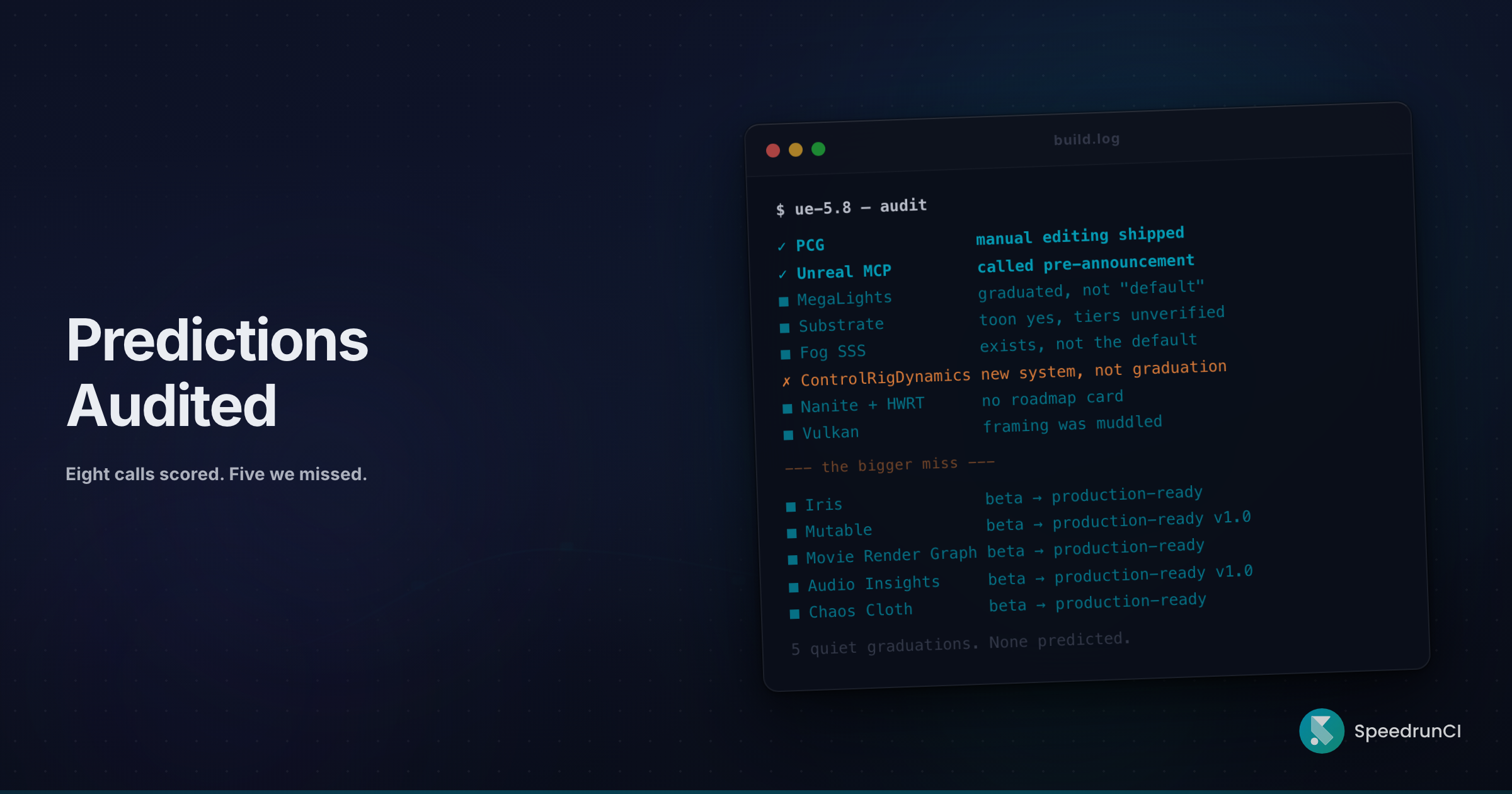
Predictions for Unreal Engine 5.8
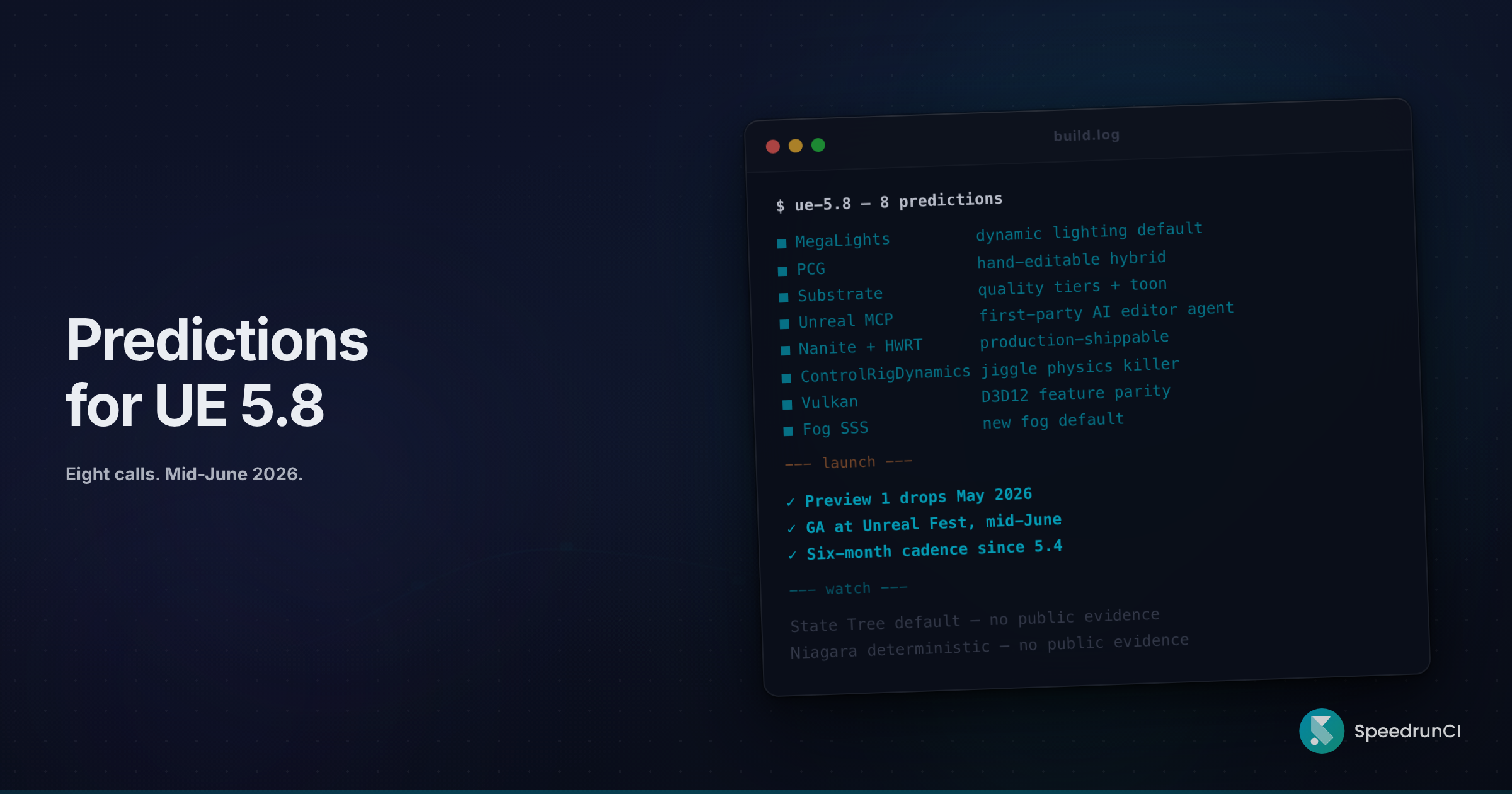
Predictions for Unreal Engine 5.8
Unreal 5.8 is six weeks out. Preview 1 drops in May. The full release ships in mid-June at Unreal Fest, on the same roughly six-month cadence Epic has held since 5.4.
Every point release lands with a mix of headline features Epic has been telegraphing for months and quieter wins that show up in the release notes. The interesting question is always which of the work-in-progress systems actually make the cut, and which slip to the next cycle.
Our team has been reading every commit landed to ue5-main since February, week by week. Here are eight things we think will be in 5.8.
Every prediction has commit-level evidence behind it.
MegaLights as the Recommended Dynamic Lighting Default
MegaLights ships in 5.8 out of Beta as the recommended dynamic lighting default for console-class hardware.
MegaLights appears as a named theme in 9 of 12 weekly reports. The arc is hard to misread. Feb 2-8: hardening. Feb 9-16: production instrumentation and unified debug CVars. Feb 16-23: front-layer translucency. Mar 2-8: cloud shadows and IES profile absorption. Mar 9-15: async compute and denoiser polish. Mar 16-22: a 27% cost reduction on glass scenes via specular-only FLT.
Then three weeks of silence. Then a return Apr 20-26, this time with multi-front console optimization: penumbra ray skip saving 0.3 to 1ms, CPU tracking removal, register pressure reduction, anti-flicker fixes.
Build, instrument, optimize, go quiet, return for console performance. That is the shape of a feature being prepped for shipping defaults.
PCG Adds Output-Point Editing
5.8 ships PCG with output-point editing: artists can edit, insert, and delete individual procedural points after the graph generates them, not just paint new input points the way 5.7’s PCG Editor Mode allows.
PCG appears with substantive work in six weeks. Feb 9-16: 10 to 12 stability commits. Feb 16-23: ISM reuse and spline fixes. Feb 23-Mar 1: a first-pass Data Override system, 12 commits in a single week. Mar 23-29: GPU compute backend maturing, GPU inline ray tracing infrastructure. Mar 30-Apr 5: five PCG GPU commits.
Then Apr 6-12: roughly 5,000 lines of PCG manual editing landing in one week. The named systems are specific (DeltaViewportExtensions, SPCGManualEditPanel, point edit/insert/delete operations). That is what a real workflow surface looks like once internal artists are using it.
The workflow gap PCG has had since launch (artists could not surgically fix a bad procedural point) finally closes.
Substrate Adds Quality Tiers and Experimental Toon
5.8 ships Substrate with quality-level-aware shader closures and experimental toon shading. The New Material Translator gets the heaviest material-compiler investment we have seen in months.
Three pieces of evidence stack. First, quality-level closure counts via r.Substrate.MaterialQualityLevelsClosuresPerPixel="L1-M1-H2-E3" appeared with the classic submit-backout-resubmit pattern, which usually means the change landed on a second attempt and is now in trunk. Second, Substrate-Toon shipped with VSM transmittance shadow and a unified diffuse ramp, explicitly tagged experimental for 5.8. Third, the New Material Translator (NMT/MIR) saw 15-plus commits in a single week (Apr 13-19): bug fixes, new expression nodes, preshader optimization that reduced op counts by 24%.
NMT is the compiler infrastructure Substrate depends on. The volume of work this close to GA tells you Epic is committed to Substrate as the long-term material system, not just maintaining the production-ready version that shipped in 5.7.
Epic Ships a First-Party MCP-Compatible AI Editor Agent
UE 5.8 ships a first-party AI editor agent inside the editor. MCP-protocol compatible. Toolsets covering Blueprints, Niagara, Sequencer, Static Meshes, Data Tables, GameplayTags, UMG, behavior trees, physics assets, and asset validation. Semantic search via FAISS in DDC. Epic has not telegraphed it publicly.
The boldest call in the post. It gets the most evidence.
AI editor tooling appears in eight consecutive weeks (Mar 2 through Apr 26). The longest sustained theme arc we have seen this cycle. Nothing else comes close. Not Substrate. Not MegaLights. Not Vulkan.
Cold start (Mar 2-8): AI Assistant Infrastructure, FProperty-to-JSON serialization, main-thread dispatch primitives. Expansion (Mar 9-15): 14-plus programmatic toolset commits and 7-plus AI assistant commits explicitly mentioning MCP. ECABridge MCP tooling lands the following week with named entry points: get_cvar, get_viewmodel_values, list_live_viewmodels, run_console_command, diff_widget_blueprint. These are not exploratory. They are the API surface a shipping agent needs.
Then it broadens. Mar 23-29: a toolset explosion across six-plus subsystems by three separate developers. Mar 30-Apr 5: the MCP server splits into a three-module architecture, with a sandbox bridge added. Apr 6-12: 15-plus commits, including AI toolsets across the editor’s major asset types.
Apr 13-19 is where it stops looking exploratory and starts looking shippable. The SequencerTools class, previously a monolithic 234-tool blob, was split into 7 focused toolsets. Python asyncio integration landed. The system was renamed from “MCP” to “Unreal MCP.” Sandbox execution went in. Apr 20-26: an eighth straight week of continued maturation.
Infrastructure, expansion, consolidation, architecture split, naming stabilization, sandbox isolation. That is textbook productionization. Epic does not invest three developers in renaming and sandboxing a system it plans to ship in 5.9. Code that gets renamed and isolated is code about to face users.
Nanite + HWRT Goes GPU-Driven
5.8 ships GPU-driven BLAS caching for Nanite + Hardware Ray Tracing. CLAS (cluster-level acceleration structures) and persistent SegmentMappingBuffer move Nanite ray tracing from “works but expensive” to scalable on console-class hardware.
Nanite RT shows up in six weeks. Feb 2-8: CLAS introduction (Cluster-Level Acceleration Structure) with 2,400-plus lines, a custom pool allocator, contiguous-fit allocation. The commit explicitly calls it “not incremental.” Feb 9-16: an atomic per-page CLAS allocator, stale page handling, a use-after-free detector. Feb 23-Mar 1: reference instance concept, BLAS streaming, optional Lumen Card PSOs.
Then the architectural moves. Mar 16-22: a GPU-side BLAS cache and a persistent SegmentMappingBuffer, called out in the commit as “a prerequisite for GPU-driven CLAS builds.” Mar 30-Apr 5: a race condition fix in RT instance caching (parallel bitfield writes producing UB). Apr 13-19: a Nanite tessellation GPU crash fix.
Build it. Make it not crash. Make it GPU-driven. The same arc MegaLights traveled in 2024 before it shipped as Beta.
ControlRigDynamics Graduates Out of Experimental
5.8 matures ControlRigDynamics past Experimental. Collision differentiation, confiners, drag settings, runtime sim space, and debugging widgets stack on top of the Control Rig Physics base that shipped Experimental in 5.6. Custom AnimBP physics for secondary motion becomes a migration target, not a parallel necessity.
Animation commits trended 12 → 12 → 17 → 21 → 17 → 13 → 22 → 29 → 45 → 45 across ten weeks. Roughly 4x the baseline by the end of the window, and the curve is still climbing.
ControlRigDynamics work concentrates in the last two weeks. Apr 13-19: 8-plus commits covering cone limits, angular limits, teleport detection, reset detection, collision support, pass-through at alpha zero, solver visualization. Apr 20-26: 11 commits adding confiners, collision differentiation by physics/query/probe types, drag settings, curve support, runtime sim space adjustment, and a debugging widget.
The foundation is doing work too. An Optimus deformer use-after-free fix landed across 45 files. A medial skeleton auto-rigging pipeline added roughly 25 commits. Control Rig ECS evaluation went default-on with a CVar escape hatch. The animation system is rebuilding the surface underneath, not just adding a feature on top.
Vulkan Reaches D3D12 Feature Parity
5.8 is the release where Vulkan finally reaches functional parity with D3D12: bindless descriptor heap support, specialization constants, plugin extension architecture, and (the headline change) dynamic rendering enabled by default on desktop.
Vulkan-specific themes appear in five-plus weeks. February: specialization constants, a Qualcomm FDM offset XR extension, then bindless descriptor ranges (D3D12 first, Vulkan plumbing in parallel). Mar 2-8: a Vulkan plugin extension architecture (FVulkanRHIExternalDeviceExtensionBase), VK_KHR_shader_untyped_pointers, and VK_EXT_descriptor_heap auto-load.
Then it accelerates. Mar 30-Apr 5: bindless descriptor heap WIP using VK_EXT_descriptor_heap, push constant state tracking, RT shaders. Apr 6-12: bindless uniform buffers and specialization constants in VULKAN_PCES3_1. Apr 13-19: dynamic rendering enabled by default on desktop (Android opts out). Apr 20-26: push constant stage flag fixes, input attachment index mappings with dynamic rendering, a dynamic local read function.
The dynamic rendering default flip is the tell. You do not flip a default in the last weeks of a release cycle unless the alternative is on its way out.
Fog Screen Space Scattering Ships as a New Default
5.8 introduces Fog Screen Space Scattering, a multiple-scattering volumetric system from Sebastien Hillaire, as the new default for height fog and local fog volumes.
Shortest arc, highest signal-per-week. The system landed Apr 13-19 with six follow-up commits in the same week: TAA stabilization, cloud ordering fixes, an optimized 5×5 Gaussian upsample (9 bilinear fetches instead of 25), NaN fixes, artist-facing power controls, filtering improvements. Apr 20-26 added three more commits making it resolution-scale independent and optimizing the 1ms cost at 4K.
Six follow-ups in a debut week is the velocity signature of a feature being fast-tracked. Epic does not polish things this fast unless they ship.
Six Weeks to GA
That is what 5.8 looks like.
For weekly UE commit analysis, subscribe to Last Week in Unreal.
Never miss a ue5-main update.
Get them delivered straight to your inbox.