Last Week in Unreal — May 4 to 10, 2026
Unreal Engine Weekly — What Changed and What Matters
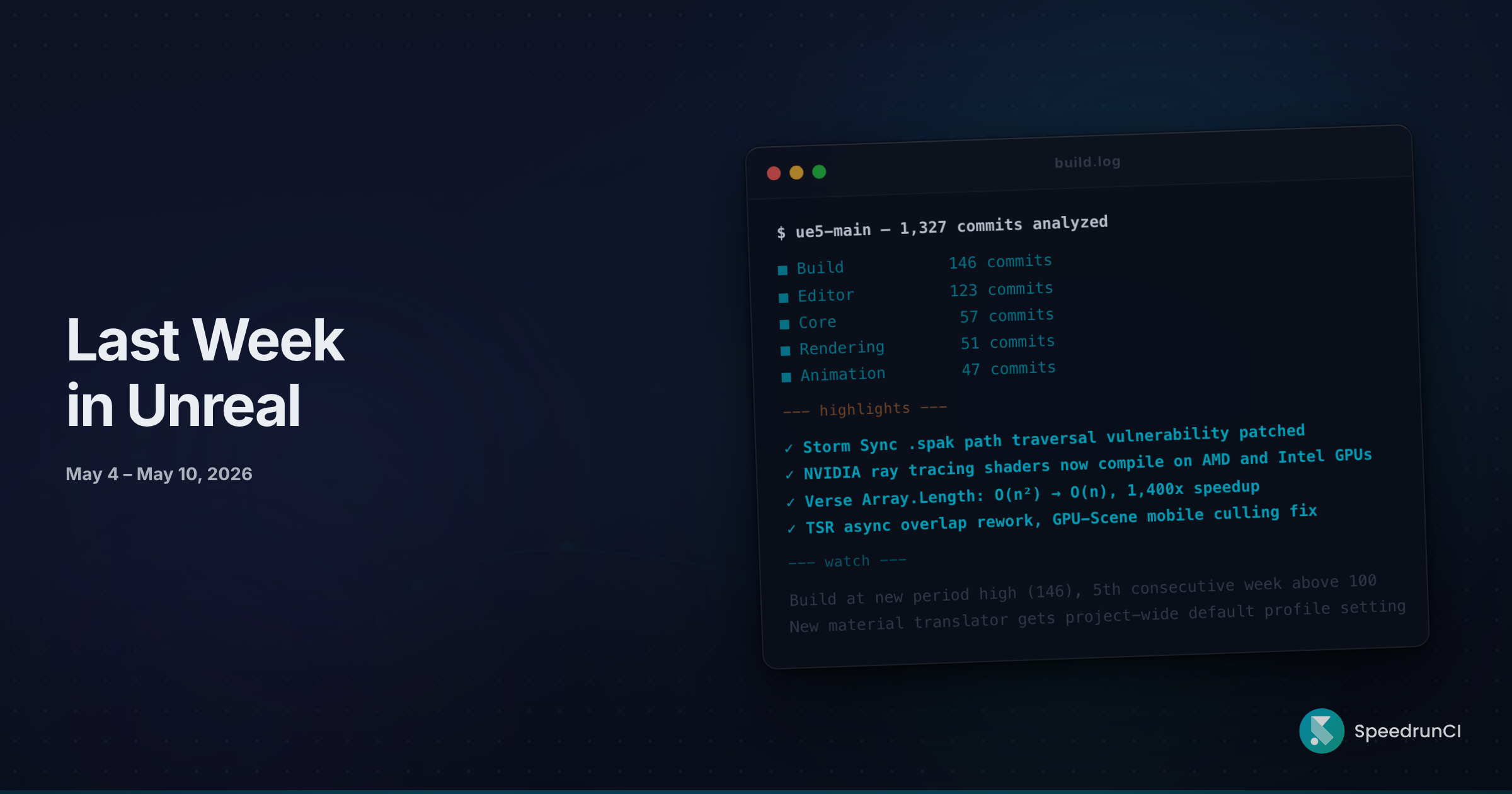
Week of May 4 to 10, 2026 | 1,327 commits analyzed | Branch: ue5-main
Overview
Post-cut composition continues. 5.8 sits in localization-dominated lockdown on its own branch, ue5-main hardens broadly, and the build subsystem keeps investing in next-cycle infrastructure. Two urgent items this week: the Storm Sync arbitrary-file-write fix, and the cross-vendor ray tracing shader fix that quietly unblocks AMD and Intel GPUs. Beyond those, TSR async overlap, GPU-Scene culling, and a 1,400x Verse Array.Length fix are the most consequential pieces.
Development Trends
Multi-week patterns based on 8+ weeks of commit history, subsystem momentum, and theme continuity.
Build Infrastructure Surge Holds, Now Three Weeks Post-Cut
Pattern: Build commits hit 146 this week, a new tracking-period high and the 5th consecutive week above 100 (118, 109, 107, 136, 146). Rendering dropped from 88 to 51 over the same window. The build-to-rendering ratio is now 2.9x. The headline infrastructure work this week is Zen Server v5.8.10 (async HTTP with cancellable request tokens, connection pooling to prevent ephemeral port exhaustion, OpenSSL on Windows to dodge Schannel TLS 1.3 framing bugs) and a queue-based DDC remote build executor API with tracing, stats, cancellation, and timeout. Platform stays elevated at 41. On the public 5.8 branch, only 14 commits this week: 8 Localization Automation runs and 6 surgical cherry-picks (RHI g_NvidiaExt cross-vendor support, HTTP proxy regression, FMonitoredProcess delegate ordering, ShaderCodeLibrary Apple metallib fallback, two AutomationTool fixes).
Interpretation: Three weeks after the cut, the shape is the same. 5.8 reads as release-candidate lockdown with localization and surgical fixes. ue5-main is in 5.9 ramp. Build keeps surging because that team is past the 5.8 handoff and now investing in next-cycle infrastructure. The Zen Server overhaul and the new queue API are not the kind of work that lands at the end of a release cycle. Rendering wound down because the rendering team finished what could fit and is now in cherry-pick mode for fixes destined for 5.8. Directional read on the trunk is unchanged: 5.9 ramp.
Who cares: Build engineers, infrastructure teams, CI/CD owners, anyone maintaining custom engine forks or DDC backends.
Signal strength: Strong. 5 consecutive weeks above 100 build commits with accelerating volume.
Animation Pipeline Reaches a New Peak
Pattern: Animation hit 47 commits this week, a tracking-period high and the 6th consecutive week above baseline (22, 29, 45, 45, 34, 47). The baseline for the first three weeks of the tracking window was 13-17. The big landing this week is per-instance custom data for non-Nanite skinned meshes, following the patterns already established in LocalVertexFactory, with a companion fix for the copy compute shader on OpenGL ES 3.1 buffer access limits.
Interpretation: Animation went from a quiet maintenance area at around 13 commits per week to one of the most active subsystems. It progressed through infrastructure, rapid feature buildout (Control Rig Dynamics), and now production hardening (crash fixes, per-instance custom data, ML-driven AnimGen hardening). The per-instance custom data work closes a long-standing gap between static and skinned mesh instancing that crowd and NPC-heavy projects have been working around for years.
Who cares: Animation programmers, tech artists, teams with crowd/NPC-heavy projects, anyone using Control Rig or instanced character rendering.
Signal strength: Strong. 6 consecutive weeks of elevated activity with clear phase progression.
New Material Translator Approaching Project-Wide Default
Pattern: A broad stabilization push this week: fixes across texture sampling, component masks, LWC matrix multiply, DBuffer and PathTracing texture expressions, per-component folding, and BreakMaterialAttributes output index mismatches. The MIR pipeline added component-aware liveness analysis and an interactive HTML debug viewer (replacing the old GraphViz output). Epic also added a project-wide default translator profile setting, the mechanism for switching the default at project scope.
Interpretation: Epic is running real content through the new translator and systematically fixing the long tail of incompatibilities. The project-wide default setting is a clear preparation signal. Combined with the multi-month shader infrastructure modernization trend, this looks like the culmination of months of shader pipeline work. Teams with complex material libraries should start testing now, not after the default flips.
Who cares: Tech artists and rendering engineers with large material libraries. Custom engine forks that touch material compilation.
Signal strength: Moderate. Stabilization push is strong but the project-wide default is not yet enabled.
AI Editor Tooling Enters Execution-Infrastructure Phase
Pattern: Tenth consecutive week of AI editor tooling commits. Twelve commits this week building Python asyncio execution infrastructure inside the editor: pollable event loops, editor-thread coroutine executors, timeout pollers, context variable proxies, an asyncio.Runner replacement, and a CallableRunner to wrap arbitrary methods. MCP gained EULA notice at server startup. The editor subsystem has been above 100 commits for 6 consecutive weeks.
Interpretation: The initiative has moved through infrastructure, expansion, production hardening, developer ergonomics, and now execution infrastructure. The Python asyncio plumbing is what you build before running LLM calls without freezing the editor. That is the last major piece before external developer exposure. The EULA notice at server startup suggests broader availability is being prepared.
Who cares: Tools programmers, anyone building editor extensions or automation. Studios evaluating AI-assisted content workflows should monitor when this becomes publicly accessible.
Signal strength: Strong. 10 consecutive weeks with clear phase progression and no signs of winding down.
TL;DR
- A Storm Sync path-traversal vulnerability allows arbitrary file writes. Patch immediately if you use Storm Sync for asset distribution.
- Ray tracing shaders referencing NVIDIA extensions now work on AMD and Intel GPUs. Hard-rejection at shader creation is gone.
- TSR async overlap rework and GPU-Scene instance culling improvements signal measurable rendering gains for dense scenes.
- Verse
Array.Lengthwent from O(n²) to O(n) with a 1,400x speedup on the affected workloads.
Highlights
Security: Storm Sync Arbitrary File Write
What changed
Epic patched a vulnerability where a malicious actor could craft an .spak package with path-traversing filenames, writing arbitrary files outside mount points on the receiving system.
Why this is important
Textbook path-traversal attack vector. If your team distributes or receives content via Storm Sync, a crafted package could overwrite arbitrary files on disk. The kind of supply-chain risk you do not want sitting in your pipeline.
Who should care
Any team using Storm Sync for asset distribution, especially across organizational boundaries.
Urgency
Act now.
Rendering: TSR Async Overlap and Translucency Velocity Rework
What changed
The translucency velocity pass can now run earlier in the frame via r.Translucency.EarlyVelocityPass, giving TSR more room for async compute overlap. The new CVar defaults to mode 2 (after volumetric cloud reconstruction), trading one extra depth texture copy for better GPU utilization. A companion fix ensures correct motion vectors when single-layer water writes velocity in the base pass.
Why this is important
Better async overlap means more GPU work happens in parallel, which directly improves frame times in scenes with heavy post-volumetric passes. The extra depth texture copy is small relative to the scheduling gains.
Who should care
Graphics engineers, anyone with custom rendering passes between volumetric clouds and translucency, teams using TSR with single-layer water.
Urgency
Track. Test with your scenes if you have custom post-processing ordering.
Rendering: GPU-Scene Instance Culling Improvements
What changed
CPU-side hierarchical instance culling now feeds into LOD selection, producing tighter instance counts and fewer empty draw calls for large-world scenes. Explicit spatial hash bounds further reduce draw calls. The mobile base pass was also missing a connection to the hierarchical culling query and is now fixed, meaning mobile was previously not benefiting from this optimization at all.
Why this is important
Fewer empty draw calls and tighter LOD ranges directly reduce CPU and GPU overhead in dense instanced scenes. The mobile fix is the notable one. Mobile projects picking up this change should see measurable culling improvements they were silently missing.
Who should care
Graphics engineers, teams with dense instanced scenes (open world, foliage-heavy), mobile renderer users.
Urgency
Track.
Rendering: Multi-Vendor Ray Tracing Shader Compatibility
What changed
Ray tracing shaders that reference NVIDIA extensions (g_NvidiaExt UAV declarations) no longer fail shader creation on AMD and Intel GPUs. The fix marks these as optional vendor extensions. Shaders compile and create successfully, root signatures include the NVAPI intrinsics space, and NVAPI setup is simply skipped on non-NVIDIA hardware.
Why this is important
Previously, ValidateShaderIsUsable hard-rejected any shader with NVIDIA extension declarations on non-NVIDIA hardware, even though the actual NVIDIA code paths were behind runtime branches that never executed. If you ship ray tracing and your players have AMD or Intel GPUs, this was silently breaking shader creation. The fix was also cherry-picked into 5.8.
Who should care
Any team shipping ray tracing features on multi-vendor hardware. D3D12 RHI developers with custom ray tracing shaders.
Urgency
Act now if you ship ray tracing on non-NVIDIA hardware.
Stability: Critical Crash and Memory Safety Fixes
What changed
A dense cluster of crash fixes landed across core systems this week:
- HTTPServer/MCP streaming: Double-invocation of
OnCompletein the MCPtools/callhandler could crash when the first write failed and the second hit a destroyed connection. Real production crash for anyone using MCP tool calls. - IoStore null file-handle: A regression where a failed partition open returned null, crashing asset loading.
- Blueprint loading: Binary serialization mismatch when a subclass overrides
Serializecrashed blueprint loads with ComponentClass overrides. The team tagged this one as release-notes worthy. - SkinnedMesh reimport deadlock: Game thread deadlocked waiting on a locked property while an async job depended on the game thread to release it.
- WASAPI audio device-cache wedge: Command queue grew unbounded to OOM when audio devices change (headphones unplugged, monitor audio). Shipped against a Fortnite bug, but any Windows project with audio device switching could hit this.
- Race condition in cluster union acceleration structure: Physics cluster unions are core to runtime collision. A race condition here means unpredictable physics behavior or crashes in shipped games.
- RigLogic OOB writes: Two separate out-of-bounds access fixes in MetaHuman RigLogic. One fires when cooked data is malformed, the other when all LODs are eliminated by LOD filtering. Both are memory corruption in shipping scenarios.
Why this is important
These are not theoretical. Several have been observed in production (the MCP crash, the WASAPI OOM, the blueprint loading crash). The physics race condition and RigLogic OOB writes are the kind of bugs that manifest as intermittent, hard-to-reproduce crashes in shipped titles.
Who should care
Everyone. These touch asset loading, networking, blueprint serialization, threading, audio, and physics.
Urgency
Act now for the blueprint loading, WASAPI audio, and physics race condition fixes. Track the rest.
Rendering: Per-Instance Custom Data for Skinned Meshes
What changed
Non-Nanite skinned meshes now support per-instance custom data, following the same patterns already established in LocalVertexFactory. A companion fix adjusts the copy compute shader for OpenGL ES 3.1 buffer access limitations.
Why this is important
This closes a long-standing gap between static and skinned mesh instancing. Per-instance custom data is the primary mechanism for driving material variation across instances (health bars, team colors, damage states, dissolve effects) without unique material instances. Until now, instanced skinned meshes with per-instance material parameters required either Nanite or workarounds. Crowd and NPC-heavy games have been waiting on this for years.
Who should care
Gameplay programmers and tech artists working with instanced characters, crowds, or NPCs. Anyone who previously worked around this limitation.
Urgency
Track. Test with your character rendering pipeline.
Performance: Verse Array.Length Fix (1,400x Speedup)
What changed
Array.Length in Verse went from O(n²) to O(n) by skipping unnecessary Freeze bytecode. Two new opcodes landed: FreezeIfAccessor and LengthWithEffects. In benchmarks, the operation went from 112 seconds to 0.08 seconds.
Why this is important
A 1,400x improvement is not an optimization. It is a bug fix for pathological performance. Any Verse code iterating over arrays was paying this cost silently.
Who should care
Verse developers. UEFN creators.
Urgency
Act now if you have Verse code with array iteration in any hot path.
Build Infrastructure: Zen Server v5.8.10 and DDC Queue API
What changed
Zen server v5.8.10 brings async HTTP with cancellable request tokens, non-blocking hub hydration, two-phase provision/deprovision on separate worker pools, connection pooling to prevent ephemeral port exhaustion, and OpenSSL on Windows to work around HTTP/2 + Schannel TLS 1.3 framing corruption. Separately, the DDC remote build executor gains a queue-based API with tracing, stats, cancellation, and timeout support.
Why this is important
The queue API (opt-in via bUseQueueApi=true) catches builds whose LSN is never reported, preventing indefinite hangs. The S3 signing-key cache staleness fix after IMDS credential rotation is relevant for cloud-hosted build farms that have seen intermittent auth failures.
Who should care
Build engineers, infrastructure teams, anyone using remote DDC or Zen-backed build caches.
Urgency
Track.
Rendering: New Material Translator Stabilization
What changed
A broad stabilization push on the new material translator: fixes across texture sampling, component masks, LWC matrix multiply, DBuffer and PathTracing texture expressions, per-component folding, and BreakMaterialAttributes output index mismatches. The MIR pipeline adds component-aware liveness analysis, a project-wide default translator profile setting, and an interactive HTML debug viewer replacing the old GraphViz output.
Why this is important
The project-wide default translator profile setting signals that Epic is preparing for the switchover to be opt-in at project scope, not just per-material. The breadth of fixes shows real content is running through the new translator and the long tail of incompatibilities is getting worked off. Teams with complex material libraries should start testing now, not after the default flips.
Who should care
Tech artists and rendering engineers with large or complex material libraries. Custom engine forks that touch material compilation.
Urgency
Track. Begin testing your material library against the new translator if you have not started.
Shadow and Lighting: CSM Debug Visualization and MegaLights Denoiser
What changed
Two new fullscreen debug modes for cascaded shadow maps: a cascade overlay coloring pixels by which CSM cascade they fall into (r.Shadow.VisualizeCSMOverlay), and a depth buffer tile visualization showing all CSM depth buffers including far shadow and dynamic cascade separation (r.Shadow.VisualizeCSMDepthBuffers). MegaLights spatial denoiser gains lobe-angle-based weighting to preserve specular detail. The single-layer water instanced stereo rendering fix corrects transmittance reconstruction and refraction UV clamping per-eye.
Why this is important
The CSM debug modes are genuinely useful for diagnosing shadow quality issues. Previously you had to infer cascade boundaries indirectly. The SLW ISR fix matters for VR teams seeing incorrect water refraction between eyes.
Who should care
Graphics engineers debugging shadow quality. VR/XR teams using instanced stereo with water. Anyone using MegaLights.
Urgency
Track.
Worth Tracking
Source Package Offset Table. A new extensible offset table is landing in source packages, described by the author as “predominantly a strategic move such that future changes to serialisation can be a) detected, and b) easily leveraged.” Currently behind a feature flag. The kind of quiet infrastructure change that precedes a serialization format evolution, potentially tied to on-demand loading, cook pipeline changes, or the broader push toward Zen store and cloud DDC. Anyone maintaining custom asset serialization, DDC backends, or cook pipeline integrations should watch for when this flips on by default.
AI Toolset Registry and Editor Asyncio Infrastructure. Twelve commits in a single week building Python asyncio execution infrastructure inside the editor: pollable event loops, editor-thread coroutine executors, timeout pollers, and context variable proxies. The plumbing for running LLM calls and other async AI operations without freezing the editor. Combined with continued Niagara EDA Skills iteration and the MCP EULA notice at server startup, Epic is clearly building the execution layer for AI-assisted editor tooling and preparing it for broader availability.
What We Ignored
This week we ignored roughly 800 commits, including automated localization runs, PCG Primitives tooltip and description cleanup (21 commits of the same team doing polish), MetaHuman incremental improvements, backout-resubmit cycles, asset resaves, binary drops, and extensive work on systems in early development (Audio Insights dashboard, TEDS outliner replacement, Mutable character system refactoring, PlainProps serialization, Horde build farm improvements). These are either automated, iterative polish, or not yet at a stage where they affect production teams.
Closing
The urgent items are narrow but clear. Patch Storm Sync. Pick up the cross-vendor ray tracing fix if you ship beyond NVIDIA. Beyond that, this is a post-cut week shaped like the last one: 5.8 in lockdown, ue5-main hardening broadly, build pivoting to 5.9 infrastructure. Worth watching the new material translator and the editor asyncio buildout. Neither has hit production yet. Both look close.
Commit References
| Claim | SHA |
|---|---|
| Storm Sync .spak path traversal vulnerability fix | a5c67a84 |
| RHI cross-vendor support for g_NvidiaExt shaders | 833d4bce |
| TSR early translucency velocity pass (CVar default) | 641aa62a |
| TSR async overlap fix when SLW writes velocity in base pass | e43b5eab |
| TSR early translucency velocity path added | 7df55cd8 |
| GPU-Scene tighter CPU-side instance culling and LOD selection | c9b65259 |
| HTTPServer/MCP streaming reentry crash on destroyed connection | 01fdd339 |
| IoStore null file-handle crash on failed partition open | 30a870e0 |
| Blueprint binary serialization mismatch crash (subclass Serialize override) | 8630d0a9 |
| SkinnedMesh reimport deadlock fix | fbf3d258 |
| WASAPI device-cache wedge (audio command-buffer OOM) | eda987e2 |
| Chaos ClusterUnion CoM race after piece removal | a37f4b06 |
| Chaos ClusterUnion locked-children defensive CoM fix | 858cc32b |
| RigLogic malformed DNA handling | b7590d7e |
| RigLogic OOB access when all LODs are eliminated | d0928e9f |
| Per-instance custom data for non-Nanite skinned meshes | 844a0c39 |
| Instanced skinned mesh copy shader for OpenGL ES 3.1 | 9e9b4f7a |
| Verse Array.Length Freeze bytecode skip (1,400x speedup) | b083e603 |
| Zen Server v5.8.10 update | 646d2e3b |
| Zen compute queue interfaces (DDC remote build) | 0988b187 |
| MegaLights spatial filtering sharpness improvements | f4c2a17c |
| MegaLights denoiser ghosting reduction | dd2e3224 |
| CSM cascade overlay + depth buffer visualization debug modes | 9cfc8dd6 |
| CSM depth buffer visualize helper (DynamicShadows gate) | a7030684 |
| SingleLayerWater instanced stereo correctness fixes | 614ae8ac |
| Source package offset table introduction | ba11bef1 |
| AI Toolset Registry: pollable event loop asyncio.Runner replacement | 40dc1ee7 |
| AI Toolset Registry: CallableRunner wrapper | bd4fb1f9 |
| AI Toolset Registry: editor-thread asyncio loop on main ticker | 508f2957 |
| AI Toolset Registry: contextvars.Context proxy | a19d38e2 |
| AI Toolset Registry: callable execution on arbitrary thread asyncio loop | 0b61065e |
| AI Toolset Registry: asyncio utilities module | 369357ea |
| AI Toolset Registry: retry on scheduled asyncio task polling | 65e17e03 |
All SHAs reference the ue5-main branch of EpicGames/UnrealEngine (except the cross-vendor RHI fix, which was also cherry-picked into the 5.8 release branch).
This analysis covers commits to the ue5-main branch of Epic’s Unreal Engine repository for the week of May 4 to 10, 2026. “Act-now” = likely affects your project, worth investigating this week. “Track” = notable change, no immediate action required.
Built by Speedrun CI, we read every commit so you don’t have to.
Never miss a ue5-main update.
Get them delivered straight to your inbox.