Last Week in Unreal — Mar 9 – 15, 2026
Unreal Engine Weekly — What Changed and What Matters
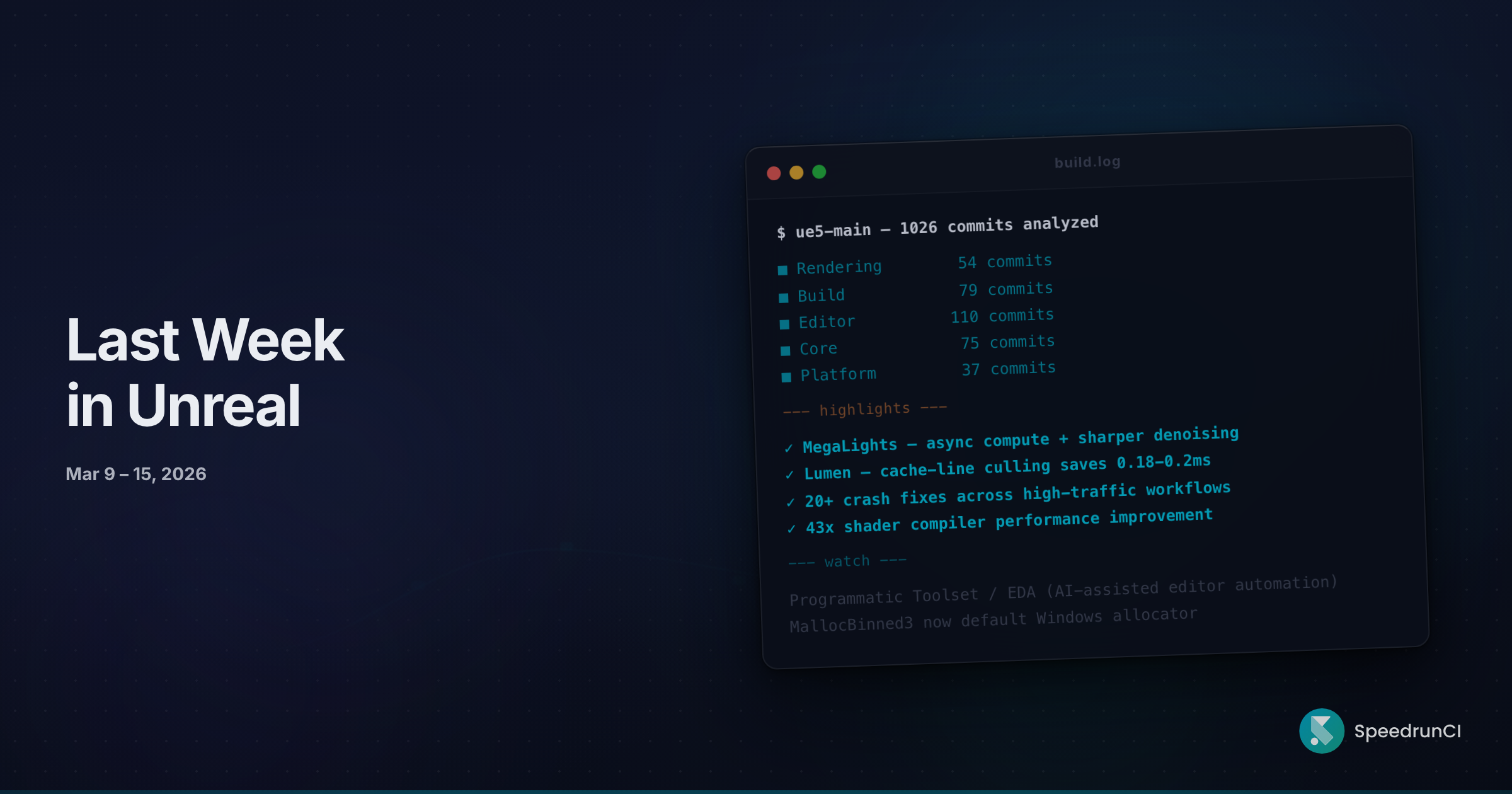
Week of March 9-15, 2026 | 1026 commits analyzed | Branch: ue5-main
Overview
A dense week. The highlight reel is dominated by crash fixes — over 20 distinct ones spanning editor, rendering, animation, networking, and core systems — but the more interesting story is the infrastructure being laid underneath. MegaLights continues its march toward production readiness, a new programmatic toolset layer for Blueprints and assets landed with unusual breadth, and a handful of under-the-radar changes (a new default memory allocator on Windows, a behavioral change to garbage collection timing) deserve more attention than they’ll probably get.
Development Trends
Rendering Pipeline Maturation: From Feature Work to Optimization and Deprecation
Pattern: Rendering subsystem commits have declined from 90 (week of Feb 9) to 54 (week of Mar 9), a 40% drop over six weeks even as total weekly commits remain stable (900-1060 range). Simultaneously, the rendering themes have shifted from feature introduction (Nanite CLAS ray tracing, MegaLights instrumentation, Substrate evolution) toward optimization and cleanup: Lumen cache-line culling saving 0.18-0.2ms per frame, SSGI deprecated, Coarse Mesh Streaming deprecated, and a 43x shader compiler performance improvement. MegaLights work has appeared in every single week for eight consecutive weeks but has moved from “instrumented for production” and “front layer translucency” to CVar cleanup and async compute — maintenance-phase signals.
Interpretation: The rendering stack appears to be transitioning from an active feature development phase into stabilization. The consistent deprecation of older systems (SSGI, Coarse Mesh Streaming) alongside aggressive micro-optimization of newer ones (Lumen culling, shader compilation) suggests Epic is preparing the rendering pipeline for a release milestone. The declining commit count isn’t abandonment — it’s the natural compression that happens when a system moves from “build it” to “ship it.”
Who cares: Studios relying on Lumen or MegaLights in production should track the optimization commits closely — these are the changes that determine real-world frame budgets. Teams still using SSGI or Coarse Mesh Streaming need to plan migration. Shader-heavy projects benefit significantly from the 43x compiler improvement.
Signal strength: Strong
Editor and Tooling Investment Surge: Programmatic Automation and AI-Assisted Development
Pattern: Editor commits jumped to 110 in the Mar 9 week, the highest in the eight-week window and a 59% increase from the prior week’s 69. This coincides with two distinct new workstreams appearing simultaneously: 14+ commits for programmatic toolset infrastructure (Blueprint/asset automation via EDA) and 7+ commits building an AI assistant with MCP tool integration. The editor subsystem has been classified as “stable” in momentum (oscillating 69-110), but the nature of the work has fundamentally changed — previous weeks showed routine editor fixes, while the current week introduced entirely new systems.
Interpretation: Epic appears to be making a strategic investment in editor automation at two levels: a deterministic programmatic API layer (EDA) for CI/CD-style asset pipelines, and an AI-assisted layer for interactive development. The simultaneous emergence of both suggests a coordinated initiative rather than independent experiments.
Who cares: Technical artists, build engineers, and anyone maintaining custom editor tooling. Studios with large asset pipelines should evaluate EDA early.
Signal strength: Early
Core Runtime Modernization: Memory, Loading, and Allocation Infrastructure
Pattern: Core subsystem commits have risen steadily from 50 (Feb 2) to 75 (Mar 9), a 50% increase and the highest count in the eight-week window. This week’s core work is unusually coherent: MallocBinned3 becoming the default Windows allocator, deferred GC timing changes, async SavePackage, RF_Public flag removal, and movement base abstraction shifting from UPrimitiveComponent to UObject.
Interpretation: This pattern suggests a deliberate effort to modernize Unreal’s runtime foundation. Changing the default memory allocator on Windows implies extensive internal benchmarking. The GC and async loading changes point toward better support for open-world streaming scenarios. The movement base abstraction is a decoupling move that typically precedes architectural flexibility.
Who cares: Engine programmers, anyone with custom memory allocators or GC-sensitive gameplay code. QA teams should benchmark the MallocBinned3 change.
Signal strength: Moderate
New Runtime Systems Emerging in Parallel: Animation, Audio, and Procedural Content
Pattern: Three subsystems show simultaneous early-stage activity this week that wasn’t present in prior weeks. Animation rose from 12 to 21 commits with a new “UAF” animation runtime. Audio jumped from 1 commit to 19 with a MetaSound channel-agnostic type rework (9 commits, 3 back-outs). A new Procedural Vegetation Editor (PVE) appeared with 10+ commits, alongside MeshPartition/MegaMesh work (6+ commits).
Interpretation: The simultaneous emergence suggests these may be features that were developed on separate branches and are now being integrated into ue5-main. The MetaSound back-outs indicate active iteration. The UAF animation runtime alongside the movement base abstraction is likely not coincidental — a new runtime would benefit from a more flexible movement base.
Who cares: Animation programmers, audio teams using MetaSound, environment artists. Expect API instability in MetaSound short-term.
Signal strength: Early
TL;DR
- MegaLights and stochastic lighting got async compute, better denoising, and practical CVar cleanup — the push toward production quality is accelerating
- 20+ crash fixes across high-traffic workflows, plus a security patch for directory traversal in UnrealPak
- A coordinated batch of programmatic toolset commits hints at AI-assisted or automated content authoring infrastructure taking shape inside the editor
Highlights
MegaLights and Stochastic Lighting
What changed. Async compute support for Front Layer Translucency in MegaLights, eliminating unnecessary barriers by passing only SceneDepth and GBuffer to the relevant passes. The denoiser picked up bicubic history resampling — high-quality Catmull-Rom when the full 12-tap region is valid, graceful fallback otherwise — producing noticeably sharper results during camera or object motion. The samples-per-pixel CVar was cleaned up to expose practical settings (1/2/4 instead of the previous 2/4/16). A subtle DeviceZ conversion drift fix addresses a class of lighting artifacts caused by the divide-by-zero prevention offset in ConvertToDeviceZ.
Why this is important. Each of these individually is incremental. Together, they represent a week where MegaLights moved meaningfully closer to replacing traditional lighting workflows for teams willing to adopt it. The async compute overlap in particular removes a performance wall that made FLT costly in MegaLights scenes.
Who should care. Teams evaluating MegaLights for production. Anyone already shipping with stochastic lighting.
Urgency. Low. These are improvements, not breaking changes. Worth pulling into your next integration window.
Lumen Scene Culling Performance
What changed. A new FLumenCardCullingInfo struct isolates hot culling data from cold card data, cutting 0.18ms off the Lumen scene update in scenes with 30k+ cards. Separately, merged primitive group bounding boxes now expand incrementally when a single primitive is added, instead of rebuilding from scratch. Lumen direct lighting also gained light-to-card-tile culling, saving roughly 0.2ms with 1.2k lights (enabled by default).
Why this is important. Cache-line optimization and algorithmic improvements in tight loops. The kind of work that compounds — individually modest, collectively the difference between hitting frame budget or not in large worlds.
Who should care. Open world teams. Anyone with dense Lumen scenes.
Urgency. Free performance. Pull it in.
Crash Fix Blitz
What changed. At least 20 distinct crash fixes this week. The most impactful ones hit high-traffic editor workflows:
- Level viewport drag-and-drop crash when a modal dialog invalidates the operation mid-drag
- ISM crash when removing instances with PerInstanceCustomData via property editor (array size mismatch)
- Incremental GC crash in UWrapBoxSlot/UPanelSlot from a raw pointer that needed IsValid
- LiveLink thread-safety crash: animation workers racing with Update() on a FrameSnapshot TMap copy
- Sequencer crash when renaming a subsequence while viewing through it
- Blueprint variable naming crash during Slate Prepass when widgets are added/removed
- Timer manager crash at module unmount with active timers bound to destroyed delegates
- Hair rendering race condition and use-after-free (instances not ref-counted)
- Async physics thread safety: unsafe UObject access on worker threads
- Path traversal security fix in UnrealPak (directory traversal vulnerability)
Why this is important. The breadth here is unusual. This isn’t one system getting a stability pass — it’s a sweep across the engine. The UnrealPak security fix is notable and should be prioritized by anyone distributing pak files from untrusted sources.
Who should care. Everyone. Scan this list for workflows your team uses daily.
Urgency. Medium to high. Several of these are in common editor workflows. The security fix warrants prompt attention.
Unreal Build Accelerator Stability Pass
What changed. Four fixes: buffer overflow in path searching, a Win32 process handle bug (null vs INVALID_HANDLE_VALUE), a crash from empty PATH entries with trailing semicolons, and a race condition where UBA’s custom module handle cache didn’t account for DLL unloads — the root cause of the long-standing mspdbcore.dll error.
Why this is important. If you’ve been hitting mysterious mspdbcore.dll errors in distributed builds, this is probably your fix. The other three are defense-in-depth against edge cases that surface in CI environments with unusual PATH configurations.
Who should care. Teams using UBA for distributed compilation.
Urgency. Medium. Pull it if you’ve been hitting mspdbcore.dll issues.
Programmatic Toolset Infrastructure (Editor-Driven Automation)
What changed. 14+ commits building a programmatic toolset layer for Blueprints, data tables, materials, static meshes, textures, and scene primitives. Python-accessible tools for add/remove/list operations on variables, function graphs, nodes, and components. The “EDA” (Editor-Driven Automation) label appears on several. Dependency-aware reloading suggests hot-reload of structs before dependent code. Test coverage was built in from the start.
Why this is important. The breadth and coordination of this push — covering this many asset types in a single week — strongly suggests infrastructure for AI-assisted or automated content authoring. This aligns with the AI Assistant / MCP tools cluster also active this week (7+ commits building an AI assistant with MCP tools into the editor).
Who should care. Technical artists. Pipeline engineers. Anyone building editor automation.
Urgency. Low. This is infrastructure being laid, not something you need to react to yet. But it’s worth understanding the direction.
Async Loading and Garbage Collection Timing
What changed. Async SavePackage support landed, along with a fix for a missing critical section around object creation listeners. UObject reconstruction rules were relaxed to allow reconstruction from loading threads. The “defer GC always” change — backed out once, resubmitted with fixes — prevents garbage collection from running mid-frame during Object Destroy calls. A separate change removes RF_Public flags from runtime entity/component creation to reduce package size and load time.
Why this is important. The “defer GC always” change is a behavioral modification to garbage collection timing that affects every UE project. If your code relies on synchronous GC during object teardown, audit it. The async SavePackage work matters most for large open worlds with streaming.
Who should care. Everyone (for the GC change). Open world teams (for async loading).
Urgency. Medium. The GC timing change is subtle but could surface issues in custom code that assumed synchronous collection.
Rendering Deprecations and GPU Crash Diagnostics
What changed. SSGI is now officially deprecated in favor of Lumen GI — the label changed from “Beta” to “Deprecated” with a one-time runtime warning. Coarse Mesh Streaming for HWRT deprecated in favor of Residency Based Update. GPU crash reports for DX11/DX12 now include D3DResult and DeviceRemovedReason. A new Insights plugin visualizes render command list recording, translation, and submission.
Why this is important. SSGI deprecation is a signal, not a removal. If you’re still using it, start planning the transition. The GPU crash diagnostics improvements — trace snapshots on crash combined with device-level error codes — represent a real quality-of-life improvement for anyone triaging GPU hangs.
Who should care. Teams still on SSGI (migrate). Anyone debugging GPU crashes (upgrade).
Urgency. Low for deprecations (plan, don’t panic). The diagnostics are immediately useful.
MallocBinned3 as Default Windows Allocator
What changed. MallocBinned3 is now the default memory allocator on Windows, replacing the previous default.
Why this is important. Memory allocator changes affect everything — allocation patterns, fragmentation behavior, peak memory, performance characteristics under contention. This is the kind of change that can silently improve or silently regress your project’s memory profile.
Who should care. Everyone shipping on Windows.
Urgency. Medium. Benchmark your project before and after integration. Don’t just pull this in blind.
Verse Compiler Performance
What changed. A 42.97x performance improvement in the Verse compiler, specifically in CSemanticProgram::GetOrCreateFunctionType (Engine/Source/Runtime/VerseCompiler/).
Why this is important. Verse is Epic’s language for UEFN and increasingly central to their UE6 vision. A 43x improvement in type resolution suggests active optimization work on the compiler’s hot paths, which matters as Verse adoption scales.
Who should care. UEFN developers and anyone tracking Epic’s Verse investment.
Urgency. Low. This is a pure improvement. Relevant to UEFN workflows.
Correction: This was originally categorized as a shader compiler change. A reader correctly identified the file paths as VerseCompiler, not the shader pipeline. Updated 2026-04-01.
Worth Tracking
Movement base abstraction. Characters and CharacterMovementComponent are being converted to use a UObject representation of movement bases instead of requiring UPrimitiveComponent. This opens up movement bases to non-actor objects — MassEntity representations, procedural surfaces, and other non-traditional foundations. If you have custom movement code that assumes movement bases are always primitive components, this will eventually require attention.
MetaSound channel-agnostic types. Nine commits (with three back-outs and relands, which tells you the complexity) reworking MetaSound’s core type infrastructure for channel-agnostic audio. The goal appears to be supporting arbitrary channel configurations — Ambisonics, 7.1.4, custom spatial formats — without the type system getting in the way. The back-out/reland pattern suggests this is still stabilizing. Worth watching but not acting on yet.
What We Ignored
Roughly 870 commits were filtered as routine or low-signal. Categories include: header/include cleanup, comment and formatting changes, copyright updates, merge commits, internal test scaffolding, platform-specific compliance changes, and incremental feature work on systems still in early development (Procedural Vegetation Editor, MeshPartition/MegaMesh, UAF animation runtime, Mass Entity sparse elements). Several emerging systems — particularly PVE with its hormone-based growth simulation and the Substrate/New Material Translator work — are interesting but too early to editorialize on.
Closing
A week where the engine got measurably more stable, measurably faster in a few key paths, and quietly laid infrastructure that hints at where the editor is heading.
Never miss a ue5-main update.
Get them delivered straight to your inbox.