Last Week in Unreal — Mar 30 – Apr 5, 2026
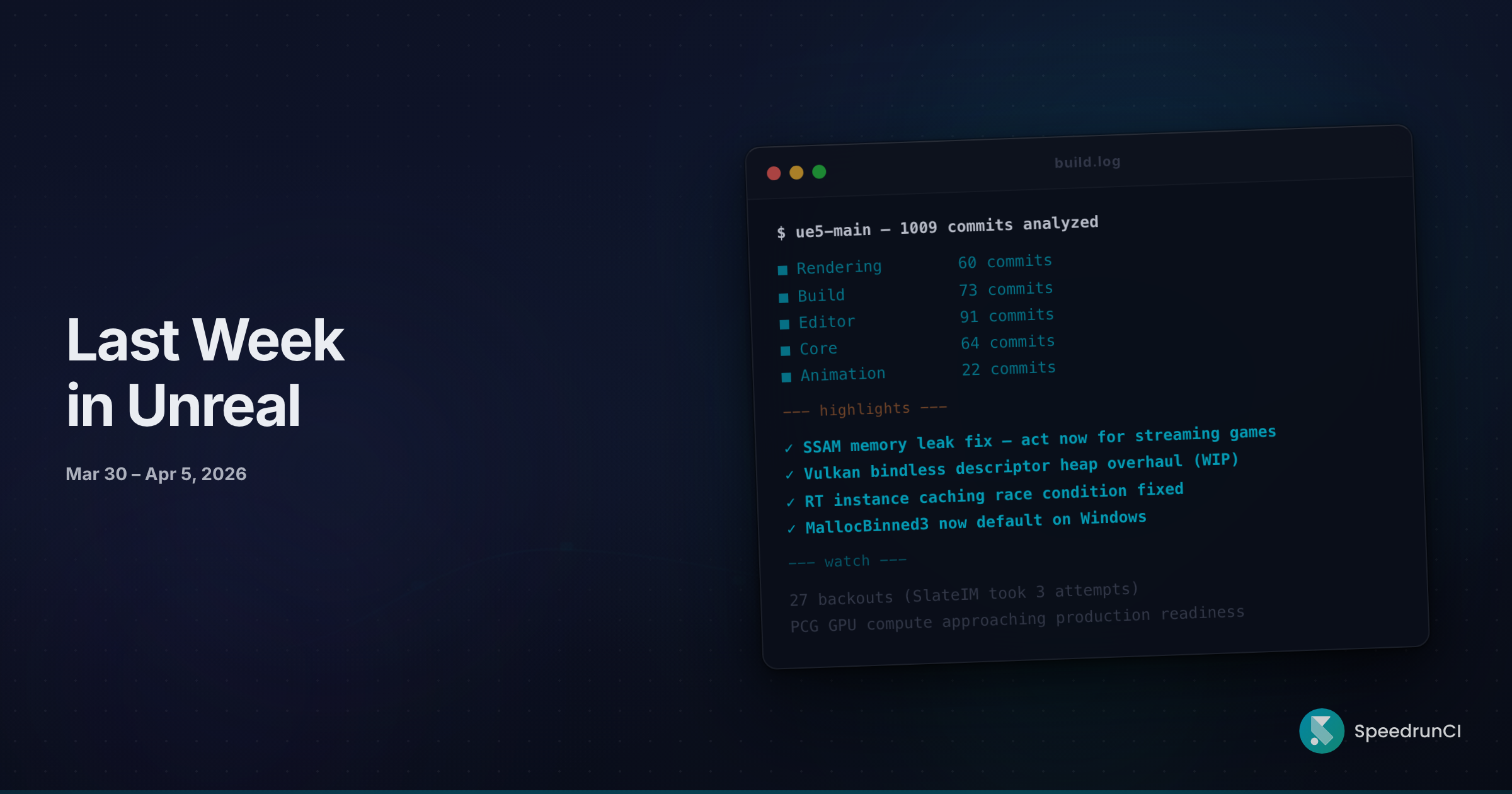
Unreal Engine Weekly — What Changed and What Matters
Week of March 30 – April 5, 2026 | 1009 commits analyzed | Branch: ue5-main
Overview
An active week across rendering, memory, and tooling. Vulkan is being rebuilt toward D3D12-level bindless descriptor support. Three distinct memory fixes landed that smell like production discoveries — one of them, a streaming-related memory leak, is act-now for open-world titles. The mobile renderer got a rationalization pass, PCG’s GPU compute path is maturing quickly, and a medial skeleton auto-rigging pipeline is taking shape in the geometry tools. Backout volume was notably high at 27, suggesting integration friction on several fronts.
Development Trends
Multi-week patterns based on 8 weeks of commit history and subsystem momentum analysis.
Memory Allocator Strategy Enters Multi-Track Production Phase
Pattern: Memory and allocation themes have appeared in four of the last five weeks with escalating scope. Week of Mar 15: MallocBinned3 became the default Windows allocator. Week of Mar 29: MallocBinned4 forked from MB2 with block header separation and 8-byte bins. Week of Apr 5: MB3 is now enabled by default with platform-specific optimizations, plus a production-grade SSAM memory leak fix and a 20% AutoRTFM mutex pool improvement. Core subsystem rose from 50 (Feb 23) to 64 this week — classified as rising.
Interpretation: Epic is running parallel allocator strategies: MB3 for near-term shipping (now default on Windows, with platform-specific optimizations on Android and iOS) and MB4 for future console-optimized workloads. The SSAM leak fix and AutoRTFM pool work suggest internal production titles are generating real memory profiling data that is driving engine-level fixes. This is not speculative infrastructure — it is allocation behavior being tuned under production load.
Who cares: Engine programmers maintaining custom allocators. All teams shipping production titles. Console teams should monitor MB4 development.
Signal strength: Strong — four consecutive weeks of allocator themes, escalating from “new default” to “parallel strategy.”
Animation Pipeline Breakout
Pattern: Animation subsystem commits: [11, 12, 12, 17, 21, 17, 13, 22]. This week’s 22 is the highest in the 8-week window. Animation surfaced as a dedicated report section for the first time this week with three distinct workstreams: GPU-side ISKM bone attachments, Optimus deformer use-after-free fix (45 files), and ~25 commits building a medial skeleton auto-rigging pipeline.
Interpretation: Animation has been quietly building momentum and this week crossed a visibility threshold. The ISKM bone attachment API targets Fortnite-scale instanced character rendering. The medial skeleton work — root bone selection, constrained skin weights, skeleton simplifier — is building toward automatic rigging from mesh geometry. These are not maintenance commits; they are new capability being built.
Who cares: Animation engineers. Teams using instanced skeletal meshes at scale. Procedural character pipeline developers.
Signal strength: Moderate — rising momentum confirmed, but first week with explicit editorial themes. Needs one more week to confirm sustained investment vs. sprint.
Vulkan’s Multi-Month March Toward D3D12 Parity
Pattern: Vulkan-specific infrastructure themes have appeared in four of the last eight weeks: specialization constants and XR extensions (Feb 16), plugin extension architecture (Mar 8), and now a full bindless descriptor heap overhaul using VK_EXT_descriptor_heap with push constant optimization and ray tracing shader support (Apr 5).
Interpretation: Epic appears to be methodically closing Vulkan’s feature gap with D3D12. The progression from specialization constants to plugin extension architecture to bindless descriptor heap follows a logical sequence: flexibility, then extensibility, now performance parity. Bindless descriptors are how modern GPUs avoid per-draw binding overhead — Vulkan catching up suggests Epic is preparing for Vulkan-first platforms (Android, Linux, Steam Deck) to match the Windows rendering feature set.
Who cares: Vulkan platform teams (Android, Linux). Graphics engineers evaluating cross-platform performance. Studios shipping on Steam Deck or mobile.
Signal strength: Moderate — four data points over eight weeks, but the descriptor heap work is WIP. The trajectory is clear; completion timeline is not.
Production Stability as a Sustained Engineering Priority
Pattern: Every week for the past eight weeks has included stability/crash/thread-safety themes. This week: ray tracing race condition (parallel bitfield writes), CVar destructor crash (three landing attempts), audio thread-safety fixes, skeletal mesh integer overflow. Backout volume hit 27 — the highest observed in the tracking window.
Interpretation: The sustained crash fix cadence combined with elevated backout count suggests Epic is in active integration testing with internal production titles. The types of bugs — race conditions in bitfields, use-after-free in deformer pipelines, CVar lifetime issues across merged modules — only surface under real production load with diverse hardware. The three-attempt SlateIM landing and XR stereo refactor backout further indicate the codebase is under stress from concurrent workstreams.
Who cares: All teams integrating from ue5-main. The backout volume suggests increased merge risk. Teams using hardware ray tracing, Deformer Graph, or merged modules should prioritize the specific fixes.
Signal strength: Strong — eight consecutive weeks of stability themes, with this week’s backout volume adding a quantitative signal.
TL;DR
- SSAM memory leak fix addresses unbounded growth across level transitions — act now if you ship with asset streaming
- Vulkan bindless descriptor heap overhaul (WIP) is moving toward D3D12 parity, touching ray tracing shaders and push constant optimization
- Mobile rendering cleanup: HDR water refraction range expanded from [0, 10] to [0, 65504], dead CVars and buffers removed
- Race condition in ray tracing instance caching fixed — any team with dynamic RT objects was potentially hitting undefined behavior
- 27 backouts this week, including a SlateIM rework that took three attempts to land
Highlights
Rendering and GPU Infrastructure
What changed. Vulkan’s bindless descriptor path is being rebuilt around VK_EXT_descriptor_heap. Three WIP commits lay the foundation: a new descriptor heap binding architecture, push address globals replacing binding0 with 8-byte values (with per-command-buffer push constant state tracking to reduce redundant data), and descriptor heap binding mappings for ray tracing shaders. On the D3D12 side, adapter device persistence now avoids redundant D3D12CreateDevice calls during startup — each call takes up to 400ms, and the previous code was releasing devices only to potentially recreate them. Lumen’s radiance cache reduced transient memory by 26.46 MB at Epic settings through a right-sized temporary atlas, and unnecessary MegaLights shader permutations are now skipped when only Substrate-Blendable is in use. The stereo rendering pipeline was refactored across 37 files to abstract texture descriptor creation for multi-view XR, though it was backed out once and resubmitted.
Why this is important. The Vulkan descriptor heap work is the most architecturally significant rendering change this week. Bindless descriptors are how modern GPUs avoid per-draw binding overhead, and Vulkan has lagged behind D3D12 here. Push constant state tracking is a smart optimization that compounds at scale. The D3D12 startup fix is small but eliminates avoidable stalls during adapter enumeration. The Lumen memory savings are free wins. The XR refactor’s backout-and-resubmit cycle warrants caution — it has a very wide surface area touching Nanite, Water, Niagara, particles, and MaterialTemplate.ush.
Who should care. Graphics engineers. Vulkan platform teams (Android/Linux). XR engineers should test the multi-view changes carefully given the resubmission history. PC teams should note the D3D12 startup improvement.
Urgency. Track. The Vulkan work is WIP. The XR refactor needs regression monitoring.
Memory and Allocation
What changed. Three production-grade memory fixes. The SSAM (Simple Streamable Asset Manager) fix addresses a leak where zombie asset slots were never reclaimed when all referencing objects were removed, causing linear memory growth across level transitions. MallocBinned3 is now enabled by default on Windows, with UE_MB3_USE_CACHED_PAGE_ALLOCATOR_FOR_LARGE_ALLOCS enabled on Windows, Android, and iOS. The AutoRTFM mutex pool delivers a measured 20% improvement for transactionally-safe recursive mutexes — 16 bytes per state object, 4096 objects per 64K allocation, eliminating per-object heap overhead.
Why this is important. The SSAM leak is the kind of bug that only manifests in open-world games with heavy streaming. If you have been chasing unexplained memory growth across level transitions, this is likely your culprit. The MallocBinned3 default change affects every Windows build going forward — this is a quiet but broad shift in allocation behavior. The AutoRTFM pool optimization matters for teams using transactional memory features at scale.
Who should care. All teams shipping production titles with streaming. Engine programmers maintaining custom allocators. Open-world teams should prioritize the SSAM fix.
Urgency. Act now for the SSAM leak if you ship with asset streaming. Track for MB3 default change — baseline your memory profile before and after.
Mobile Rendering
What changed. The mobile renderer got a coordinated cleanup. The r.Mobile.SupportsSM5MaterialNodes CVar was removed entirely across 11 files — SM5 capabilities for volumetric fog on mobile are now properly feature-gated instead of hidden behind an opaque switch. MobileLocalLightsBuffers were removed across 19 files, simplifying the local lighting path to use a direct LocalLightsEnabled flag. The R11G11B10 SceneColor copy for SingleLayerWater expanded its HDR range from [0, 10] to [0, 65504], fixing bloom inconsistencies between mobile and desktop. A separate fix addresses shallow water striping caused by texture gather quad misalignment.
Why this is important. The HDR range expansion is a meaningful visual quality improvement — [0, 10] was clipping bright reflections and causing visible bloom differences on mobile. The CVar removal is good housekeeping: feature-gating by actual hardware capability is more reliable than a global toggle. The buffer removal simplifies the rendering path, which reduces maintenance burden and potential for bugs.
Who should care. Mobile graphics engineers. Teams shipping on Android/iOS with water rendering or volumetric fog.
Urgency. Track. Pull these into your next integration, especially if you have reported bloom or water rendering inconsistencies on mobile.
Animation and Skeletal Mesh Pipeline
What changed. The instanced skeletal mesh system gained a GPU-side bone attachment API — SetInstanceBoneAttachment and ClearInstanceBoneAttachment allow child ISKM instances to attach to a parent instance’s bone, with GPU scene resolve handling the transform chain. The Optimus deformer runtime received a significant stability fix across 45 files: the MeshObject data interface was being cached from the game thread and accessed on render, causing use-after-free. It now queries via render thread APIs. Foliage batching was fixed to separate GPU skin and Nanite into distinct batches, preventing scene extension skipping.
Separately, roughly 25 commits landed building out a medial skeleton workflow: automatic root bone selection, constrained skin weight binding from medial skeletons to animation skeletons, a skeleton simplifier with sphere overlap thresholds and skinny triangle splitting, and performance improvements to vertex sculpt tools and MeshSelfUnion.
Why this is important. The ISKM bone attachment API is significant for Fortnite-scale games where thousands of instanced skeletal meshes need attachment relationships without CPU-side transforms. The Optimus use-after-free fix is a real crash fix for anyone using Deformer Graph chains. The medial skeleton work is building toward automatic skeleton generation from mesh geometry — relevant for procedural rigging pipelines and character generation tools.
Who should care. Animation engineers. Teams using instanced skeletal meshes at scale. Anyone using Deformer Graph should pull the Optimus fix. Procedural character pipeline developers should monitor the medial skeleton work.
Urgency. Act now for the Optimus use-after-free if you use Deformer Graph. Track for ISKM attachments and medial skeleton tooling.
Stability and Thread Safety
What changed. A race condition in ray tracing instance caching was fixed — bIsCachedRayTracingInstanceValid and bDynamicRayTracingInstanceCachedDataDirty were sharing a bitfield, meaning parallel task writes produced undefined behavior. They now use separate storage units. The FAutoConsoleObject destructor crash with merged modules took three attempts to land (with backouts), addressing CVar objects surviving past their library lifetime. Audio thread-safety races were fixed in vorbis DLL initialization and AudioFormatOgg singleton access. Dangling pointers in post-processing volumes without UObject base were resolved. FPointerEvent::PressedButtons now copies by value for thread safety in input event handling. A skeletal mesh build was failing to report required memory due to integer overflow. A networking edge case related to recovery from sequence history overflow was patched.
Why this is important. The ray tracing race condition is the most critical fix here — undefined behavior from parallel bitfield writes can manifest as anything from visual corruption to crashes, and it affects any team using hardware ray tracing with dynamic scene objects. The CVar destructor crash with merged modules is structurally important for teams using monolithic builds. The audio thread-safety fixes prevent intermittent crashes that are difficult to reproduce and diagnose.
Who should care. All teams using hardware ray tracing with dynamic objects (the race condition). Teams using merged/monolithic module configurations (the CVar crash). Audio engineers (the thread-safety fixes).
Urgency. Act now for the ray tracing race condition and the CVar destructor crash. Track for the remaining thread-safety fixes.
PCG GPU Compute
What changed. Five PCG commits advancing the GPU compute backend: override support for TransformPoints, broadened override types adding bool/float/struct, a persistent UV cache for inline ray tracing (avoiding per-dispatch rebuilds), GPU memory stats in the profiling window, and a new AlignPoints node.
Why this is important. The addition of memory profiling and ray tracing data caching suggests Epic considers the GPU path ready for production evaluation. Per-dispatch UV rebuilds were a real performance bottleneck for ray tracing nodes, and the persistent cache removes that overhead. Broader override types make GPU graphs actually flexible enough for real workflows.
Who should care. Teams evaluating PCG for open-world or procedural level generation. Technical artists building GPU-accelerated PCG graphs.
Urgency. Track. If you have been waiting to evaluate PCG GPU nodes, the tooling maturity suggests now is a reasonable time to start testing.
Build and Infrastructure
What changed. BuildGraph gained an OptionalRequires attribute, allowing nodes to declare soft dependencies — useful for CI pipeline authors who need conditional stage ordering. Merged module leaks are now fatal in test builds, a policy change that catches silently accumulating leaks that previously caused downstream crashes. A shader cache bypass fix restored the r.DumpShaderDebugInfo=3 retry mechanism, which was broken because resubmitted jobs were still hitting cache. Runtime network status monitoring was added for iOS, Android, Mac, and Linux (Windows delayed due to performance issues).
Why this is important. The BuildGraph soft dependencies are a quality-of-life improvement for CI pipeline complexity. The merged module leak fatality is a subtle but important policy shift — if you run test builds with merged modules, expect new failures that are actually exposing pre-existing problems. The shader debug info fix restores a workflow that shader engineers depend on for iterating.
Who should care. CI/CD pipeline authors (BuildGraph). Engine programmers using merged modules (leak fatality). Shader engineers debugging compilation issues.
Urgency. Track.
Worth Tracking
ChaosMover networking is being stress-tested. Active work on ChaosMover’s prediction layer includes gameplay tag diffing with rollback correction on the physics thread and a fix where state was being recorded pre-solve instead of post-solve, causing a one-frame offset on clients. The velocity of fixes suggests active internal production testing. Teams evaluating ChaosMover for networked character movement should monitor this — it is approaching the point where evaluation is reasonable, but the fundamental timing bugs being found indicate it is not yet battle-hardened.
SlateIM landed after three attempts. A “Major changes” commit to Slate input method handling was submitted three times with two intermediate backouts. The commit message provides no detail. If your project has custom text input, localized IME support, or complex Slate text widgets, verify behavior after upgrading. This area produces subtle regressions with non-Latin input methods, and the repeated backouts signal something structurally difficult was reworked.
What We Ignored
This week we ignored roughly 860 commits covering routine maintenance, formatting changes, automated merges, MetaHuman character editor updates (roughly 20 commits of texture/material override tooling and viewport modes), AI assistant plugin reorganization (22+ commits moving toolsets into a unified directory), PlainProps serialization bringup (10+ commits working through TMap and EnumAsByte edge cases), Dataflow graph-based asset processing improvements (17 commits), NNE runtime upgrades (IREE 3.11.0, ONNX Runtime 1.24.3, DirectML 1.15.4), and assorted platform-specific fixes that do not affect most teams.
Closing
A week where the fixes mattered more than the features — pull the SSAM leak fix and the ray tracing race condition if nothing else.
Never miss a ue5-main update.
Get them delivered straight to your inbox.