Last Week in Unreal — Mar 23 – 29, 2026
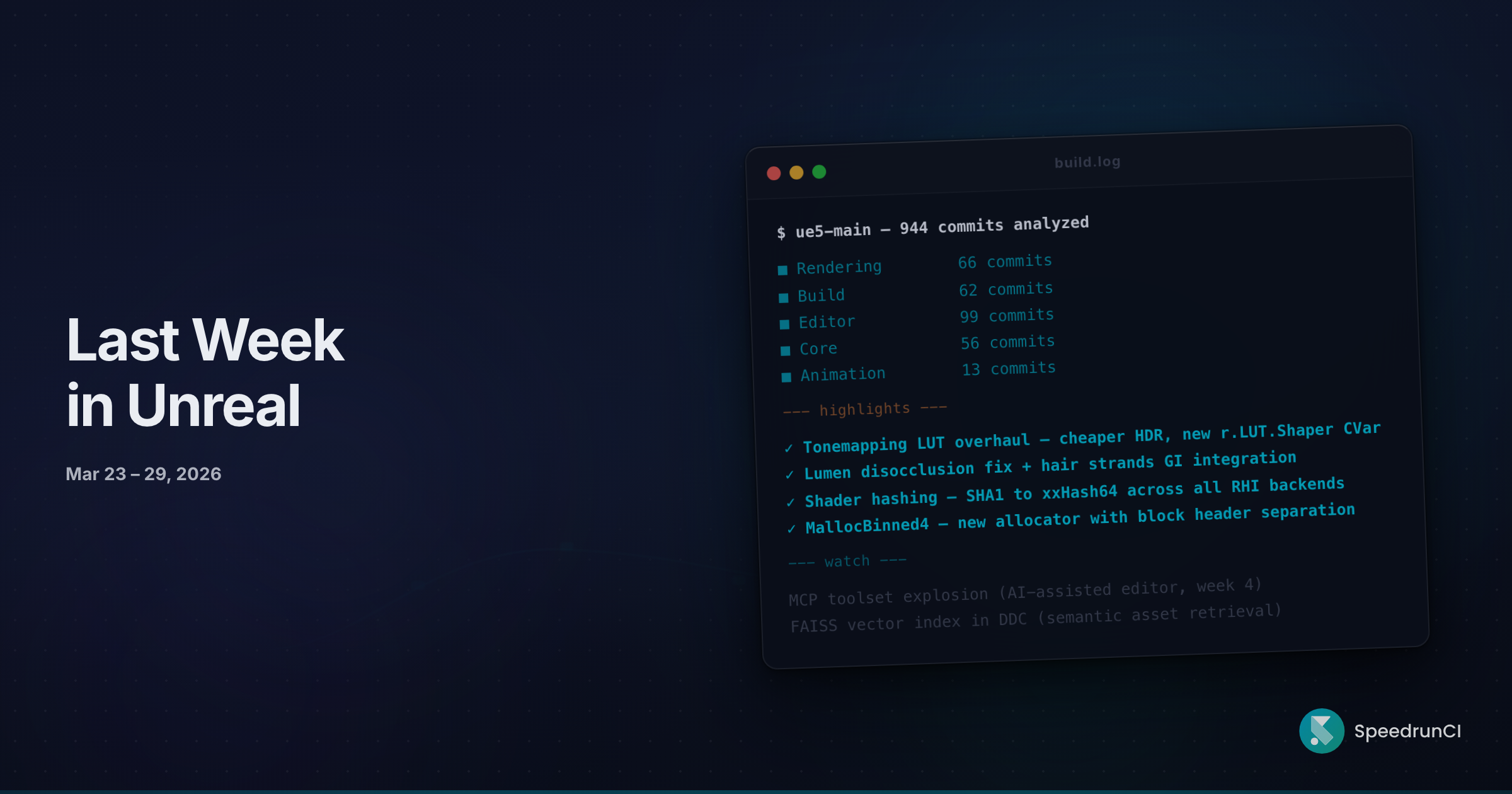
Unreal Engine Weekly — What Changed and What Matters
Week of March 23–29, 2026 | 944 commits analyzed | Branch: ue5-main
Overview
A week of rendering polish, infrastructure modernization, and memory subsystem investment. The tonemapping pipeline got a coordinated rework — LUT generation is cheaper and more controllable. Lumen fixed a long-standing disocclusion artifact and gained hair strands support. The shader system replaced SHA1 hashing with xxHash64 and introduced proper type safety for light scene IDs — touching every RHI backend. And a new memory allocator, MallocBinned4, appeared with architectural changes that suggest it’s the intended successor for shipping titles.
On the tooling side, the “toolset” explosion continued with three separate developers adding MCP-callable tool surfaces for everything from behavior tree inspection to physics assets. Control Rig quietly flipped to ECS-based evaluation in Sequencer. And a FAISS vector index integration into DDC hints at embedding-based asset retrieval — likely foundational work for AI-assisted workflows.
Development Trends
MegaLights: Ten Weeks and Counting — Now Entering Quiet Maintenance
Pattern: MegaLights has appeared as a named theme in every week from Feb 2 through Mar 22 — ten consecutive weeks. This week breaks the streak: no dedicated MegaLights theme for the first time. The progression over those ten weeks was methodical — hardening (Feb 2-8), production instrumentation (Feb 9-16), front layer translucency (Feb 16-23), stability hardening (Feb 23-Mar 1), cloud shadows and IES absorption (Mar 2-8), stochastic denoiser improvements (Mar 9-15), and performance micro-optimization including a 27% cost reduction on glass-heavy scenes (Mar 16-22).
Interpretation: The absence of a dedicated MegaLights theme this week, after ten weeks of sustained investment, likely signals that the feature has reached a stability plateau rather than being abandoned. The progression from feature addition to performance polish to silence is the classic pattern of a subsystem entering maintenance mode. MegaLights appears feature-complete for 5.8 and is likely in internal validation. Expect it to resurface only for targeted fixes rather than new capabilities.
Who cares: Lighting artists and graphics engineers. If you’ve been waiting for MegaLights to stabilize before evaluating it, the quiet period suggests now is a reasonable time to start.
Signal strength: Strong
AI-Assisted Editor Tooling: Fourth Consecutive Week — Scope Expanding Beyond Read-Only
Pattern: AI editor tooling themes have appeared for four consecutive weeks: “AI Assistant Infrastructure” (Mar 2-8), “Programmatic Toolset Infrastructure” (Mar 9-15), “ECABridge MCP tooling” (Mar 16-22), and this week three separate developers added MCP-callable toolset plugins covering behavior trees, physics assets, GAS, logs, widget trees, MVVM bindings, and asset validation. Editor subsystem commits have been elevated for four weeks: 69, 110, 106, 99. The editor subsystem is flagged as “rising” in momentum data.
Interpretation: The scope is expanding from structured read access (week 1-2) to actionable toolsets that can inspect and potentially modify editor state across multiple subsystems. Three different developers contributing independently this week suggests this is no longer a single team’s project — it’s becoming a platform-level initiative with adoption across subsystems. The FAISS vector index integration into DDC this week (embedding-based asset retrieval) adds a complementary capability that could enable semantic search for AI workflows.
Who cares: Tools programmers, editor extension developers, and studios evaluating in-engine AI assistance. Plugin developers should consider whether their tools need MCP-callable surfaces. CI/CD teams may find new automation opportunities as the programmatic API matures.
Signal strength: Moderate (four weeks of sustained data, scope widening)
Memory Allocator Evolution: From Default Swap to New Architecture in Two Weeks
Pattern: MallocBinned3 was made the default Windows allocator on Mar 9-15, replacing MallocBinned2. This week, MallocBinned4 appeared — a fork of MB2 with block header separation and 8-byte bin support. MB3 also gained Unix platform support this week. Core subsystem momentum is “stable” at 50-75 commits/week, but the memory allocator work represents a distinct acceleration: two new allocator milestones in consecutive weeks after no allocator themes in the preceding six weeks.
Interpretation: Epic appears to be running parallel allocator strategies: MB3 as the current shipping default (now cross-platform with Unix support) and MB4 as the next-generation architecture optimized for memory-sensitive targets. The block header separation in MB4 — moving headers out of the 64KB block into a separate lookup table — is a structural change that eliminates waste for power-of-two allocations at scale. This two-track approach suggests MB4 is being developed with console targets in mind, where per-allocation overhead matters most.
Who cares: Engine programmers with custom memory allocators. Console teams with tight memory budgets. Anyone doing memory profiling should baseline on MB3 now and track MB4’s progression.
Signal strength: Emerging (strong architectural signal but only two weeks of data)
Shader and Rendering Infrastructure Modernization: Sustained Cleanup Accelerating
Pattern: Shader and rendering infrastructure cleanup has been a recurring background theme for six weeks: “PSO Precaching and Shader Infrastructure Overhaul” (Feb 23-Mar 1), “Deprecation Cleanup Is Live” (Mar 2-8), “Shader Compiler Performance” (Mar 9-15), “RHI Submission Pipeline Rework” (Mar 16-22), and this week “Shader System Modernization” — SHA1 replaced with xxHash64, FLightSceneId replacing raw int32 across 500+ lines, and shader source file hashing parallelized for startup performance. Build subsystem has been consistently elevated (62-115 commits/week) throughout the 8-week window.
Interpretation: This isn’t one initiative — it’s a coordinated modernization sweep across the shader pipeline, the RHI layer, and the build system. The common thread is replacing legacy patterns (SHA1 hashing, raw integer IDs, serialized startup) with modern equivalents (xxHash64, type-safe wrappers, parallel pre-warming). Each week touches a different layer but the direction is consistent: faster compilation, safer types, lower startup cost. Combined with the aggressive 5.7 deprecation cleanup (109 files removed last week), this suggests Epic is clearing technical debt ahead of a 5.8 milestone.
Who cares: Engine programmers maintaining forks. Anyone with custom RHI backends or shader pipeline modifications — merge conflicts from these broad surface-area changes are increasingly likely if you fall behind on integration.
Signal strength: Strong
TL;DR
- Tonemapping LUT pipeline reworked — ACES moved to secondary LUT, shaper function decoupled from display output, new r.LUT.Shaper CVar for fine-grained control
- Lumen disocclusion artifacts fixed with stronger spatial filtering for newly uncovered pixels, plus hair strands now get proper Lumen GI
- Shader type hashing switched from SHA1 to xxHash64, FLightSceneId replaces raw int32 — both touch every RHI backend
- MallocBinned4 forked from MB2 with block header separation and 8-byte bins — saves real memory at scale
- TSR memory spike fix (31.6MB at 1080p during camera cuts) and several GPU crash fixes are act-now items
Highlights
Tonemapping and LUT Pipeline Overhaul
What changed. James Park landed a coordinated series of commits reworking how tonemapping LUTs are generated and evaluated. ACES calculations now run through a secondary LUT, avoiding per-frame recomputation in the main LUT generation pass. The shaper function is decoupled from display output format, defaulting to Log2 for speed even in HDR paths. A redundant 1.05 division is skipped for non-Filmic-SDR paths. A new CVar, r.LUT.Shaper, controls the shaper independently of EDisplayOutputFormat.
Why this is important. This reduces GPU cost on the tonemapping pass while giving studios finer-grained control over LUT quality. The Log2 default is faster than PQ for the shaper, and decoupling it from the display output format means you can optimize for your specific HDR pipeline without worrying about side effects. The ACES secondary LUT avoids redundant computation that was previously baked into the main pass.
Who should care. Graphics engineers. Anyone shipping HDR or using custom tonemapping chains.
Urgency. Track. Pull these in on your next integration and evaluate. The CVar gives you a revert path.
Lumen Quality and Hair Strands Integration
What changed. Two significant Lumen improvements. The screen probe gather pipeline got a fix for disocclusion artifacts — newly uncovered pixels during fast camera movement now receive stronger spatial filtering, controlled by a per-probe disocclusion factor based on pixel frame count (r.Lumen.ScreenProbeGather.SpatialFilter.DisocclusionFraction). A secondary fix tightens probe interpolation to recover from black splotches during disocclusion events. Separately, hair strands now integrate with LumenIrradianceFieldGather, so groom-based characters receive proper Lumen GI instead of falling back to reflection probes or screen traces.
Why this is important. The disocclusion fix addresses a visible quality issue — black splotches during fast camera turns are one of Lumen’s most noticeable artifacts. The hair strands integration closes a gap that forced groom-based characters to use inferior lighting fallbacks, which was particularly obvious in scenes mixing Lumen GI with MetaHuman or groom characters.
Who should care. Graphics engineers. Character and lighting artists. Anyone using Lumen with MetaHumans or groom assets.
Urgency. Track. If you’ve been working around Lumen disocclusion artifacts or faking GI on groom characters, these are worth pulling in.
Shader System Modernization
What changed. SHA1-based shader type hashing was replaced with 64-bit xxHash across the shader pipeline. This cuts 12 bytes per hash and is dramatically faster to compute — touching 12+ modules across every RHI backend. Separately, FLightSceneId was introduced as a proper type replacing raw int32 light IDs throughout the renderer, Lumen, and hair strands — over 500 lines changed.
Why this is important. Both are architectural cleanup, but the kind that matters for engine forks. xxHash64 is a well-understood fast hash; the migration reduces memory overhead in shader-heavy projects and speeds up shader compilation and lookup. The FLightSceneId type safety catches a class of bugs at compile time that previously required runtime debugging — mismatched light ID parameters, wrong integer passed to the wrong function.
Who should care. Engine programmers. Anyone maintaining custom RHI backends or shader pipeline modifications.
Urgency. Act now for engine forks. Both changes touch broad surface area — merge conflicts are likely if you’ve modified shader infrastructure or light ID plumbing.
MallocBinned4: A New Memory Allocator
What changed. Dmytro Vovk forked MallocBinned2 into MB4, adding 8-byte bin support and moving block headers out of the 64KB block into a separate lookup table. This eliminates waste for power-of-two allocations, where the header previously consumed space inside the block itself. MallocBinned3 also received Unix platform support in the same timeframe.
Why this is important. Block header separation saves real memory at scale. When your allocator wastes a few bytes per 64KB block, and your game has hundreds of thousands of allocations, the aggregate waste is meaningful — especially on console. The 8-byte bin support covers the small allocation patterns that are common in gameplay code. MB4 is clearly being positioned as the successor allocator for shipping titles.
Who should care. Engine programmers. Anyone with custom memory allocators or memory-sensitive console targets.
Urgency. Track. This is early infrastructure. Don’t adopt yet, but watch the progression.
Editor and Build Startup Performance
What changed. Shader source file hashes are now pre-warmed in parallel instead of computed one-at-a-time on the game thread under a lock. Shader symbol export was moved to a background task, saving approximately 6 seconds on editor startup. CPU profiling scopes were added to D3D12 adapter init, DDC backends, and device profile selection. The D3D12 bindless descriptor heap got deduplication — updates were ballooning to 10x-1000x the actual descriptor count in the editor, now gated by D3D12.Bindless.HeapUpdateUniqueUploadThreshold.
Why this is important. Shader pre-warming under a lock is a classic serialization bottleneck in large projects — parallelizing this directly improves editor startup for studios with large shader counts. The 6-second shader symbol export win is free. The D3D12 bindless fix matters more than it sounds — a 10x-1000x overcount on descriptor heap updates can cause visible editor hitching.
Who should care. Build engineers. Anyone optimizing editor iteration time. Studios with large shader counts or editor performance issues.
Urgency. Track. Free improvements on next integration.
Skinning Pipeline Reordering
What changed. The skinning pipeline moved to PreGPUSceneUpdate, earlier in the frame, ensuring bone transforms are ready before hair groom reads and GPU Scene instance uploads. ASTP was optimized to use single-pass mode for skeletons with unified bone indices and 256 or fewer bones.
Why this is important. The reordering fixes a frame-ordering dependency that could cause hair grooms to read stale bone transforms — a subtle one-frame-behind artifact on skeletal meshes with groom components. The ASTP single-pass optimization reduces draw call overhead for the common case of characters with moderate bone counts.
Who should care. Animation programmers. Character TDs. Anyone with hair or groom on skeletal meshes.
Urgency. Track. If you’ve noticed groom lag on skeletal meshes, this may be your fix.
Stability Fixes Worth Noting
A batch of crash and safety fixes that didn’t fit neatly into themes but warrant attention:
- TSR memory spike — 31.6MB spike at 1080p during camera cuts and teleports, caused by over-allocated history color texture. Fixed.
- GPU page fault — Cascade particle state textures not cleared at creation, causing residency failures. Fixed.
- SKM render crash — opening a skeletal mesh with morph targets but no skin cache. Fixed.
- Mutable compilation hangs — oversubscription causing deadlocks in the mutable system. Fixed.
- Stack overflow in FJsonObjectConverter — circular instanced properties causing infinite recursion. Fixed.
- Dangling OwnerLastRenderTimePtr — pointer left dangling after component reparents. Fixed.
- Cooking failure — fix for a crash path during asset cooking.
- Linux crash reports — now include callstacks for all threads, essential for diagnosing deadlocks on dedicated servers.
Urgency. The TSR memory spike and GPU page fault fixes are act-now. The Linux crash report improvement matters for anyone running dedicated servers. Scan the rest against your workflows.
Worth Tracking
The “Toolset” Explosion Continues. Three separate developers added MCP-callable toolset plugins this week: AI ConversationToolset, AI BehaviorTree inspection, Logs analysis, Physics asset tools, GAS tools, plus ECABridge commits adding blueprint authoring, MVVM bindings, widget tree tools, and asset validation. All callable from MCP. This is no longer a small experiment — it’s a coordinated effort to make the Unreal Editor AI-addressable across every major subsystem.
FAISS Vector Index in DDC. An abstract vector index interface with FAISS integration landed in DDC, followed by ID-filtered search support. Vector similarity search inside DDC suggests Epic is building infrastructure for semantic or embedding-based asset retrieval. Likely foundational work for AI-assisted workflows — search by similarity rather than by name or tag.
Control Rig Moves to ECS Evaluation. A single commit flipped Control Rig to use the new ECS-based evaluation path in Sequencer, with ControlRig.UseLegacySequencerTemplate true to revert. ECS evaluation means the animation system is migrating from per-instance sequential evaluation toward batch-friendly data-oriented processing. Worth monitoring if you have custom Control Rig evaluation or Sequencer integration.
UBA Sprint. 38 commits this week on Unreal Build Accelerator — the largest single-subsystem commit count. NtCreateFile now relies entirely on the directory table for file existence checks. SN-DBS executor uses per-job tool template directories. This is a massive infrastructure sprint on the distributed build system.
iOS Deployment on Windows. go-ios is replacing libimobiledevice for app launching on Windows. If you deploy iOS builds from Windows CI machines, this is worth testing immediately.
Path Tracing Decals. Decals now work in the PrimaryRays path tracing mode — previously they were only supported in the slower full path tracing mode.
PCG GPU Inline Ray Tracing. New engine infrastructure enabling PCG (Procedural Content Generation) to do GPU ray tracing inline. Early infrastructure, but interesting for procedural placement that needs visibility or occlusion queries.
What We Ignored
Roughly 540 low-interest commits were filtered as routine or low-signal. Major categories: TEDS (new editor data backbone) received ~10 commits replacing the old editor data model. PlainProps had 7 commits building a lightweight reflection and property system. Horde got 15 commits including a .NET 10 upgrade and JWT validation changes. Mass Entity saw ~10 commits of continued crowd simulation investment. UAF (next-gen animation graph) had 7 commits of infrastructure work. HLG color support (ITU-R BT.2100-3) for image sequences and media I/O. NetPhysics networked Actions feature. Verse parser 1.19x performance improvement. RemoteHeap read sharing — a distributed memory sharing primitive. Remote console protocol for bidirectional UE console commands. Material Cache first-pass virtual texture allocator. MetaSound CAT (Channel Agnostic Transport) adding ~1000 lines of channel-agnostic output support. A deprecated UDatasmithStaticMeshCADImportData class flagged as a security vulnerability. Include-what-you-use and deprecation cleanup across multiple modules.
Closing
A quieter week by commit count — 944 versus last week’s 1,139 — but the changes that landed carry weight. The tonemapping and Lumen work represent production-quality rendering improvements, not experiments. The shader system modernization and MallocBinned4 are the kind of deep infrastructure changes that signal where Epic’s engine priorities are heading. And the toolset explosion — three developers, multiple subsystems, all wiring into MCP — is looking less like scattered experiments and more like a coordinated push to make the editor AI-native. The FAISS integration in DDC quietly reinforces that direction.
Never miss a ue5-main update.
Get them delivered straight to your inbox.