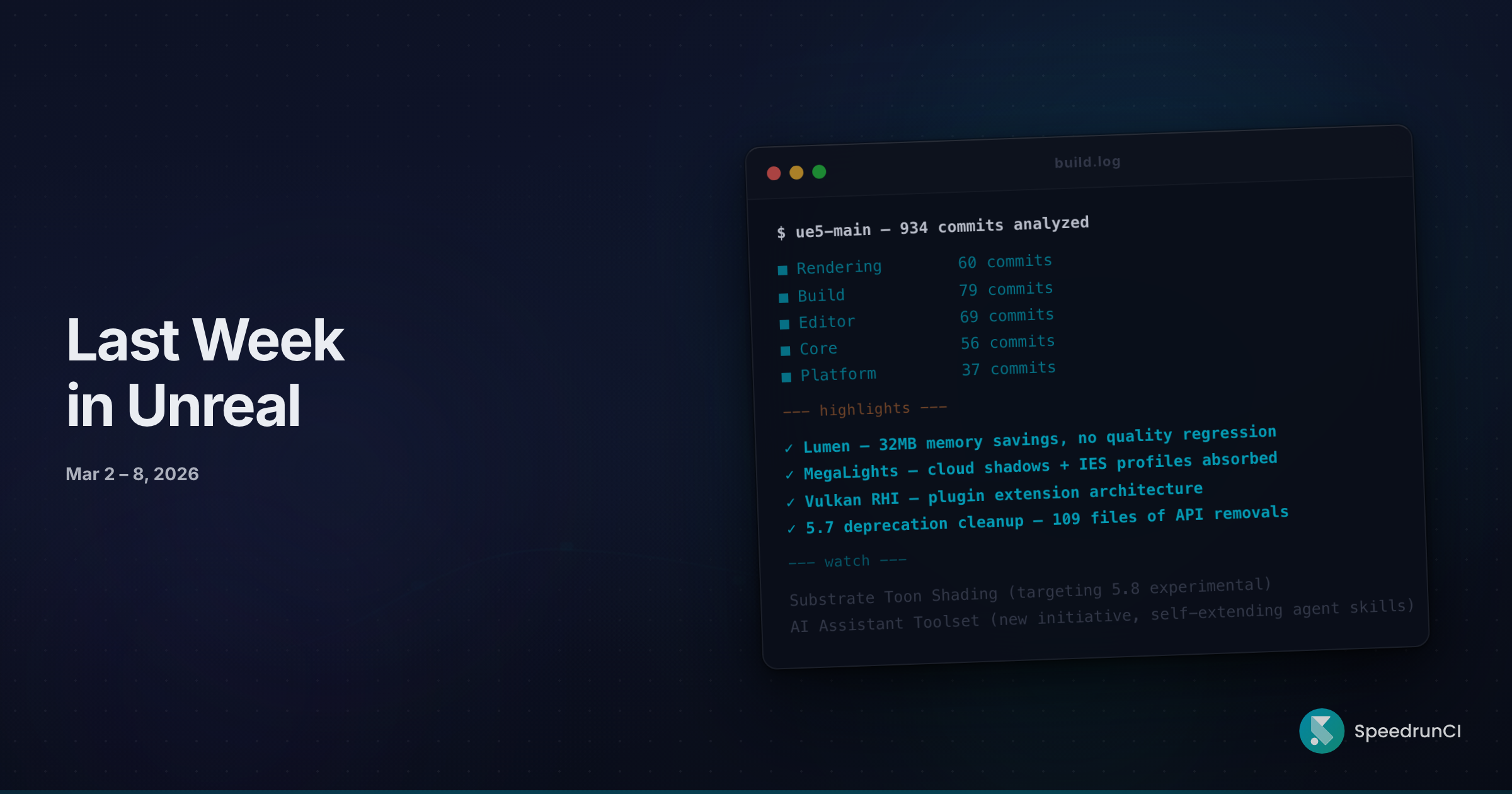
Last Week in Unreal — Mar 2 – 8, 2026
Unreal Engine Weekly — What Changed and What Matters
Week of March 2-8, 2026 | 934 commits analyzed | Branch: ue5-main
Overview
A rendering-heavy week. Lumen shed 32MB of memory overhead across two targeted optimizations, MegaLights absorbed cloud shadows and IES profiles, and the path tracer picked up visibility flags and volume preshading that signal active cinematic production use. On the platform side, Vulkan’s extension system got a proper plugin architecture, and mobile teams landed real crash fixes for Adreno 8xx and iOS remote builds. The 5.7 deprecation train is now in motion — 109 files of legacy API removals landed in Core and CoreUObject. If you have a C++ plugin, this is your warning.
Development Trends
Multi-week patterns from 7 weeks of commit data (Feb 8 – Mar 8, 2026).
MegaLights: From Instrumentation to Feature-Complete Lighting Default
Pattern: MegaLights appears in 5 consecutive weeks (Feb 8 through Mar 8). Week of Feb 8: hardening. Feb 16: instrumented for production. Feb 23: front layer translucency. Mar 1: stability hardening alongside Lumen. Mar 8: cloud shadows and IES profiles absorbed. Each week adds a different capability class — stability, then profiling, then feature coverage.
Interpretation: This is not maintenance. Epic is systematically filling the feature matrix required to make MegaLights the default lighting path. The progression from instrumentation (Feb 16) to absorbing cloud shadows and IES (Mar 8) follows a classic “stabilize, measure, extend” cadence. Expect MegaLights to be the recommended default in 5.8 or shortly after.
Who cares: Graphics engineers evaluating lighting pipelines, technical artists managing lighting complexity, anyone still using legacy light sampling paths.
Signal strength: Strong
Lumen Optimization Is a Sustained Initiative, Not a One-Off
Pattern: Lumen appears in 4 of 7 weeks. Feb 16: memory optimization mentioned. Mar 1: “stability hardening.” Mar 8: 32MB memory savings via surface cache opacity removal and radiosity atlas reduction. Rendering subsystem remains stable at 60–90 commits/week throughout, meaning this work is happening within a consistent resource allocation, not a spike.
Interpretation: The memory-focused optimizations suggest Lumen is being prepared for tighter memory budgets — likely console certification or next-gen mobile. The fact that rendering commit volume is stable while Lumen keeps showing up means dedicated engineers are assigned to this, not drive-by fixes. The 32MB savings this week with no quality regression is the kind of result that comes from weeks of profiling.
Who cares: Console teams budgeting GPU memory, teams shipping Lumen on mid-spec hardware, anyone tracking Lumen’s viability for their target platform.
Signal strength: Strong
Build and Platform Subsystems Rising in Tandem — 5.7/5.8 Release Preparation
Pattern: Build subsystem rising: 61 → 115 → 76 → 80 → 66 → 67 → 79. Platform rising: 24 → 36 → 32 → 32 → 30 → 30 → 37. Both trended up from their baselines and remain elevated. Correlated themes: ARM64/ARM64EC (weeks of Mar 1, Feb 8), 5.7 deprecation cleanup (109 files, Mar 8), iOS/Android tooling (Feb 23, Mar 8), Xbox GDK going public (Feb 23), UHT codegen consolidation (Mar 1).
Interpretation: Coordinated build + platform activity is the signature of release branch preparation. The deprecation cleanup removing 5.4-era APIs, the platform-specific crash fixes, and the build tooling improvements are all things that happen in the 2–3 months before a release branch cut. The ARM64EC work specifically points to Windows on ARM becoming a first-class target for 5.8.
Who cares: Plugin and middleware developers (deprecation breaks are live now), platform teams targeting ARM64 or mobile, anyone planning around 5.7/5.8 release timing.
Signal strength: Strong
AI Assistant Toolset: New Initiative With No Prior History
Pattern: “AI Assistant Infrastructure” appears for the first time in the Mar 8 week. No AI-related themes in any of the prior 6 weeks. The work includes main-thread dispatch, toolset registry, FProperty-to-JSON conversion, and self-extending agent skills — this is not a prototype commit, it is architectural.
Interpretation: This is a cold start of a new initiative landing on ue5-main. The architecture choices (modular converters, safe C++ execution from LLM responses, runtime skill creation) indicate this was developed internally and is now being merged. The absence from prior weeks means either it was developed on a feature branch or in a separate repo. Given the industry trend and the maturity of the code, expect this to become a visible feature in 5.8 announcements.
Who cares: Tools programmers, editor extension developers, studios evaluating in-engine AI assistance, anyone building editor automation.
Signal strength: Early
TL;DR
- Lumen memory footprint dropped ~32MB by removing surface cache opacity and shrinking the radiosity atlas. No visible quality regression reported.
- Vulkan RHI now supports plugin-registered extensions via a new base class, with bindless-relevant extensions auto-loading. Custom Vulkan plugin developers should review.
- 5.7 deprecation cleanup is live on ue5-main. Deprecated APIs from 5.4-5.5 are gone from Core/CoreUObject. Plugin and middleware code targeting 5.7+ needs updating now.
- Adreno 8xx GPU crash fixed by disabling DualSrc blending on Android Vulkan. Ship-blocking if you’re testing on that hardware.
Rendering Performance
Lumen Gets Leaner
What changed. Two optimizations from Krzysztof Narkowicz: surface cache opacity was removed entirely (27 files), saving 16MB and eliminating shader permutations, and the radiosity accumulated atlas was reduced to one texel per card tile, saving another ~16MB. The reflection denoiser’s spatial filter was also updated to reduce disoccluded artifacts.
Why this is important. 32MB of memory savings with no quality regression is the kind of optimization that compounds. Fewer shader permutations also means faster shader compilation, which matters for iteration time and first-run experience. On console and mid-spec PC where Lumen’s memory footprint is a real constraint, this is material.
Who should care. Graphics engineers, anyone shipping Lumen on console or memory-constrained hardware.
Urgency. Track. No action required, but worth noting if you’re budgeting GPU memory.
MegaLights Absorbs Cloud Shadows and IES Profiles
What changed. MegaLights gained cloud shadow support across its sampling, shading, and light complexity paths (13 files). IES profile evaluation was added for volumetric fog and translucency, with zero performance cost when profiles are unused.
Why this is important. MegaLights continues to consolidate functionality that previously required separate rendering paths. The direction is clear: this is being positioned as the default lighting solution. Each integration reduces the number of special cases teams need to manage.
Who should care. Graphics engineers, technical artists working with volumetric lighting and atmospheric effects.
Urgency. Track.
Path Tracer Moves Toward Production
What changed. The “Visible in Reflections” primitive flag — previously ignored by the path tracer — now works (8 shader files). Heterogeneous volume preshading via callable shaders landed (18 files), and the 3rd dimension of the random sequence was optimized for convergence.
Why this is important. The visibility flag was simply missing, which means production teams were hitting this limitation. The volume preshading work and convergence optimization suggest the path tracer is being driven by real cinematic or archviz production needs, not speculative development.
Who should care. Cinematic and archviz teams using path tracing in production.
Urgency. Track.
Platform RHI
Vulkan Gets a Plugin Extension Architecture
What changed. A multi-commit series restructured how Vulkan extensions are initialized, queried, and managed. The key addition is FVulkanRHIExternalDeviceExtensionBase, a base class that lets plugins register their own Vulkan extensions with typed feature and property structs. VK_KHR_shader_untyped_pointers and VK_EXT_descriptor_heap now auto-load. VkMemoryPropertyFlags is exposed through the allocation info API.
Why this is important. This is the foundation for a modular Vulkan runtime. The auto-loaded extensions are significant for bindless rendering. If you maintain custom Vulkan extensions or XR plugins, the new base class changes how you integrate.
Who should care. Graphics engineers, XR platform teams, custom render plugin developers.
Urgency. Review now if you maintain custom Vulkan extensions. The integration point has changed.
Mobile Platform Fixes
What changed. DualSrc blending disabled on Android Vulkan for Adreno 8xx to prevent a real GPU crash. Android memory-mapping robustness improved. Multiple iOS remote build and packaging fixes landed, including a blueprint-only TestFlight upload fix. macOS universal builds now default to “universal” instead of “all.”
Who should care. Mobile platform teams, anyone shipping on Adreno 8xx or using remote Mac builds for iOS.
Urgency. Act now if you’re testing on Adreno 8xx or relying on iOS remote builds.
Engine Build
5.7 Deprecation Cleanup Is Live
What changed. All “trivial” deprecations from 5.4-5.6 were removed from Core and CoreUObject (109 files, validated against Lyra BuildCookRun). FField::FlagsPrivate was deprecated and stripped across 76 files including Python bindings. UBT’s lowest supported EngineIncludeOrderVersion bumped to 5.6, and 5.8 deprecation markers were added.
Why this is important. This is not a warning — these APIs are gone on ue5-main. Plugin developers, middleware vendors, and game teams with C++ code targeting 5.7 need to audit their codebases. The scope (109 files of Core/CoreUObject changes) means this touches nearly everyone.
Who should care. Every team with C++ code. Plugin and middleware developers especially.
Urgency. Act now if targeting 5.7+.
Async Package Loading Optimization
What changed. Hash indices are now cached to avoid redundant binary searches, and only RF_Public exports are hashed. This was backed out and resubmitted — significant enough to fix twice.
Why this is important. Reduces load times for world partition and heavy external actor setups. The back-out-and-resubmit pattern suggests it hit a real regression that was worth fixing properly rather than abandoning.
Who should care. Teams with large open worlds or heavy streaming.
Urgency. Track.
Stability
Several thread-safety and crash fixes surfaced from the low-interest tier that deserve mention:
- PixelStreaming2 deadlock fix — a real crash in production streaming setups.
- TSAN-flagged streaming race conditions addressed.
- FastGeo thread safety in async render state creation.
- Missing physics scene lock — a race condition in Chaos.
- Control Rig instance pool crash and a use-after-free in async shader compilation both fixed.
r.SkipRedundantTransformUpdatedeprecated after ASAN caught issues.
No single item here is a headline, but the pattern shows active sanitizer-driven stability work across the engine.
Worth Tracking
Substrate Toon Shading Maturing Toward 5.8
Four commits landed for Substrate-Toon: VSM transmittance shadow support, unified diffuse ramp, and shadow fixes, alongside explicit 5.8 experimental tagging. The hard problem here is making NPR shading work with shadow maps designed for PBR. Worth watching if your project has any interest in stylized rendering on Substrate.
AI Assistant Infrastructure
The in-editor AI Assistant plugin is getting serious toolset infrastructure: a RunOnMainThread utility for safe C++ execution from LLM responses, a restructured toolset registry, FProperty-to-JSON conversion for external plugins, and — notably — tools that let the LLM create and update “agent skills” at runtime. The architecture (modular converters, main-thread dispatch, self-extending capabilities) is designed for production use, not prototyping.
What We Ignored
934 commits is a lot. Here is what we intentionally skipped:
- Mutable/CustomizableObject (20+ commits) — heavy character customization churn, mostly internal iteration.
- AnimNext/UAF (20+ commits) — the most active area by commit count, but still early next-gen animation runtime work.
- Cameras/GPC system (15+ commits) — new camera system being built out, too early to evaluate.
- StateTree (12+ commits) — parallel events, property bags, compilation improvements. Incremental.
- TEDS Outliner (8 commits) — the scene outliner replacement. Progressing but not yet impactful.
- Horde CI/CD (15+ commits) — internal build infrastructure.
- Composure VFX (5 commits) — compositing plugin work.
- RemoteObjects (5 commits) — crash prevention and replication readiness, likely stress-tested against large-scale distributed gameplay.
- Chaos Async Physics — new ShapeInstance abstraction with sphere/box support. Architecture is extensible but still limited in shape coverage.
Closing
This was a week where the rendering team delivered measurable wins — 32MB off Lumen, MegaLights gaining feature coverage, path tracer gaps filled. The Vulkan extension architecture is the kind of infrastructural change that enables an ecosystem. And the deprecation cleanup is a clear signal: 5.7 is being actively prepared, and backward compatibility with 5.4-era APIs is over. If you have not audited your C++ code against current ue5-main, this is the week to start.
Never miss a ue5-main update.
Get them delivered straight to your inbox.