Last Week in Unreal — Mar 16 – 22, 2026
Unreal Engine Weekly — What Changed and What Matters
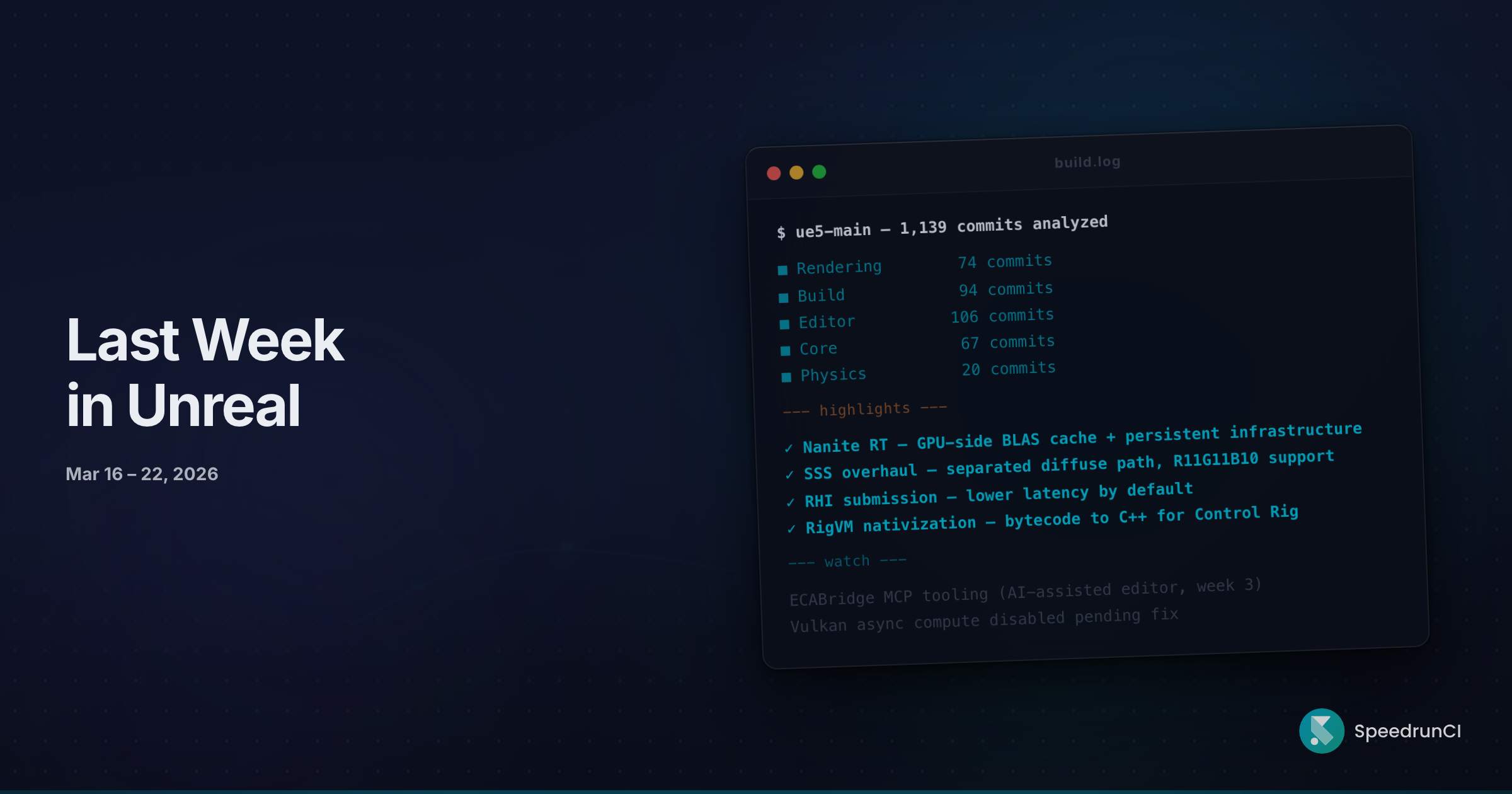
Week of March 16–22, 2026 | 1,139 commits analyzed | Branch: ue5-main
Overview
A rendering-heavy week. Nanite ray tracing got persistent GPU-side infrastructure that points toward fully GPU-driven acceleration structures. Subsurface scattering was restructured in a way that matters for anyone doing skin rendering or targeting tight render target budgets. The RHI submission pipeline was reworked to reduce GPU latency. And quietly, the RigVM nativization system landed — bytecode-to-C++ code generation for Control Rig — which could meaningfully change the cost equation for studios running dozens of character rigs.
Outside rendering, the build system got targeted fixes for real problems (a thread-safety bug causing intermittent dSYM failures on Mac, FMA numerical divergence on Clang/Windows), and a cluster of MCP tooling commits shows Epic continuing to build first-party infrastructure for AI-assisted editor workflows.
Development Trends
MegaLights: Nine Consecutive Weeks Toward Becoming the Default Lighting Path
Pattern: MegaLights appears as a named theme in every single week from Feb 2 through Mar 22 — nine weeks running. The progression is methodical: hardening, production instrumentation, front layer translucency, stability hardening, cloud shadows and IES profile absorption, stochastic denoiser improvements, and this week — denoiser temporal refinement, GBuffer optimization saving 0.03ms on console, and a specular-only front layer translucency scalability option dropping cost by 27% in glass-heavy scenes. Each week adds a different capability class: first stability, then instrumentation, then feature coverage, then performance polish.
Interpretation: The shift from feature addition (cloud shadows, IES, translucency) to performance micro-optimization (0.03ms GBuffer saves, specular-only cost reduction) suggests the feature matrix is largely complete and the team is now tuning for production frame budgets. MegaLights appears likely to become the recommended lighting default in 5.8.
Who cares: Lighting artists and graphics engineers evaluating dynamic lighting pipelines. Studios still on legacy light sampling paths should be planning migration timelines. Console teams should track the per-frame cost reductions — the compound savings are becoming material.
Signal strength: Strong
Nanite Ray Tracing: From Crash Fixes to GPU-Driven Architecture in Six Weeks
Pattern: Nanite RT appears as a named theme in 5 of the last 8 weeks with a clear progression. Feb 9-16: crash fixes and memory safety. Feb 23-Mar 1: reference instance concept for BLAS streaming, API stabilization. Mar 16-22: GPU-side BLAS cache and persistent SegmentMappingBuffer — infrastructure for fully GPU-driven acceleration structure management. The work has moved from “make it not crash” to “make the GPU manage its own acceleration structures.”
Interpretation: This trajectory suggests Nanite RT is being prepared for production deployment. The GPU-side BLAS cache — where the GPU determines cache hits and skips rebuilds for stable geometry — is the architectural payoff that the earlier crash fixes and streaming work enabled. This points to Nanite RT becoming viable for shipping titles with stable scene geometry.
Who cares: Graphics engineers evaluating HWRT with Nanite for shipping titles. Studios doing archviz or open-world games with large static geometry counts.
Signal strength: Strong
AI-Assisted Editor Tooling: From Cold Start to Sustained Investment in Three Weeks
Pattern: No AI-related themes appear in the first 5 weeks of the dataset. “AI Assistant Infrastructure” appears for the first time on Mar 2-8 with architectural commits: main-thread dispatch, toolset registry, FProperty-to-JSON conversion. Mar 9-15 brings “Programmatic Toolset Infrastructure” with 14+ commits covering Blueprint, data table, material, static mesh, texture, and scene primitive automation. This week, ECABridge MCP tooling adds 5 structured read tools for live editor state. Editor subsystem commits are at 110 and 106 the last two weeks — the two highest readings in the 8-week window.
Interpretation: Three consecutive weeks of coordinated investment across a deterministic programmatic API (EDA) and an AI-agent layer (MCP tooling) is no longer an experiment. The architecture choices are production-grade: modular converters, safe C++ execution from LLM responses, structured read access to live editor state. This appears to be a coordinated initiative to make the Unreal Editor AI-addressable.
Who cares: Tools programmers, editor extension developers, technical artists building automation. Studios evaluating in-engine AI assistance. Anyone building editor scripting or CI/CD pipelines that interact with editor state.
Signal strength: Moderate (sustained but only 3 weeks of data)
Core Runtime Modernization: Memory, Loading, and GC Infrastructure Under Active Revision
Pattern: Core subsystem commits rose from 50 to 75 over the last 8 weeks — a 50% increase. The work is unusually coherent: MallocBinned3 as default Windows allocator, deferred GC timing changes, async SavePackage, RF_Public flag removal for runtime entities, movement base abstraction, asset registry memory optimization, delegate lifetime tracking overhaul, async package loading optimization. Build subsystem has remained elevated at 66-115 commits/week throughout, with IoStore consolidation this week and aggressive 5.7 deprecation cleanup removing 109 files of legacy APIs.
Interpretation: Epic is systematically reworking Unreal’s runtime foundation — memory allocation, garbage collection timing, asset loading, and object lifetime management — in a way that suggests preparation for large open worlds with heavy streaming. Combined with the aggressive deprecation cleanup, this looks like a concerted effort to modernize the runtime for 5.8 while shedding technical debt.
Who cares: Engine programmers, anyone with custom memory allocators or GC-sensitive gameplay code. Plugin and middleware developers — backward compatibility with 5.4-era APIs is ending. Open world teams should benchmark the MallocBinned3 and async loading changes.
Signal strength: Strong
TL;DR
- Nanite ray tracing now has a GPU-side BLAS cache and persistent segment mapping — infrastructure for GPU-driven acceleration structure management
- Subsurface scattering reworked to separate diffuse luminance into a dedicated texture, enabling RGB-only SceneColor formats and fixing specular error amplification
- RHI submission pipeline delivers completed command lists immediately instead of batching, reducing GPU latency
- RigVM nativization converts Control Rig bytecode to C++ — meaningful for animation-heavy projects
- Thread-safety fix for Mac dSYM generation and FMA divergence fix for Clang/Windows are act-now items for build engineers
Highlights
Nanite Ray Tracing Infrastructure
What changed. A GPU-side BLAS cache for Nanite ray tracing determines cache hits and updates on the GPU itself, keyed by cut-of-tree reference errors. Separately, the SegmentMappingBuffer was refactored from per-frame to persistent allocation — a prerequisite for GPU-driven CLAS builds. Stability fixes round this out: a crash fix for skeletal mesh LOD/RayTracingGeometry mismatches and a thread-safety fix in geometry collections.
Why this is important. These aren’t independent fixes. Together they’re building toward fully GPU-driven acceleration structure management for Nanite meshes. The BLAS cache means RT performance should improve substantially in scenes with stable geometry, because the GPU can skip rebuilds when reference errors haven’t changed. The persistent SegmentMappingBuffer removes per-frame allocation overhead that would block GPU-driven CLAS builds.
Who should care. Graphics engineers shipping HWRT titles with Nanite. Tech artists evaluating whether Nanite + ray tracing is production-ready for their project.
Urgency. Track. This is infrastructure, not something you integrate piecemeal. But the trajectory is clear.
Subsurface Scattering Overhaul
What changed. Two commits restructured how SSS handles diffuse/specular separation. A new dedicated R16F texture path decouples subsurface diffuse luminance from SceneColor.a, enabling RGB-only SceneColor formats (R11G11B10) without checkerboard workarounds. A second commit fixes error amplification by storing specular luminance instead of diffuse luminance, shifting numerical bias to a perceptually invisible region. New CVars control this per-platform (r.SSS.SeparatedDiffuse.Supported) and at runtime (r.SSS.SeparatedDiffuse.Enable). The changes touch every major lighting pass — deferred, clustered, ambient cubemap, reflections, MegaLights spatial — for MRT output.
Why this is important. Two wins in one. First: projects pushing skin rendering quality get cleaner specular-to-diffuse separation with less error. Second: projects targeting tight memory budgets (console, mobile) can now use RGB-only SceneColor formats without compromising SSS quality. The subsurface diffuse path also becomes a texture clear instead of a SceneColor read — a small but free performance win.
Who should care. Graphics programmers. Character artists doing realistic skin. Console teams looking to reduce render target memory.
Urgency. Track. Worth evaluating on your next integration, especially if you’re on R11G11B10 or considering it.
RHI Submission Pipeline Rework
What changed. Completed command lists now reach the platform RHI immediately after finalization, rather than batching until an explicit flush on the render thread. The new default (r.RHICmd.ParallelTranslate.BatchSubmissions=false) uses linked-list submit tasks to deliver translate chains to the RHI as they complete. A new “RenderTrace” Insights channel records command list recording, submission, and queue processing — initially instrumented for D3D12 — with tail-buffer recording that can attach to crash reports. A separate change adds prerequisite task support for AddDispatchPass, enabling sub-tasks to reference RDG resources for tighter parallelism.
Why this is important. Lower GPU latency by default, and better tools to diagnose when things go wrong. The RenderTrace channel is the kind of infrastructure that makes GPU hang debugging less painful — trace data attached to crash reports means you can see what the GPU was doing when it died, not just what the CPU was submitting.
Who should care. Engine programmers doing RHI-level optimization. Anyone debugging GPU hangs or stalls.
Urgency. Track. The default changed, so test your existing workloads. The CVar is there to revert if needed.
MegaLights Polish
What changed. The denoiser’s temporal filter now works with non-downsampled neighborhoods, uses soft neighborhood clamping, and remaps shading confidence non-linearly to max accumulated frames — better shadow retention during camera and object motion. GBuffer loading was optimized for simple shading tiles (unlit/default lit), saving 0.03ms on console at 1080p. Specular-only front layer translucency landed as a scalability option (r.MegaLights.FrontLayerTranslucency.SpecularOnly), dropping cost from 1.75ms to 1.28ms in a glass-heavy scene — a 27% reduction.
Why this is important. MegaLights continues its steady march from “interesting experiment” to “production-viable.” None of these changes are individually dramatic, but the pattern is consistent: every week brings measurable improvements in either quality or performance. The front layer translucency scalability option is particularly useful — glass-heavy scenes were one of MegaLights’ weak spots.
Who should care. Teams evaluating or already using MegaLights.
Urgency. Low. Free improvements. Pull them in at your convenience.
RigVM Nativization
What changed. A new nativization system converts RigVM bytecode into C++ source code through a Bytecode-to-JSON-to-Inja-template pipeline. The 14-step bytecode parsing handles external variables, memory layouts, callables, control flow, and dependency tracking. Editor integration includes execution stack view support in both ControlRigEditor and RigVMEditor.
Why this is important. Control Rig evaluation is interpreted bytecode at runtime. For studios running dozens of character rigs — crowds, cinematics, multiplayer — that interpretation overhead adds up. Nativization converts it to compiled C++, which should meaningfully reduce animation evaluation cost. This is the same pattern as Blueprint nativization, applied to the animation system.
Who should care. Animation programmers. TA teams with heavy Control Rig usage. Anyone doing crowds or character-heavy scenes where animation evaluation is a measurable cost.
Urgency. Track. This is new infrastructure. Evaluate it once it stabilizes, don’t rush to adopt.
Build System Fixes
What changed. A thread-safety bug in MacToolChain.DebugInfoFiles — a List<FileItem> mutated from a parallel for-each, causing intermittent dSYM generation failures. FMA contraction disabled under Clang on Windows when using FPSemanticsMode.Precise, fixing numerical divergence that varied depending on hardware FMA support. MSVC toolchain version checks for precompiled modules and Win64 2022 toolchain support. IoStore OnDemand settings consolidated into a proper class with a new --ForceOnDemandAssets list. A circular dependency in Horde’s DI container that caused server startup hangs was fixed.
Why this is important. The dSYM thread-safety bug is a classic concurrent collection mutation — if you’ve been seeing intermittent dSYM failures on Mac CI, this is almost certainly your root cause. The FMA fix matters for anyone doing precise floating-point work (deterministic simulation, replay systems) on Clang/Windows — you may have been getting different results depending on whether the hardware had FMA instructions.
Who should care. Build engineers. CI/CD teams. Cross-platform shipping teams. Anyone doing deterministic simulation on Clang/Windows.
Urgency. Act now for the dSYM and FMA fixes. These are the kind of bugs that waste hours of debugging time because they’re intermittent.
Stability Fixes Worth Noting
A batch of crash and memory-safety fixes that didn’t fit neatly into themes but warrant attention:
- Double-delete in gameplay container — memory safety issue in a core gameplay system
- Null deref when async PSO compilation is disabled — crash in the rendering path
- WorldPartition actor removal during FlushAsyncLoading — crash/corruption in async streaming
- Missing CachedExpressionData on MaterialInstanceDynamics during cooking — cook crash
- Race condition in Streamables/JITAsyncLoader — core asset loading race
- Audio device swap deadlock — deadlock between StopGeneratingAudio and FAudioRenderScheduler during WASAPI/XAudio2 device swaps
- Linked anim layer crash during Blueprint reinstancing — latent crasher with Blueprint dependencies
- Two race conditions in async world partition streaming — fixed separately
- AutoRTFM transactional capture crash during commit — Verse runtime stability
Urgency. Scan this list against your workflows. The WorldPartition and asset loading fixes matter most for open world projects. The audio deadlock fix matters if you’ve seen hangs during device swaps (headphone plug/unplug).
Worth Tracking
ECABridge MCP tooling for live editor inspection. Five commits added Model Context Protocol tools to the ECABridge system: get_cvar, get_viewmodel_values, list_live_viewmodels, run_console_command, and diff_widget_blueprint. MCP is the protocol that lets external AI agents interact with a running application. This is Epic building structured read access to live editor state for AI workflows — not debug utilities, but infrastructure. Combined with last week’s programmatic toolset commits, the pattern is unmistakable: Epic is investing seriously in AI-assisted editor tooling.
Vulkan async compute disabled. Async compute on Vulkan has been disabled pending a parallel render pass fix. This can silently regress GPU performance on Linux, Android, and Steam Deck. If you’re targeting those platforms and relying on async compute overlap, test carefully after integrating.
What We Ignored
Roughly 900 commits were filtered as routine or low-signal. Major categories: UBA (Unreal Build Accelerator) received ~25 commits of internal distributed build infrastructure. USD/Interchange got 10+ commits maturing the VFX/virtual production pipeline. AutoRTFM had 7+ commits hardening Verse transactional memory. Horde build system maintenance (~10 commits). FastGeo work for HLODs and procedural ISM (6+ commits). AnimGen/LearningCore ML-based animation generation. Editor Utility Dialog system for Blutility modal dialogs (useful for non-C++ tool developers, but too early to editorialize). Instanced Skinned Mesh Component dropping its experimental tag. Chaos multithreading changes to task-spawning thresholds. Reflection capture editing optimization (60ms down to 2ms for transforms). Shader library lock contention reduction. Include-what-you-use cleanup yielding ~10% TU size reduction and ~13% compilation time improvement in non-unity builds. Oodle 2.9.16 enablement. Pixel Streaming and RemoteSession fixes.
Closing
A week where rendering infrastructure took center stage. The Nanite RT and SSS work represents meaningful architectural investment, not incremental polish. The RigVM nativization system is the kind of change that doesn’t make headlines but could quietly save significant frame time for animation-heavy projects. And the MCP tooling commits, now appearing for consecutive weeks, are starting to look less like an experiment and more like a roadmap.
Never miss a ue5-main update.
Get them delivered straight to your inbox.