Last Week in Unreal: June 8 to 14, 2026
Unreal Engine Weekly: What Changed and What Matters
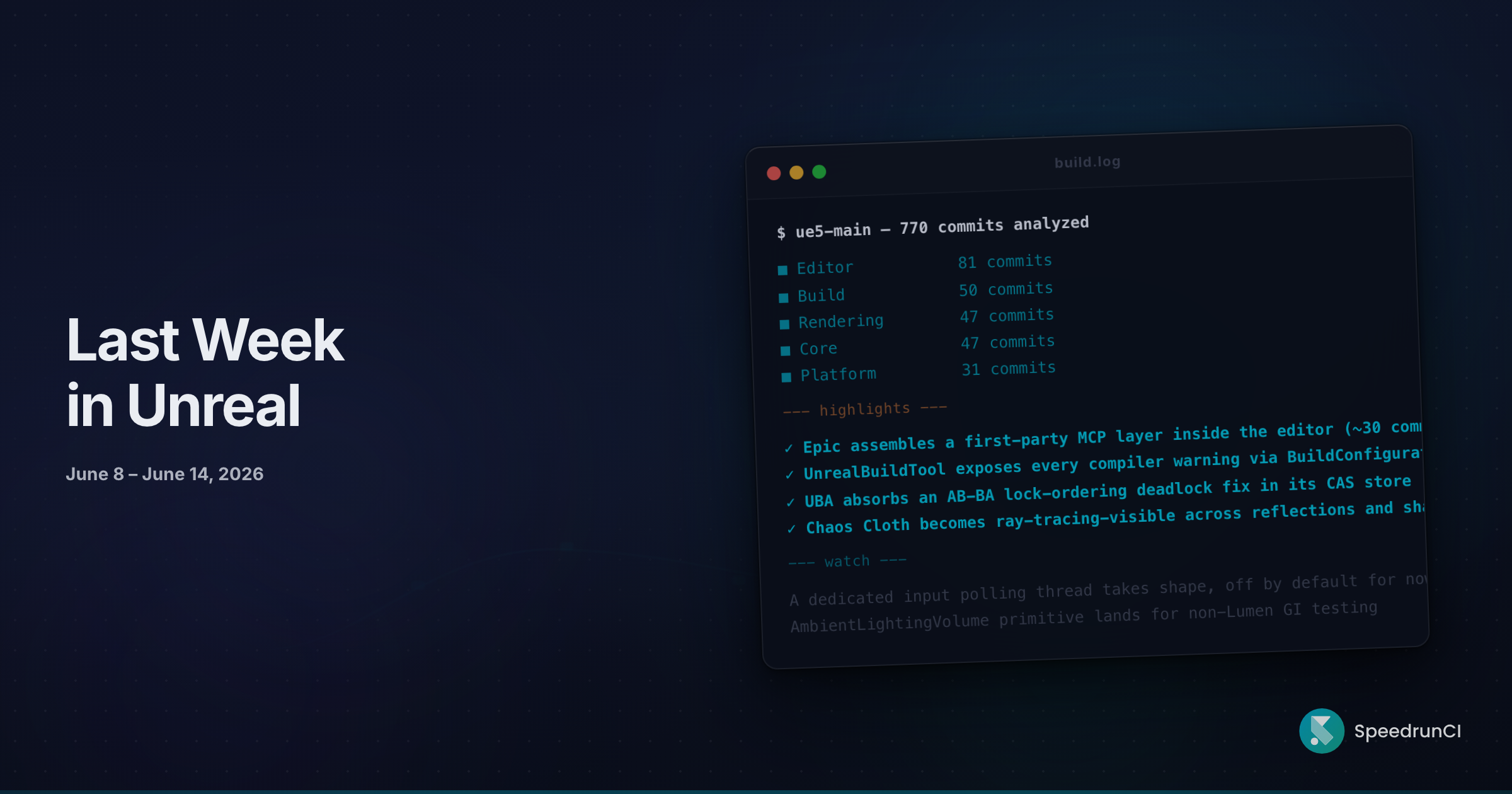
Week of June 8 to 14, 2026 | 770 commits analyzed | Branch: ue5-main
Overview
This was an infrastructure week, dominated by two themes: Epic building first-party agentic tooling into the editor, and a broad cleanup of the build system. There was no flagship rendering feature, but several quiet correctness fixes in the distributed-build path are more consequential than they look. The 22 backout commits and an active mix of gameplay-systems work suggest a week of churn rather than a clean landing.
Development Trends
Editor AI Tooling: From AI Assistant to First-Party MCP Platform
Pattern: This is the fifteenth consecutive week of editor-AI work, and the first where it shows up as a named editorial theme on its own (“AI & Editor Tooling”). The editor subsystem reversed its multi-week slide, jumping from 40 to 81 commits week-over-week, largely on the back of roughly 30 commits across the Model Context Protocol and editor-toolset layer: MCP servers with stdio transport, an asset-tools layer that now resolves Unreal virtual paths, a CheatsToolset plugin, EditorAppToolset tools, per-toolset analytics with tool-hash mapping, a UnrealConsole -mcp mode, and a pre-release “Unreal Toolbox” app. The AI-in-editor theme also appeared in the Apr 13 and Apr 27 weeks; the line back to the original AI Assistant work is unbroken.
Interpretation: Epic appears to be productizing LLM-driven editor automation as first-party infrastructure rather than an experiment. Prior weeks were about wiring the AI Assistant into Python and Blueprints. This week the energy moved to a standalone MCP layer with its own transport, analytics, and an external app. The path-resolution and snap-to-ground hardening suggest it is being tested against real editor behavior, not just demoed. Shipping an external Toolbox app on a pre-release channel is how you start preparing something for distribution.
Who cares: Tools teams, technical artists, studios evaluating in-editor automation, and anyone building their own MCP integrations against the editor.
Signal strength: Strong. 15 weeks of continuity, with a clear escalation in scope this week.
Build Infrastructure: Quiet Post-Cut Hardening Continues
Pattern: Build commits fell again, from 66 to 50, the lowest in the tracked eight-week window and a long way down from the 251 peak the week of May 17. But the character is consistent with the last several weeks: not features, but correctness and policy. UnrealBuildTool gained a full per-toolchain, per-warning control surface in BuildConfiguration.xml; UBA absorbed an AB-BA lock-ordering deadlock fix in its CAS store; and Epic reverted a prior merged-modules “faster build times” change in favor of serial DLL linking. This extends the build infrastructure trend to roughly nineteen weeks.
Interpretation: Falling volume alongside continued reliability work fits a branch that has already been cut and is now being made reproducible and safe to build at scale. The merged-module revert quietly admits that path had problems. The UBA deadlock fix likely resolves intermittent hangs that distributed-build teams had written off as flaky infrastructure.
Who cares: Build engineers, CI compile-config owners, warnings-as-errors teams, and anyone running UBA at scale.
Signal strength: Strong. Sustained for about 19 weeks, now firmly in low-volume polish mode.
Ray Tracing Productionization: Cross-Vendor and Cross-Renderer Reach
Pattern: Sixteenth week of the ray-tracing modernization arc. Last week removed the r.RayTracing.EnableOnDemand cvar (RT default-on); this week the work pushed outward in two directions. Chaos Cloth components became ray-tracing-visible, so simulated cloth now contributes to RT reflections, RT shadows, and Lumen HWRT, closing a known gap. And NVIDIA shader-extension headers were made SPIR-V-safe with platforms now able to inject their own RT hit-group functions, plus Opacity Micromap support landed as “Part 1” in the D3D12 RHI.
Interpretation: After promoting on-demand RT to always-on last week, the effort this week is about reach: making HWRT portable beyond NVIDIA and D3D12 (the SPIR-V and hit-group injection work) and pulling more of the scene into the RT path (cloth). This is consistent with treating RT as production infrastructure rather than a high-end opt-in. Opacity Micromaps remain early.
Who cares: Graphics engineers shipping HWRT, multi-platform teams on Vulkan/SPIR-V, and teams with dynamic cloth in RT scenes.
Signal strength: Strong. 16 weeks, though this week’s RT volume is moderate.
Pre-Release Stability Sweep: Steady Crash Hardening Amid Churn
Pattern: Thirteenth week of the named stability theme. A run of genuine crash and safety fixes landed across gameplay and media systems (skin-weight slider, Mass representation traits, StateTree transition null deref, LearningAgents NaN assertion, Media IO interlace switch, PRT NaN/Inf JSON export), plus two thread-safety fixes and two OpenXR swapchain crash fixes. Set against 22 backout commits this week, the picture is a release line still working through instability rather than a clean landing.
Interpretation: The fixes cluster around active gameplay-systems work (Mass, StateTree, Mover), which suggests those systems are getting attention and a steadier base at the same time. The 22 backouts are the counter-signal: this was a churny week, not a settled one. Consistent with a maturing release line that is still absorbing change.
Who cares: Teams on Mass, StateTree, Mover, LearningAgents, Media IO, or OpenXR; anyone tracking ue5-main stability before upgrading.
Signal strength: Strong on continuity (13 weeks), moderate on this week’s specific intensity.
TL;DR
- Epic is assembling a real Model Context Protocol (MCP) layer inside the editor, around 30 commits across MCP servers, asset tools, a CheatsToolset, an “Unreal Toolbox” app, and per-toolset analytics. This is first-party LLM-driven editor automation, and the velocity says it has moved past prototype.
- UnrealBuildTool gained a full compiler-warnings control surface in BuildConfiguration.xml (per-toolchain, per-warning), and UBA absorbed an AB-BA lock-ordering deadlock fix in its CAS store, plus a revert of the merged-module link path. If you run distributed builds at scale, this is the most actionable group of the week.
- Nothing this week forces an upgrade. The MCP direction is the thing to watch; the build fixes are the thing to act on if they touch you.
Highlights
🔥 Rendering & Performance
What changed: Substrate Toon shading continued to be built out: matching toon shadow and transmittance across CSM and VSM, streaming-aware ToonProfile textures, cubemap and matcap support, and baking indirect specular into a LUT. A first-pass AmbientLightingVolume system also landed (new shaders, a component visualizer), a tiled-culled ambient lighting primitive that currently only affects diffuse on the non-Lumen path and is explicitly marked for testing. On the ray tracing side, Chaos Cloth components became ray-tracing-visible, so simulated cloth now contributes to RT reflections, RT shadows, and Lumen HWRT. Opacity Micromap support landed as “Part 1” in the D3D12 RHI, and NVIDIA shader-extension headers were made SPIR-V-safe with platforms now able to inject their own RT hit-group functions. Lumen irradiance-field clipmaps bumped to six.
Why this is important: The Substrate Toon work confirms NPR and stylized rendering as a first-class Substrate target rather than a side path. AmbientLightingVolume is an early-experimental signal of where mobile and non-Lumen GI is heading. The cloth RT change closes a known gap, since dynamic cloth was previously missing from RT scenes. (The cross-vendor RT story is covered in Development Trends above.)
Who should care: Graphics engineers shipping HWRT, multi-platform teams (especially Vulkan/SPIR-V), and anyone on stylized or NPR projects.
Urgency: Track. AmbientLightingVolume and Opacity Micromaps are early. The cloth RT change is low risk and worth picking up if you have cloth in RT scenes.
🔧 Build & Tooling
What changed: UnrealBuildTool now exposes every compiler warning through BuildConfiguration.xml and the command line. The monolithic warnings config was split into per-toolchain files (Clang, ClangVC, Intel, MSVC, Performance), replacing per-module flags with a single declarative surface. A header-units toggle was added to BuildConfiguration.xml, and an Intel-toolchain -Wno-error= token bug was fixed. New PreCleanSteps and PostCleanSteps hooks plus a -CleanGenerated flag improve CI build hygiene. On the distributed side, UBA absorbed a fix for an AB-BA lock-ordering deadlock in its CAS store (two locks taken in opposite order under heavy load), which had been surfacing as intermittent hangs on large UbaNinja builds. Epic also reverted a prior merged-modules “faster build times” change and forced merged-module DLL links to run serially.
Why this is important: The warnings overhaul gives build and CI teams one place to define a warnings policy instead of scattering flags across modules. The UBA deadlock fix likely explains hangs that have been written off as flaky infrastructure. And if you turned on merged modules for build speed, the revert is worth knowing about before you upgrade.
Who should care: Build engineers, CI compile-config owners, warnings-as-errors teams, and anyone running UBA or large distributed builds.
Urgency: Act now if you maintain a custom warning policy, a CI lint gate, or run UBA at scale. Track otherwise.
🤖 AI & Editor Tooling
What changed: Epic landed coherent work on an in-editor asset-tools layer driven by Model Context Protocol. Asset tools now resolve Unreal virtual paths (/Game/..., /PluginName/...) instead of mis-mapping to filesystem roots, gained a reload_asset tool, and actor placement got snap-to-ground robustness plus a “placement skill” that teaches the agent when to snap. Around that core, the surface accreted across many authors: a CheatsToolset plugin that lists and calls cheat-manager commands, EditorAppToolset tools for notifications, cached thumbnails and viewport show-flags, MCP client and proxy fixes, stdio transport for local MCP servers, an “Unreal Toolbox” app on a pre-release channel, per-toolset analytics with tool-hash mapping, and a UnrealConsole -mcp mode. Verse VM also renamed its llm_* metadata to ai_*.
Why this is important: The virtual-path resolution and snap-to-ground fixes are the practical part. They mean the agent now addresses assets and places actors the way a human tools engineer would, which is the difference between a demo and something a technical artist can actually drive. (For the multi-week direction read on this workstream, see Development Trends above.)
Who should care: Tools teams, technical artists, and anyone tracking Epic’s AI-in-editor direction.
Urgency: Track closely. Nothing to integrate yet, but this is the workstream most likely to change how editor automation looks in upcoming releases.
🛟 Stability & Fixes
What changed: A run of genuine crash and safety fixes landed across gameplay and media systems: a skin-weight slider crash on commit, a Mass representation-traits crash when no representation subsystem is present, a StateTree null deref in transition pin calculation, a LearningAgents NaN assertion in flow-matching inference, a Media IO assertion when switching interlace and progressive, and a PRT export change to write NaN/Inf as null instead of crashing on JSON export. Two thread-safety fixes also landed: Mover concurrency control over its Rollback Blackboard, and an input device hardware delegate now always executing on the game thread. Two OpenXR swapchain crash fixes and an AnimatorKit deformer race-condition fix round it out.
Why this is important: Each of these quietly removes a reproducible crash from production workflows. The Mass, StateTree, and Mover fixes cluster around active gameplay-systems work this week, so projects on those systems should expect a steadier base.
Who should care: Teams on Mass, StateTree, Mover, LearningAgents, Media IO, or OpenXR.
Urgency: Low. Pick these up on your normal integration cadence.
Worth Tracking
A dedicated input polling thread is taking shape but is off by default. Two commits plus a backout add an input.UseInputThread CVar and a dedicated thread for polling input devices, landing alongside work that removes the game-thread requirement on device connections and adds Unreal Insights CPU trace scopes to the input thread. Adding trace scopes means Epic plans to profile and tune this thread, not throw it away. That makes it a latency play. Watch whether the CVar default flips in a future release.
Two quieter items are worth a line each. A “progressive navdata” navigation cluster (background coverage scan plus per-tile state tracking) uses terms that are not standard shipped UE vocabulary, which suggests an in-progress streaming or adaptive navmesh system rather than maintenance. And the AI tooling trajectory above is the broader thing to keep an eye on: MCP, Unreal Toolbox, AI Assistant, and LearningAgents were all active in the same week, which reads as a sustained workstream rather than a one-off experiment.
What We Ignored
This week we ignored roughly 29 commits, mostly related to formatting, minor refactors, editor UI cleanups, and localization. Worth noting for context: the 22 backout commits this week are themselves a signal of an unstable stretch on ue5-main, and a cluster of around 20 “UAF” commits is Unreal Animation Framework work, not memory-safety fixes, despite the acronym.
Closing
No fireworks this week, but the build-system fixes will save someone a debugging afternoon, and the editor AI tooling is the trend worth reading early. We read every commit so you do not have to.
Commit References
| Claim | SHA |
|---|---|
| UBT exposes every compiler warning through BuildConfiguration.xml | 307800a2bc |
| CppCompileWarnings split into per-toolchain files | 4817a4124c |
Intel toolchain -Wno-error= token bug fixed |
80f9b021f0 |
| Header-units toggle added to BuildConfiguration.xml | 84c5d52c12 |
New PreCleanSteps/PostCleanSteps and -CleanGenerated flag |
72c2a68839 |
| UBA AB-BA lock-ordering deadlock fix in CAS store | 6507e24916 |
| Merged-modules “faster build times” change reverted | bf8f4b326d |
| Merged-module DLL links forced serial | 42984161ec |
| MCP asset tools resolve Unreal virtual paths | 90d4e4dc56 |
New reload_asset tool |
5083e1d6f0 |
| Actor placement snap-to-ground plus placement skill | bdc61f390c |
| MCP proxy fix (no longer consumes first HTTP entry) | 05ea622e69 |
| CheatsToolset plugin | 878e534437 |
| EditorAppToolset tools (notifications, thumbnails, show-flags) | 90d0fba561 |
| MCP stdio transport for local servers | dc19d0aa24 |
UnrealConsole -mcp mode |
b472e3e41d |
Verse VM llm_* metadata renamed to ai_* |
aa5fcb400f |
| Substrate Toon shadow/transmittance across CSM and VSM | eef3f0de5c |
| First-pass AmbientLightingVolume primitive | 94560b8a14 |
| Chaos Cloth components become ray-tracing-visible | d70b02a3e6 |
| Opacity Micromap support Part 1 in D3D12 RHI | 98841f07c7 |
| NVIDIA shader-extension headers made SPIR-V-safe | b4c5775a20 |
| Nanite RT switches to RootPageIndex over RuntimeResourceID | 9469789725 |
| Lumen irradiance-field clipmaps bumped to six | 754d184203 |
| Skin-weight slider crash on commit fixed | d4f3d2929b |
| Mass representation-traits crash fixed | 5169b57bc4 |
| StateTree null deref in transition pin calc fixed | 4bdb3f3f0c |
| LearningAgents NaN assertion in flow-matching inference fixed | 45f8b8804b |
| Media IO assertion switching interlace/progressive fixed | b262343564 |
| PRT writes NaN/Inf as null instead of crashing on JSON export | c666b332d3 |
| Mover concurrency control over Rollback Blackboard | addd2d4f79 |
| Input device hardware delegate always executes on game thread | 7c50c828de |
| OpenXR swapchain crash fixes | 1336ec50be |
| AnimatorKit deformer race-condition fix | 8c5bc1b90d |
input.UseInputThread dedicated input polling thread (off by default) |
9771532fec |
| “Progressive navdata” navigation cluster (background coverage scan) | b9c8981e4c |
All SHAs reference the ue5-main branch of EpicGames/UnrealEngine.
We read every commit on ue5-main so you don’t have to. Last Week in Unreal is published weekly by Speedrun, CI/CD built for Unreal Engine teams.
Never miss a ue5-main update.
Get them delivered straight to your inbox.