Last Week in Unreal: The Editor Walls Keep Falling Through the July 4 Lull (June 29 to July 5, 2026)
Unreal Engine Weekly: The Walls Keep Coming Down Through the Holiday Lull
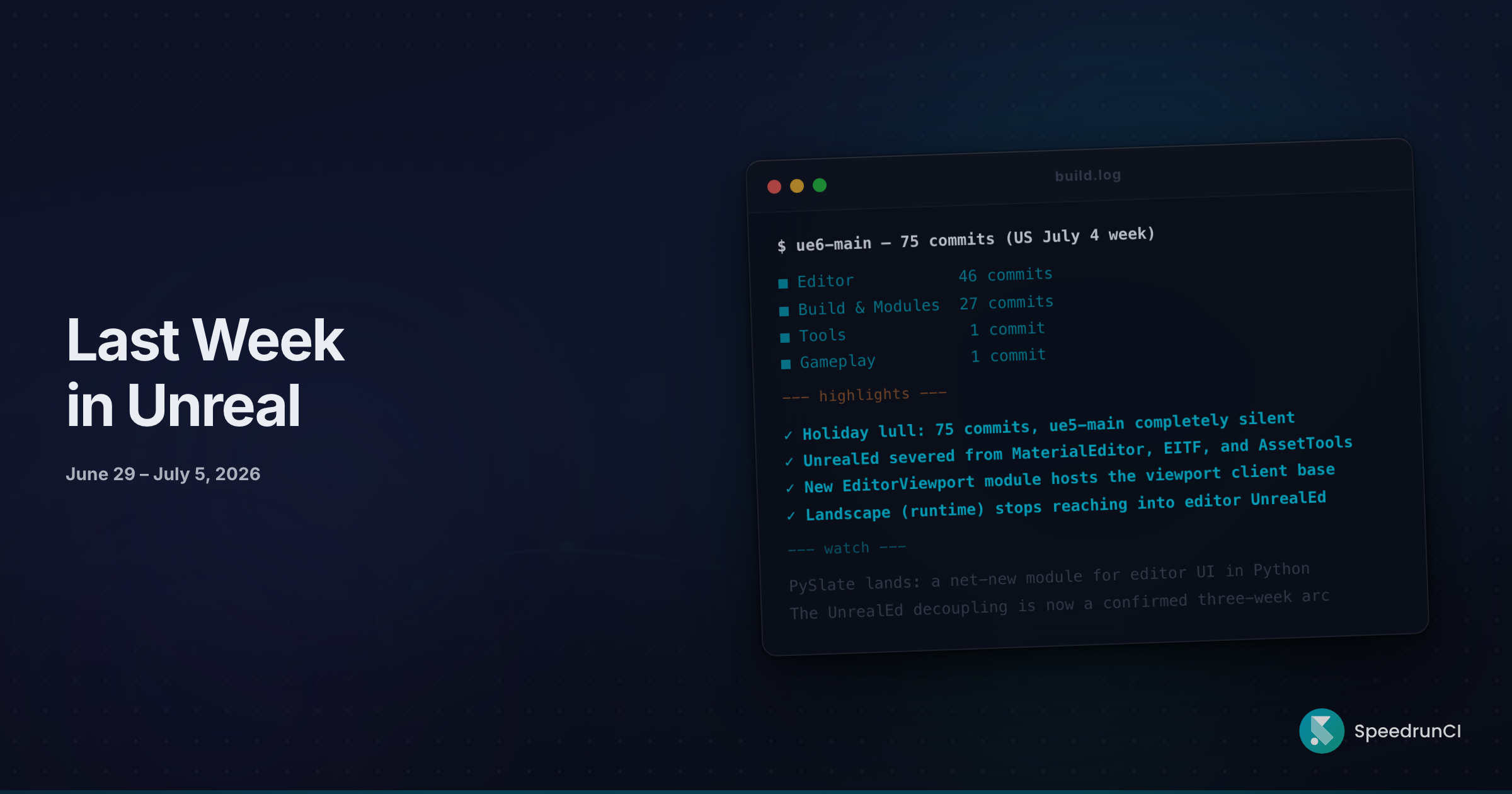
Week of June 29 – July 5, 2026 | 75 commits on ue6-main, 0 on ue5-main | Branch: ue6-main
Overview
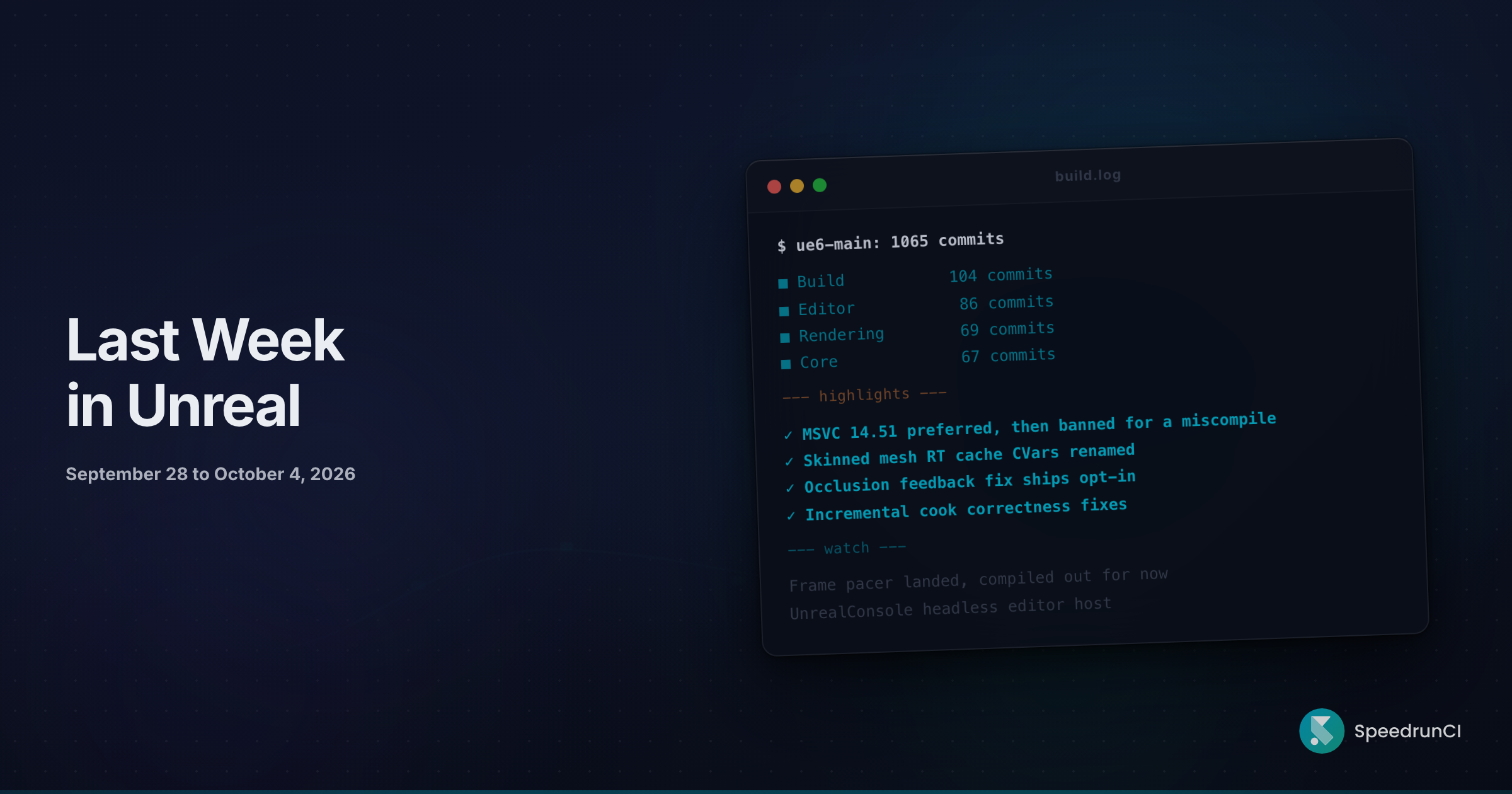
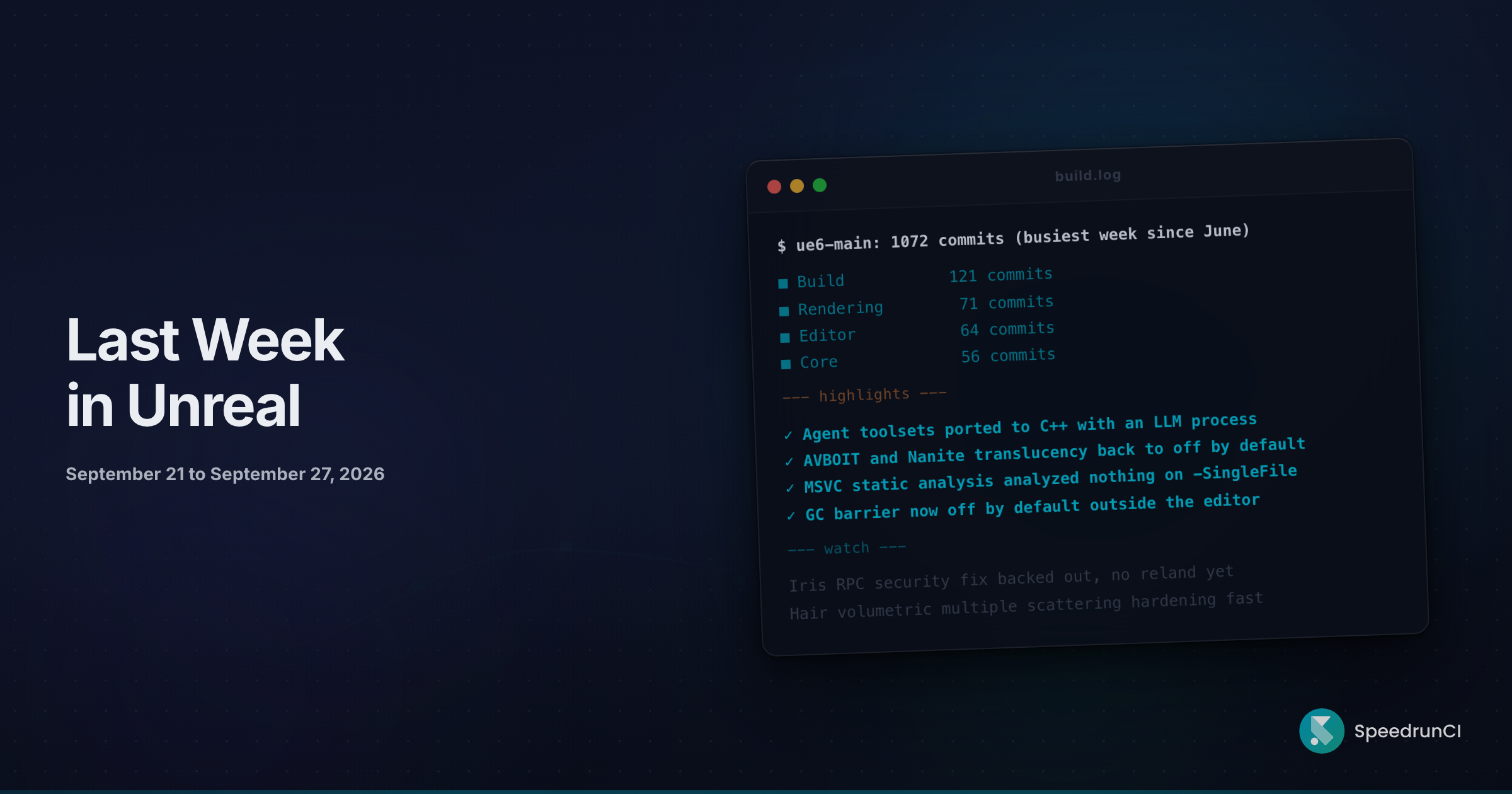
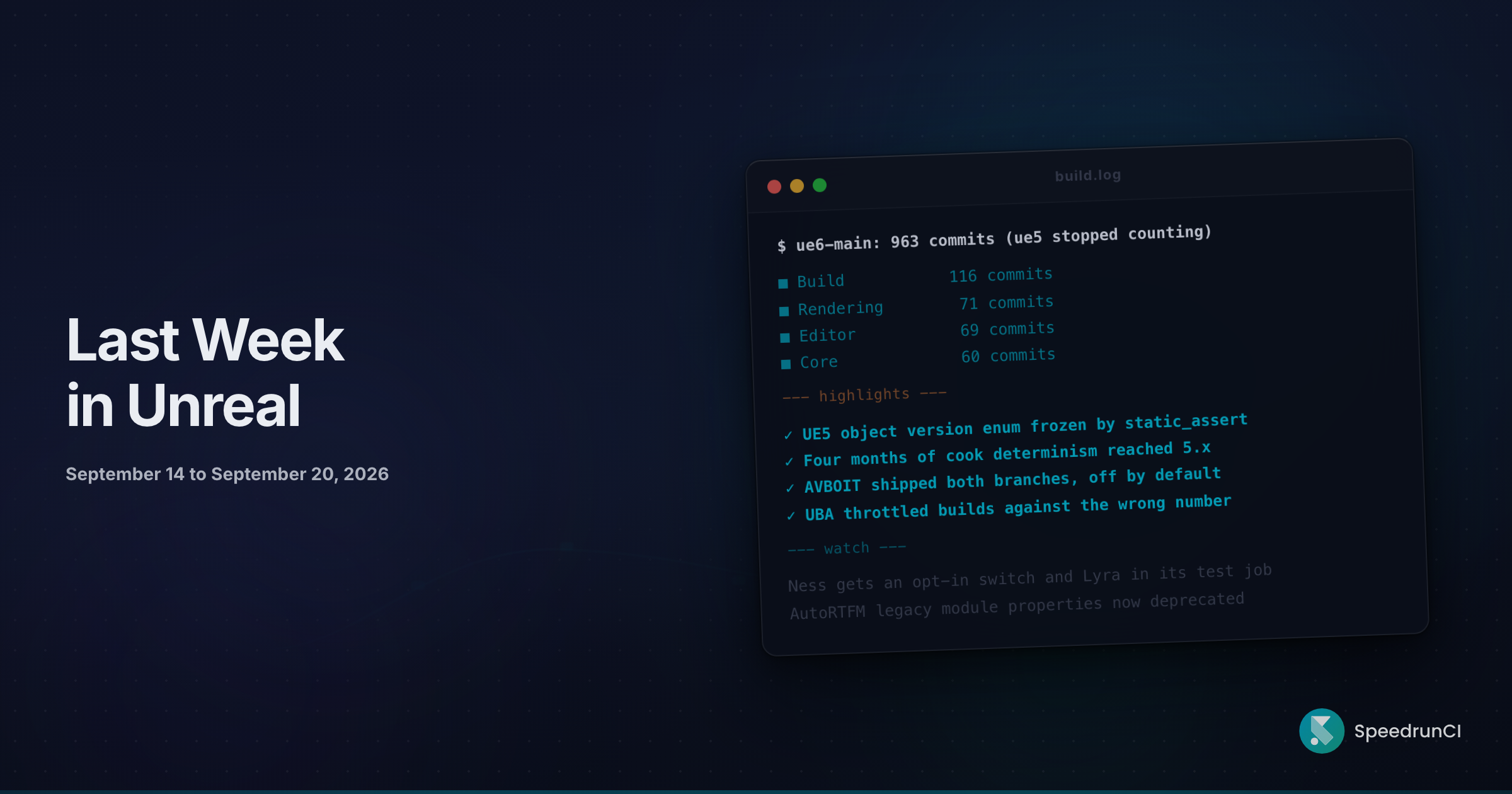
This was the US July 4 holiday week, and the commit graph shows it: 75 commits on ue6-main against the ~880 of a normal week, and ue5-main was completely still. With the offices mostly empty, one engineer kept the lights on, and the week reads as a single coherent story instead of the usual dozen. The UE6 editor-modularization effort we’ve been tracking for three weeks did not pause for the holiday. It came for MaterialEditor, for the Interactive Tools Framework, and for AssetTools. If last week was “an agent going in, the walls coming down,” this week was just the walls, quietly, one load-bearing beam at a time. Nothing here is user-facing or runtime. The audience is build engineers and tools programmers on ue6-main, and anyone maintaining an engine fork who is going to feel these merges.
Development Trends
The UnrealEd decoupling campaign is now a three-week arc, and it’s accelerating. The theme showed up when ue6-main coverage began, and last week it produced the headline change: Engine stopped linking UnrealEd, a ~176-file inversion through provider interfaces. This week, even at a quarter of normal volume, the campaign came straight for the next targets, and the CircularDependenciesAllowList kept dropping, one entry or pair at a time, across more than a dozen modules (SubobjectDataInterface, LevelEditor, the Sequencer and MovieSceneTools split, Kismet, Documentation, MeshBuilder, and more). The MaterialEditor cut alone ejected a 28-module dependency cycle down to 15. This is not scattered cleanup. It’s a disciplined, repeatable playbook (relocate the code to its natural home, replace the hard link with a name-loaded provider or bridge interface, add CoreRedirects so serialized and script references survive, delete the allowlist entry) applied module by module. The through-line from the UE6 announcement is intact: a modular editor is the precondition for the agentic tooling layer Epic is building on top of it, and this is the unglamorous foundation work that makes that possible.
A new module is being born to catch the falling pieces. The EditorViewport module started the week essentially empty and has been accreting the viewport core (camera transform and controller, click and cursor and navigation types, hover effects, and now the FEditorViewportClientBase class) so that tool and gizmo code can be typed against a base that sits below UnrealEd. Watch this one: it’s the extraction target the whole viewport story routes through, and it isn’t finished.
TL;DR
- Holiday week. 75 commits, almost all one engineer’s editor-decoupling campaign, plus a handful of audio and media fixes from others.
ue5-mainwas silent. UnrealEdno longer linksMaterialEditor. The entire MaterialGraph node and schema cluster moved into the MaterialEditor module, collapsing a 28-module dependency cycle to 15 (762b1941).- The Interactive Tools Framework (EITF) was severed from
UnrealEd, retyped across ~50 files against a newFEditorViewportClientBasein a newEditorViewportmodule (fbc487ba,b8139326). This is the highest fork-conflict risk of the week. AssetToolswas ejected from the editor dependency cycle, swapping 32 call sites to name-loaded access and relocating a reflected enum (7f47c982). Under-rated: it touches nearly every editor tool and changes a public API.- A runtime layering violation got fixed too:
Landscape(a runtime module) no longer reaches into editor-onlyUnrealEd, routing through Engine-owned provider interfaces instead (a3171f31). - The refactor is landing net bugfixes as it goes: tool-stack lifecycle correctness, multiple null-guards flagged by static analysis, and a same-day fix for a startup crash the work itself introduced (
6dbbeaf6). - Underneath the decoupling, a small amount of real feature and fix work: a Quartz timing out-of-bounds regression fix, media encoder and pixel-streaming reliability fixes, and a net-new
PySlatemodule for authoring editor UI in Python.
Highlights
Build & Tooling: UnrealEd Loses Three More Walls
What changed
Three of UnrealEd‘s biggest dependency edges came down this week. MaterialEditor was cut loose: the whole MaterialGraph node and schema cluster (the UMaterialGraph, UMaterialGraphSchema, and UMaterialGraphNode_* family) relocated out of UnrealEd into the MaterialEditor module, with include paths preserved and ClassRedirects covering script references, ejecting a 28-module link cycle down to 15 (762b1941). The Interactive Tools Framework was severed in two stages: first a prep pass evacuated the reflected, UnrealEd-coupled tool-stack types out of EITF (b8139326), then EITF was retyped across roughly 50 files against a new FEditorViewportClientBase in a new EditorViewport module instead of UnrealEd’s concrete FEditorViewportClient (fbc487ba). And AssetTools was ejected from the cycle: 32 IAssetTools::Get() call sites swapped to name-loaded module access across the core file-and-package tools, with a reflected enum relocated behind an EnumRedirect and a new public GetPackageLengthForCooking API added (7f47c982). Smaller cuts landed in the same spirit, including MeshBuilder (163abb29) and an EditorStyleSettings relocation with a config-defaults fixup (02cc7197, 41c663da).
Why this is important
UnrealEd has been the monolithic module everything links against, and its circular-dependency web is the single biggest driver of editor relink times. Shrinking the strongly-connected component means less of the editor has to rebuild when any one module in the cycle changes. The provider-and-bridge-interface pattern being established here (IMaterialEditorModule, the IEditorXProvider family, ISubobjectDataBridge) is the sanctioned way to reach editor services without taking a hard UnrealEd link. The AssetTools cut is the one to read closely: it sits under nearly the entire content pipeline, it changes call semantics (the module now loads on first menu evaluation), and it moves a reflected enum, so it carries more real regression and fork-conflict risk than the headline MaterialEditor change.
Who should care
Build and DevOps engineers who own editor compile times. Tools and plugin programmers, especially anyone building on the Interactive Tools Framework, subclassing an editor viewport client, or linking MaterialGraph or AssetTools symbols out of UnrealEd. And anyone maintaining an engine fork: changes at this surface generate painful, wide merge conflicts.
Urgency
Track. Act now if you maintain a fork touching these module boundaries, or ship custom interactive tools or viewport-client subclasses on ue6-main. The EITF retype changes public header types and adds a new virtual to the viewport-client base, so downstream code will recompile and may need re-fixing.
A Runtime-to-Editor Layering Violation Gets Fixed
What changed
Landscape, a runtime module, had been reaching into editor-only UnrealEd for its WITH_EDITOR paths: actor selection and deletion, package saving, static-lighting export, name sanitization. That edge is gone, routed through Engine-owned provider interfaces with new verbs added for the editor-time operations (a3171f31). The same pattern reached into the audio runtime, where the Engine to AudioMixer circular dependency was removed (24521a60).
Why this is important
Runtime modules that link editor code are a recurring source of packaged-build and cook surprises. This is a categorically different (and arguably more valuable) fix than the editor-internal cycle cuts, because it corrects a real layering violation rather than just untangling two editor modules. It’s also a signal: Epic is actively hunting these, so expect more runtime modules to lose their editor edges in the coming weeks. If you have runtime modules with #if WITH_EDITOR blocks calling GUnrealEd or GEditor directly, this is the pattern to copy.
Who should care
Engine programmers and studios maintaining forks with custom runtime modules that touch editor state.
Urgency
Track.
Stability & Fixes: The Refactor Is Auditing Itself
What changed
The decoupling work is not pure mechanical relocation. It keeps folding in real correctness fixes as it moves code. The EITF prep stage fixed six genuine pre-existing defects in the tool-stack code: a mis-stored identifier that meant editor-scope tool types never unregistered, several unchecked null dereferences in destructors and activation callbacks, .Last() calls on possibly-empty arrays, and a leaked command-list mapping (b8139326). The viewport retype pulled in three more null-guards flagged by static analysis (fbc487ba). And a static-initialization-order crash on editor startup, introduced by the EditorViewport work itself, was caught and fixed the same day in the same synced changelist (6dbbeaf6). Separately, a Quartz timing regression got a fix: an out-of-bounds access in Tick plus a PlayQuantized CoreRedirect resolution (6fd07009).
Why this is important
This is what a healthy large-scale refactor looks like. Relocations double as bug audits, and the regressions the work introduces surface and get fixed fast. The Quartz out-of-bounds fix is the one non-refactor stability item worth acting on: if you sync recent ue6-main and use quantized audio, confirm you have it.
Who should care
Editor engineers, anyone who has hit flaky tool-lifecycle or startup issues on ue6-main, and teams using Quartz quantized audio.
Urgency
Track. Act now on the Quartz fix if you’re on quantized audio.
Media & Streaming: Two Narrow Reliability Fixes
What changed
Two small but real fixes landed in the media stack. The WMF audio encoder was emitting multiple output packets per SendFrame call when the contract expects one, now corrected (2639c6d7). And PixelStreaming2 was throwing errors when a frame was requested before the first one had been pushed into the video capture pipeline, an initialization-ordering bug now guarded (052fc56a).
Why this is important
Individually minor, but relevant to anyone doing capture-and-encode work or running a pixel-streaming pipeline. They’re also the clearest signal this week that ordinary feature-and-fix work continued underneath the decoupling push.
Who should care
Teams with media encoding or pixel-streaming pipelines.
Urgency
Track.
Worth Tracking
A new PySlate module. A net-new module landed as an “Initial Commit” (0b279ece): a Python-Slate binding surface for authoring editor UI in Python. It’s a single early commit with nothing built on it yet, but a first-party path to scripting editor UI in Python is a genuinely notable capability, and it fits the broader UE6 direction of making the editor more scriptable. Worth watching whether it accretes real surface area in the coming weeks or stays a stub.
The EditorViewport module. As noted in the trends section, this module is being stood up specifically to host FEditorViewportClient‘s base class and the viewport POD types, so tool and interaction code can depend on viewport primitives without linking the editor monolith. Several commits explicitly describe themselves as “prepares” or “stage X of,” and public types are relocating behind CoreRedirects. If you build against viewport internals, the correct include is shifting under you even though forwarding headers keep most code compiling for now.
What We Ignored
We set aside roughly 30 commits this week, most of them the expected fallout of a large refactor: non-unity compile fixes, static-analysis annotations (CA_ASSUME, check(ptr) guards), and a handful of near-identical auto-generated Horde schema documentation updates. None of these affect runtime behavior, performance, or upgrade risk. On a normal week many would not even register; on a 75-commit holiday week they’re a visible fraction of the total, which is itself a fair picture of how quiet the week was.
Closing
A holiday week is a good week to see what a team does when nobody is watching. Epic kept paying down the editor’s oldest architectural debt, carefully, one module at a time. Nothing to act on unless you maintain a fork. Everything to appreciate if you care where the engine is going.
For what it’s worth, this was the shortest read since we started doing this. We keep wanting to say we did something noble with the spare time. Mostly we just enjoyed a quiet inbox and read the diffs slowly for once.
Commit SHAs are cited inline, in parentheses, next to each claim. They reference the ue6-main branch of EpicGames/UnrealEngine. Some entries may resolve to Commit.gitdeps.xml binary-manifest blobs: the commit message is real, but the code lives in Epic’s internal binaries, which we cannot see.
Never miss a ue5-main update.
Get them delivered straight to your inbox.