Last Week in Unreal: UE6 Starts Tearing Down the Editor Walls (June 22 to 28, 2026)
Unreal Engine Weekly: UE6 Starts Tearing Down the Editor Walls
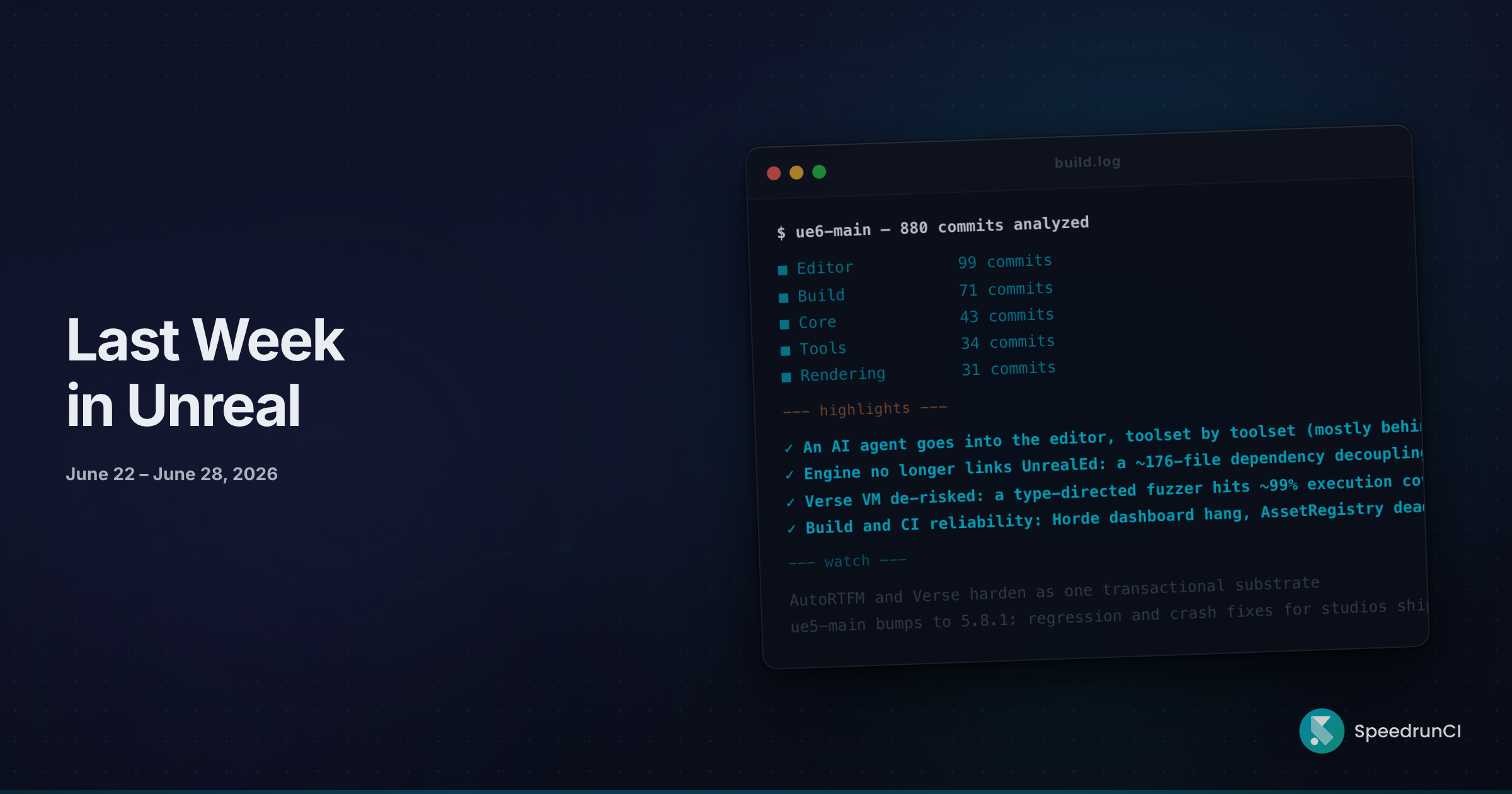
Week of June 22-28, 2026 | 880 commits on ue6-main, 155 on ue5-main | Branch: ue6-main
Overview
Week two on ue6-main carried 880 commits against ue5-main‘s 155, holding the divergence we saw when the branch switched. A week ago this looked like a thin new layer riding on ordinary engine work. This week the layer starts to take a recognizable shape. The story is two halves of the same move: Epic is wiring an AI agent directly into the editor, and at the same time tearing out the circular module dependencies and old VM layers that would make that agent hard to build. The loud half (a first-party agentic toolset framework) is mostly invisible to us, sitting behind binary-manifest blobs. The quiet half (Engine no longer links UnrealEd, a type-directed Verse VM fuzzer, AutoRTFM correctness hardening) is fully readable in source, and that’s where the credibility comes from. None of it is production-actionable for teams shipping today. Early Access is targeted for late 2027. If you ship a game now, you stay on 5.8, and the 5.8.1 maintenance sidebar at the bottom is the part that touches you.
TL;DR
- The biggest storyline (Epic’s agentic in-editor toolset framework) is also the least verifiable: most of those commits resolve to
Commit.gitdeps.xmlbinary blobs. The intent is clear from the messages, the implementation is not. - The agent framework is consolidating from “add a toolset” into shared infrastructure:
ToolsetRegistrysplit into runtime + editor modules and made a singleton so non-editor targets can call it, and MCP server settings enabled in Fortnite/UEFN builds (cee54db2,13a4ae6e). - The most important visible change is structural:
Engineno longer linksUnrealEd. A ~176-file refactor inverts editor calls through ~28 provider interfaces (3ccf3ec3). This is years-of-payoff plumbing, and it will conflict hard against any custom fork. - The Verse VM got a fuzzer: a type-directed one that generates type-correct programs pushed VM-execution coverage from near-zero to ~99%, running cross-backend with auto-triage (
70d06ad5). Usually that comes right before a team flips the default VM. - AutoRTFM and Verse are hardening as one transactional substrate, with commits on each side referencing the other.
- A cluster of CI and build-farm reliability fixes is the most act-now material this week: a Horde Dashboard hang, an AssetRegistry gatherer deadlock, a ZenCacheStore shutdown race (
ecd1ca21,79564ad3,4a2e16ad). ue5-mainbumped to 5.8.1. The sidebar covers the regression and crash fixes worth cherry-picking if you ship on 5.8 today.
The Through-Line: An Agent Going In, the Walls Coming Down
If you read the week as one move instead of a list, it’s this. Epic is bolting an AI agent into the editor and simultaneously removing the architectural debt that would make that agent expensive to maintain. The two efforts are not announced as related, but they fit together. A clean, broadly-callable agent surface is much easier to build once runtime and editor modules stop linking each other in a circle, and once the language the agent reasons about (Verse) has a VM you trust. So the week splits into the loud-but-invisible (the agent) and the quiet-but-visible (the refactors), and the two deserve different grades. We can confirm the refactors from source. We can only read the agent’s intent from commit messages, because the code lives in Epic’s binaries.
The New Layer (UE6-Specific)
An AI Agent Is Going Into the Editor, Toolset by Toolset
What changed. This is no longer one experiment. There’s now a family of “toolsets” being registered for an in-editor agent to call: AssetTools, StateTree, PCG, MetaHuman Generator and a MetaHuman wardrobe toolset, plus a new CrashDiagnostics toolset that lets the assistant fetch and explain prior editor crashes by GUID (1aed1cb3). The plumbing under them matured this week too: ToolsetRegistry was split into runtime and editor modules (fe41b687) and FToolsetRegistry converted to a singleton, explicitly “so we can access it from outside editor in later CLs” (cee54db2), and MCP server settings were enabled in Fortnite/UEFN builds (13a4ae6e). The toolsets themselves are thin Python and Verse wrappers around existing BlueprintCallable APIs, with docstrings written for the agent to discover capabilities and guardrails to keep it from hanging the editor: find_assets gained a max_results cap after agents fired queries returning tens of thousands of results and appeared to hang (c8023dfa), and MetaHuman Generator registration is now gated on optional content because a set_skin_tone call asserted and crashed the editor when that content was absent (c936322e).
Why this is important. The shift from “add a toolset” to “refactor the shared registry so non-editor targets can call it” is what gives this away. Epic is preparing a first-party agentic layer as a stable, broadly-callable API, not a collection of one-off editor panels. The guardrails point the same direction. Result caps and content-availability gates are exactly what you add when the caller is a model retrying against state it can’t fully see.
Who should care. Tools and pipeline teams, technical artists, and studios evaluating UE6 automation. Nobody needs to act, but this is the workstream that would reshape how a tools team thinks about editor automation if it ships.
The honest caveat. Nearly every commit in this theme resolves to a Commit.gitdeps.xml binary-manifest blob. The messages are real and descriptive, but the implementation lives in Epic’s internal binaries we cannot see. Treat the direction as confirmed and the contents as unverifiable.
Urgency Track.
The Engine-to-UnrealEd Wall Comes Down
What changed. Engine no longer links UnrealEd. The ("Engine","UnrealEd") entry is gone from the circular-dependency allow-list, replaced by roughly 28 IEditorXProvider interfaces that invert the editor-time calls Engine used to reach through UnrealEd for (GEditor, asset tools, transactions, selection, save), across about 176 files (3ccf3ec3). PropertyEditor got the same treatment: ~50 call sites inverted through FPropertyEditorHooks, with FPropertyEditorToolkit extracted into a new module (2f9e23de). Smaller untanglings landed in the same spirit, including NiagaraEditor being severed from the experimental toolset-registry plugin so it no longer force-enables it wherever Niagara ships (472b1e83).
Why this is important. UnrealEd has been the monolithic module everything links against. Breaking those edges is a precondition for faster editor iteration builds and for letting tooling depend on editor-framework pieces without dragging in the entire editor. This is the fully-visible, unambiguously-real counterweight to the agent story: it ships no feature, and it pays off for years. It also fits the through-line. A clean agent surface is far easier to build on modules that don’t link each other in a circle.
Who should care. Engine programmers, plugin and module authors, and anyone maintaining a custom fork. Changes at this scale generate painful merge conflicts, so read them before your next integration.
Urgency Track. Act now if you maintain a fork that touches Engine or PropertyEditor module boundaries.
The Verse VM Gets a Fuzzer
What changed. The work around the new Verse VM this week is about confidence, not surface area. A type-directed language fuzzer now generates programs that are type-correct by construction, which pushed VM-execution penetration from effectively zero to around 99%, and runs them across both the legacy BPVM and the new Verse VM with automated crash fingerprinting, delta-debug shrinking, and auto-filed tickets (70d06ad5). Alongside it, a new assert_bytecode facility pins down that specific language constructs compile to the exact expected bytecode (bb02745a), and a toggle_compile_features macro allows per-test compiler-feature opt-in (f2db1e4d). The feature work continued in parallel: a “Verse Animation Phase 2” arc added playback, time, looping, ease-in/out, replication, and async loading (81a5e1bb, 362f1cf4), and CoreRedirects for type aliases appeared (62d488c8), a backward-compatibility path you only bother to maintain once content is being authored against the new VM.
Why this is important. A cross-backend fuzzer and bytecode-equality assertions are what a team builds when it intends to flip the default VM and wants proof the two backends agree first. Read together with the animation phase-2 work and the compatibility redirects, Verse is moving from scaffolding into hardening. If you want to know where UE6’s gameplay-authoring direction actually sits, this is where to look.
Who should care. Verse and UEFN-ecosystem developers, and language-tooling teams.
Urgency Track.
AutoRTFM and Verse Harden as One Transactional Substrate
What changed. Roughly a dozen AutoRTFM commits landed, almost all correctness hardening: more virtual-function-mode violations fixed, support for unbalanced recursive locking in TTransactionallySafeMutex, and AUTORTFM_IMPLICIT_DISABLE / AUTORTFM_OVERRIDE_MAY_DISABLE annotations applied to AutoRTFM::Open() and UCommandlet::Main(). The cross-references to Verse are now explicit, including a verse-clang change to emit AutoRTFM static-local-initializer calls for non-AutoRTFM-enabled functions, and a Verse-side drop of an AutoRTFM::UnreachableIfClosed() from the Solaris runtime link path. Two real runtime fixes also landed: a latent memory leak in the Verse package cache from an unsafe AUTORTFM_OPEN on a TSharedRef (c306b881), and relinquishing Verse heap access across UE::Tasks::Wait to avoid a GC-handshake deadlock (1ee866b5).
Why this is important. AutoRTFM provides the transactional-memory guarantees Verse’s gameplay and replication model leans on, and the commits this week are wiring the C++ side (mutexes, virtual-function modes, static initializers) to satisfy that contract. The two systems are advancing as one substrate, and the activity is hardening rather than new scaffolding. That work, plus the EpicClang gating we noted last week, is what “transactionalize C++” actually amounts to so far.
Who should care. Gameplay programmers evaluating Verse, and engine teams touching threading or transactions.
Urgency Track.
SceneGraph Keeps Weaning Off Actor Proxies
What changed. The SceneGraph and Entity work this week has one consistent sub-theme: removing the dependency on proxy actors. Commits fixed util and Python-exposed functions that were actor-proxy-reliant, removed an unused proxy-reliant SceneGraphUtil function, and made edit-in-place plus step-in and step-out work without proxy actors (8bdf3f43). Around that, editor integration landed: entity-outliner sorting without GUIDs, duplicate-suffix handling, constrained drag-and-drop, and exposing custom depth and custom-depth-stencil values on mesh entity components.
Why this is important. SceneGraph is the entity model Epic has named as the eventual replacement for the AActor proxy system. Severing proxy-actor dependencies makes entities stand on their own representation rather than shadowing the legacy actor model, and the simultaneous outliner and prefab work signals Epic wants entities usable through normal editor workflows, not just as a backend. This is the groundwork for deprecating Actors, and it is years ahead of any actual deprecation.
Who should care. Engine and framework teams, and anyone weighing the long-term actor-versus-entity direction.
Urgency Track.
Ordinary Engine Work That Still Matters
Build & CI Reliability
What changed. A cluster of genuine production-reliability fixes landed in the parts of the stack a studio’s build farm actually depends on. The one most teams will feel is a Horde Dashboard hang: a job page would spin forever (HTTP 200, never repaints) when a summary report packed many <br/> tags into one block and triggered catastrophic regex backtracking in markdown-to-jsx (ecd1ca21). DDC Verify can now split into a priming job and a verification job (fc452788). An AssetRegistry gatherer deadlock where all threads could block was fixed by having the gatherer contribute to directory processing when explicitly waited on (79564ad3), and a ZenCacheStore shutdown race in the perf-monitoring thread was closed (4a2e16ad). On the toolchain side, Epic added a direct, non-VM BuildGraph builder API as the foundation for eventually removing the C# BuildGraph VM (28d001c2), and fixed a data race in UnrealBuildTool’s PCH dependency calculation that could produce a wrong dependency list and a build exception (555da914), plus a ~40% speedup on shared-PCH dependency lookup (253b35aa).
Why this is important. These are the failures that cost a build farm real hours: a dashboard that hangs on a specific report shape, a gatherer that deadlocks, a cache store that races on shutdown. None are dramatic, all are worth pulling into your fork if you run Horde, Zen, or a large DDC at scale. The BuildGraph VM-removal groundwork is worth noting early if you author graphs in C#: the eager-Def API is the future surface, though nothing is deleted yet and the VM stays default.
Who should care. DevOps, build-farm operators, and CI/CD owners.
Urgency Act now for studios running Horde/Zen/DDC at scale. Track for everyone else.
Rendering: Nanite Ray Tracing and TSR
What changed. Nanite ray tracing now keys hierarchy traversal on which pages actually have CLAS allocated, which fixes BLASes with holes when the CLAS pool runs out of memory (fce21cf5), plus a GPU crash fix in the Nanite Voxel rasterizer (a34274e1). TSR split its Guide uncertainty into a dedicated single-channel PF_R16F_FILTER array, removing a redundant full FloatRGBA slice per frame when alpha is enabled (69a9c2b1). A stereo refactor renamed the View uniform buffer (View to VUB) to support a static ViewState alias for instanced stereo, touching about ten files, half of them shaders (1c769f66).
Why this is important. This is correctness-and-cost tuning on a maturing path, not a feature launch. The CLAS-availability traversal stops intermittent corruption under memory pressure, the failure mode that’s painful to reproduce. The View-to-VUB rename will conflict against any custom shaders, so flag it before integrating.
Who should care. Rendering engineers, studios on Nanite with hardware ray tracing, and teams using alpha-channel TSR.
Urgency Track. Note the shader rename if you maintain custom shaders.
Stability: Core Thread-Safety and the New Systems
What changed. A few fixes this week sit below the headline themes but matter because of where they are. A data race was fixed in FNameTokenStore (8190796e), thread-safety in one of the most fundamental engine primitives. The new Verse Animation Framework got a use-after-free fix caught by ASAN, where local stack memory was freed before an update context used it (4b0505d5). The multiserver and RemoteObjects path picked up serialization and shutdown-ordering fixes for the distributed-world tech (80d7dd09, 21775ccc).
Why this is important. The FName data race matters most: that primitive is touched everywhere, so a race there produces rare, unreproducible corruption across unrelated systems. The UAF and multiserver fixes are early-system hardening, which is expected and healthy on a young branch, but worth noting because they sit in the UE6-specific code, not the inherited engine.
Who should care. Engine programmers, and anyone tracking the maturity of UE6’s new animation and distributed-simulation systems.
Urgency Track.
Mass ECS Gets Layered Into a Core
What changed. About a dozen Mass commits this week were structural reorganization rather than features: element-bitset declarations moved from MassEntity into a new MassCore module, fragment access and presence enums plus the requirement-description and error-reporting helpers pushed down into MassCore, and dead editor-only build dependencies stripped from Mass modules. Test replication into a low-level-test target and README and documentation additions landed alongside.
Why this matters. Pulling Mass’s foundational pieces down into a lower MassCore layer and stripping editor-only dependencies usually precedes wider reuse across runtime and server targets. Read together with the SceneGraph entity work, Epic is making the entity and ECS stack a first-class, broadly-depended-on engine layer in UE6. The documentation and test work suggests an API stabilizing for external consumption, the kind of cleanup that follows last week’s MassIrisReplication feature push.
The 5.x Stabilization Sidebar: ue5-main
ue5-main is now bug-fix and regression maintenance only, and this week it bumped the installer version from 5.8.0 to 5.8.1 (3a421871), confirming the branch is feeding a 5.8.1 hotfix release. At ~155 commits against ue6-main‘s 880, it’s doing exactly what a post-final-release branch should. If you ship on 5.8 today, these are the fixes worth cherry-picking:
- Nanite crash with translucency disabled (default config). With
r.Nanite.AllowTranslucencyoff (the default), translucent materials still reached translucency and base-pass codepaths and crashed instead of falling back to the default material. Any 5.8 title using Nanite on stock settings could hit this; it now degrades gracefully with a warning (40789343). - Landscape spline tangent regression. Landscape editor tools were switched back to legacy viewport interactions to fix spline tangent manipulation that broke in 5.8. A real workflow regression for anyone doing landscape, road, or spline authoring (
e348bec2). - Vulkan submission-thread deadlock. Fixes a
SubmissionThreaddeadlock from a recycled “rendering done” semaphore handle, plus a guard that acceleration structures support mutable descriptors before enabling ray tracing. Relevant if you ship Vulkan with RT in the mix (11c1d64a). - Sequencer crash on stale section pointers (UE-385130).
CheckForEdgeInteractionasserted on stale weak pointers when a section was removed before the underlapping-segments list refreshed. An editor-stability fix for heavy cinematics work (256a80f8). - MegaLights + Forward Rendering missing-shader crash. A compile-versus-use condition mismatch on
FFrontLayerTranslucencyClearGBufferPScrashed projects using Forward Rendering with MegaLights enabled. Narrow config, hard crash, mostly the mobile, VR, and forward crowd experimenting with MegaLights (55fc8ae9).
Honorable mentions worth a fork cherry-pick: a Metal breadcrumb crash fix on Apple platforms (dd1c69ab), a non-deterministic AnimationSequence DDC fix from uninitialized curve padding that would otherwise spuriously invalidate a team’s shared cache (6d47614c), and a bindless-uniform-buffer texture-reference fix (5f8f0741). The overall character is what you’d expect from a release winding down: regression patching, crash hardening across editor tooling, and routine plumbing, with the 5.8.0-to-5.8.1 bump the only structural event. Low, fix-only volume is exactly what UE5 should be doing now.
Worth Tracking
Two early signals worth a note. First, incremental cook is getting opt-in multithreaded dependency-key computation, precomputing each wave of ready vertices’ per-package keys across worker threads before the serial loop consumes them, with blueprint hashing made thread-safe behind a reader-writer cache lock (3246bde7). It’s behind a new CVar and off by default, with a couple of cookincremental version bumps landing the same week. Cook-key computation is a known serial bottleneck in large CI pipelines, so if that CVar flips to default-on in a future release it’s a direct iteration-time win. Track whether it stays experimental or graduates.
Second, MetaHuman Crowd is being wired into the Mover plugin’s authoritative simulation, with teleport handling overridden so Mover’s state updates alongside the actor transform (95b02b1a), landing next to a “Mass Characters animation pipeline” update (6feac289). The combination of MetaHuman Crowd, Mover as movement authority, and Mass character animation points at Epic converging its crowd and NPC story onto the Mass framework. If you’re choosing a large-population character solution in UE6, this is the stack to watch consolidate.
What We Ignored
We set aside several hundred commits this week, mostly routine crash-fix hardening (Mutable, PVE foliage, Niagara, Sequencer, MetaHuman import), formatting and comment changes, vendor binary bumps, and the usual integration churn including a dozen straight backouts. These don’t affect runtime behavior, performance, build reliability, or upgrade risk for production teams. The interesting work this week was not at the top of the volume chart; the architecture campaigns above were spread thin across many small commits, which is exactly why they’re easy to miss on a fast skim.
Closing
Week two of UE6 is the week the new layer started to resolve into intent: an agent going into the editor, and the walls coming down to make room for it. Most of it is years from anything you’d ship. If you’re shipping today, read the 5.8.1 sidebar and ignore the rest.
Commit SHAs are cited inline, in parentheses, next to each claim. They reference the ue6-main branch of EpicGames/UnrealEngine unless noted as ue5-main. Many of the highest-interest entries (notably the agentic toolset work) resolve to Commit.gitdeps.xml binary-manifest blobs: the commit message is real, but the code lives in Epic’s internal binaries, which we cannot see.
Never miss a ue5-main update.
Get them delivered straight to your inbox.