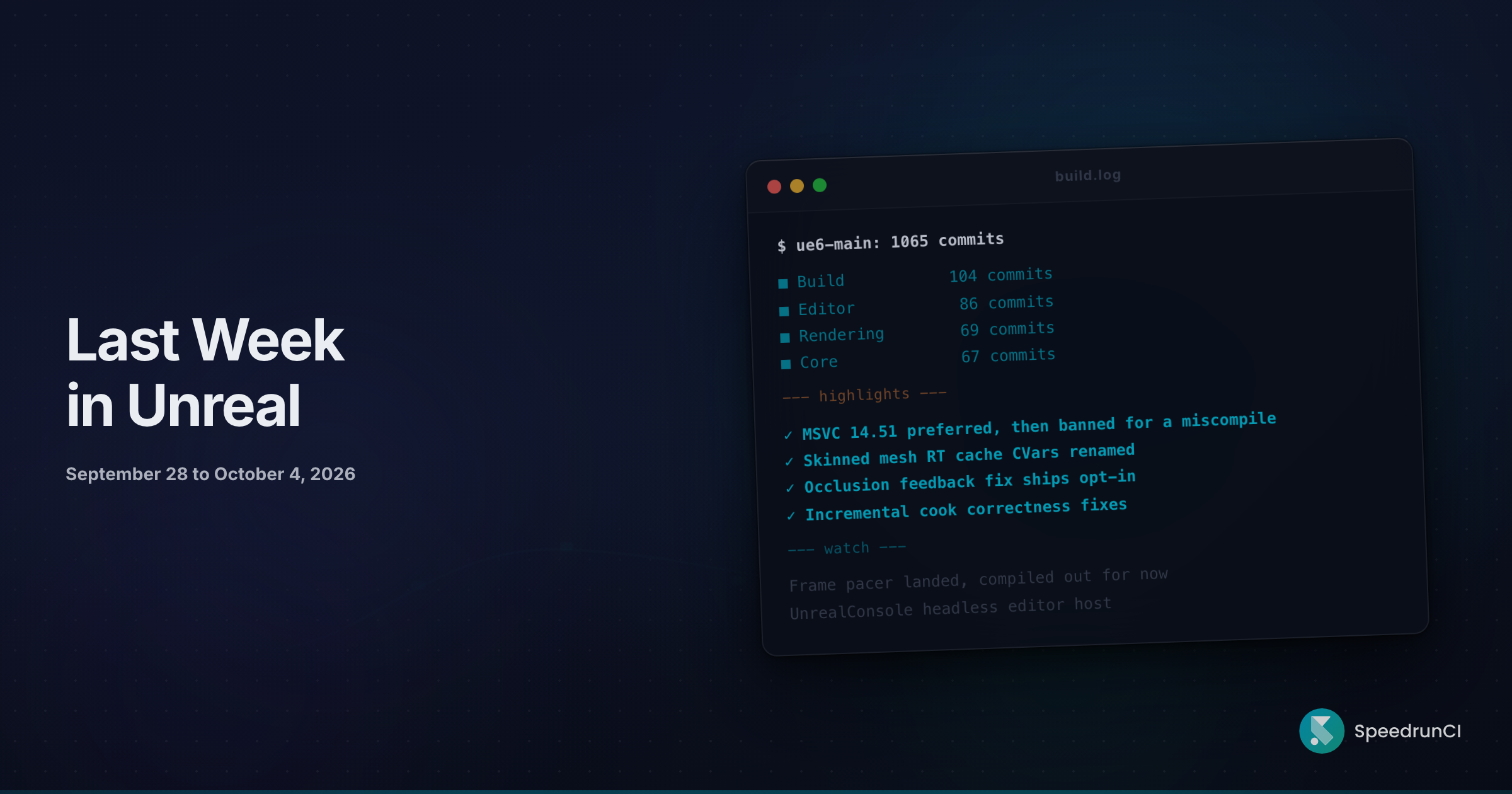
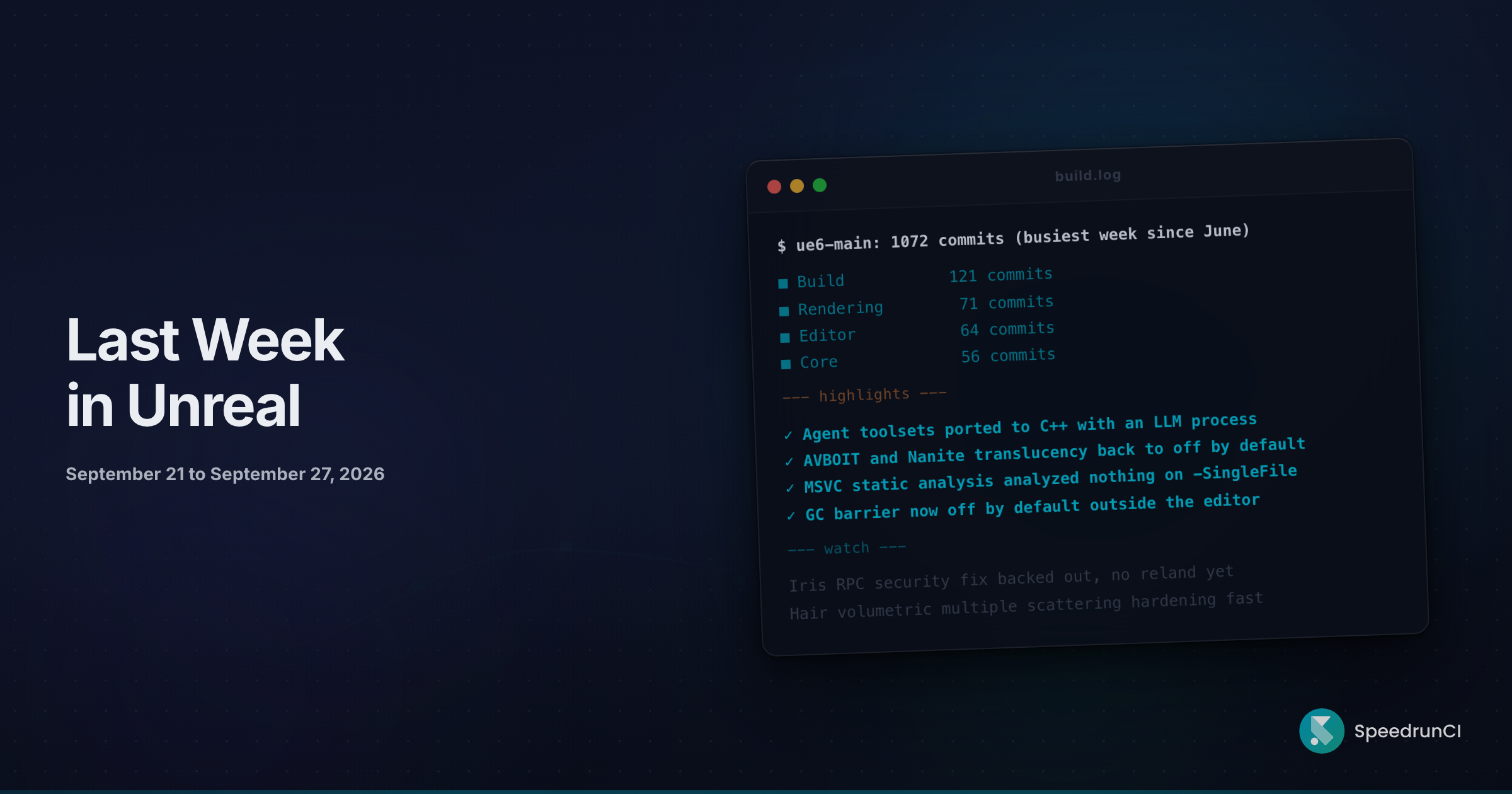
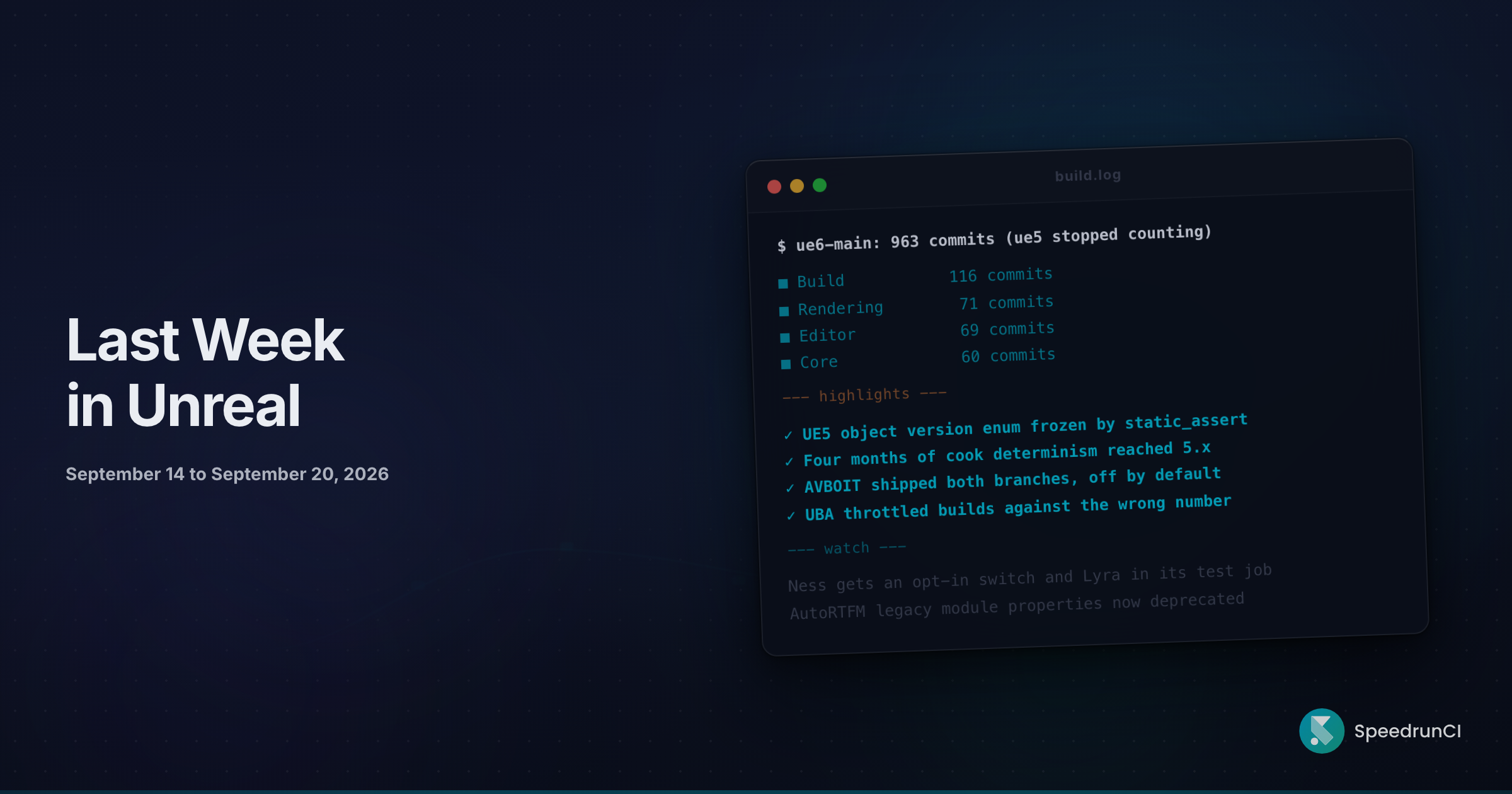
Last Week in Unreal: UE6 Development Has Begun (June 15 to 21, 2026)
Unreal Engine Weekly: UE6 Development Has Begun
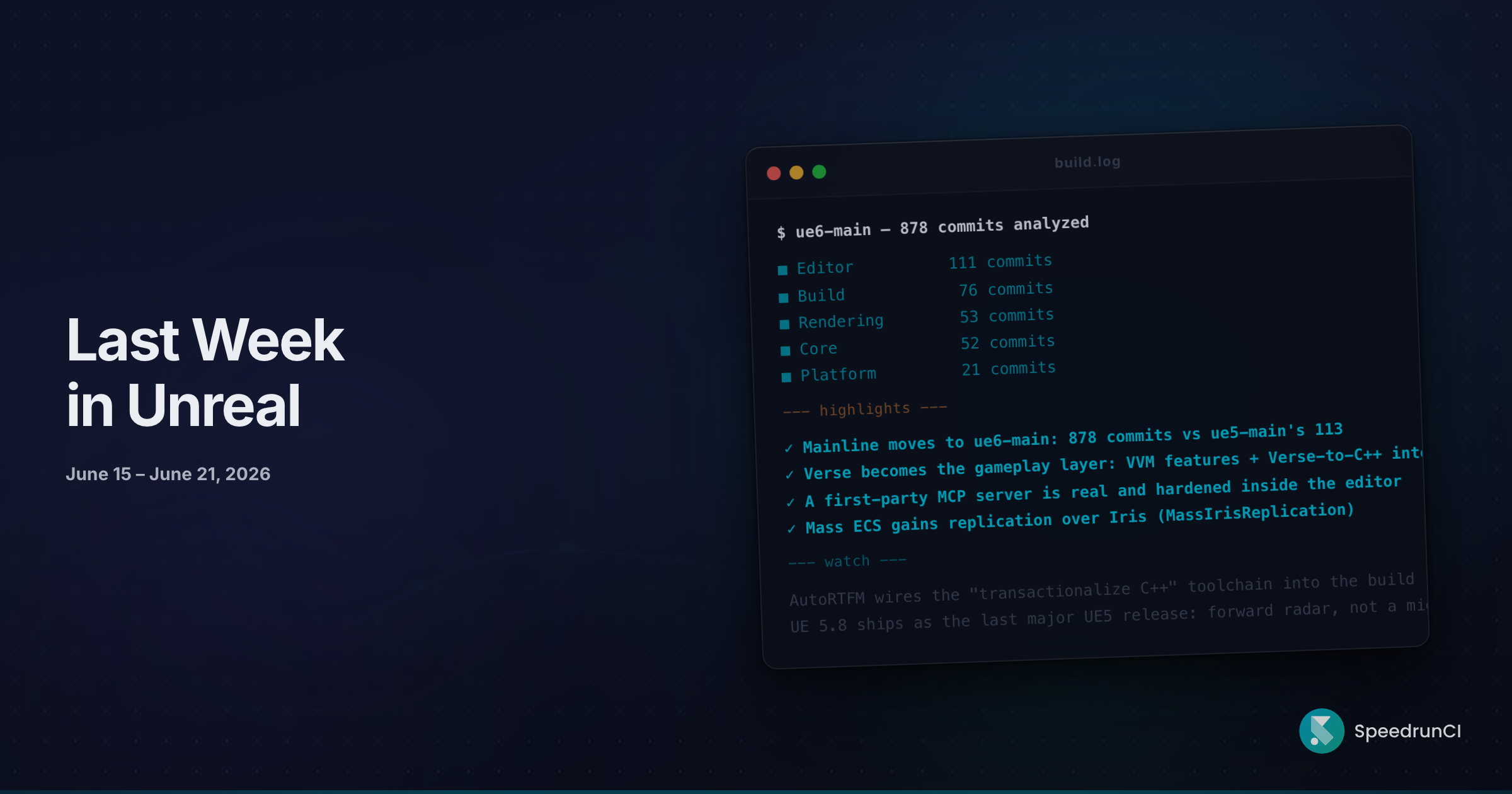
Week of June 15-21, 2026 | 878 commits analyzed | Branch: ue6-main
Overview
UE 5.8 shipped on June 17 as the last planned major UE5 release, and active mainline development has now moved to ue6-main. The branch switch is the news this week. ue6-main carried 878 commits against ue5-main‘s 113, the first genuine divergence in our ledger. Read the diff honestly and week one of UE6 looks less like a clean-slate rewrite and more like incremental re-platforming of the UE5 codebase: the bulk of the work is renderer hardening, build and cook plumbing, and async-loading fixes that would look identical on ue5-main. Nothing here is production-actionable. Early Access is targeted for late 2027, with full release 12 to 18 months after that, so this coverage is forward radar, not a migration prompt. We switched branches because this is simply where the engine is being built now.
TL;DR
- UE6 development is live on
ue6-main. Week one is mostly ordinary engine work wrapped around a thin, genuinely-new architecture layer. - Verse is becoming the gameplay programming layer: VVM heap-correctness fixes, new language semantics (discriminated unions, bitwise ops, closures), and Verse-to-C++ interop wired through UHT.
- A first-party, in-editor MCP server is real and being hardened (chunked streaming, commandlet guards, live URL composition). The AI pillar is shipping as working networked code, not a slide.
- Mass ECS gained replication over Iris (the
MassIrisReplicationarc), the networking backbone for persistent large-scale worlds. - The deprecation everyone is reacting to (Blueprints and Actors) has no commit deprecating either one this week. The replacement foundation (SceneGraph, Entity framework, Verse) is landing, but Blueprints still got a week of active fixes. Years out, not months.
- Nothing is production-actionable. This is a 2027+ horizon. If you ship today, you stay on 5.8.
What UE6 Actually Is, So Far
The honest read on week one: UE6 is, for now, an incremental re-platforming of the UE5 codebase rather than a clean-slate rewrite. The vast majority of the 878 commits are routine engine maintenance, the kind of renderer, cook, and loader work that has been landing on ue5-main for years. The branch name is new. Most of the work under it is not.
Epic named three initiatives for UE6: Verse as the gameplay programming model, open standards that make content, code, and economies portable across games and engines, and an AI-driven development pipeline (an MCP layer plus in-engine generative AI via diffusion models). The overarching vision above those is the merge of UE5 and UEFN into one engine. It is worth checking the week’s commits against that announced plan rather than assuming they line up.
Two of the three pillars show up clearly. Verse is being hardened into a first-class gameplay layer: roughly three dozen Verse and VVM commits across the VM and the language, plus the access-control machinery that governs a merged UEFN/UE5 monorepo. The AI pipeline is landing as a first-party Model Context Protocol server, four commits this week, hardened as networked code (the generative-AI half of that pillar produced nothing visible this week). The third pillar, open standards and portability, has no commit footprint yet, which is worth stating plainly rather than glossing: it is the one announced initiative we cannot see moving. The UEFN merge itself is not just a slide: Solaris and Fortnite paths are in-repo and UEFN cook and profiling work is landing alongside engine code. Scene Graph, the new high-level gameplay framework Epic announced, also made its first appearance, in asset-digest commits (5dbc77d8). Add the MassIrisReplication arc and the AutoRTFM toolchain wiring, both read from the commits rather than announced as headline features, and that is the whole of the distinctly-new surface. A few dozen commits in total.
The distinctly-UE6 work is directionally important and architecturally load-bearing, but it is a thin layer riding on top of a large body of ordinary engine churn. One caveat: many of the highest-interest commits are Commit.gitdeps.xml binary-manifest blobs. The commit message is real, but the code lives in Epic’s internal binaries we cannot see, so several claims below rest on a message, not on readable source. We flag those where they matter.
The Blueprints and Actors Question
The loudest reaction to the UE6 announcement is not Verse or AI. It is deprecation. Epic said Blueprints and Actors are both on the way out: the Actor model gives way to SceneGraph and the Entity framework, and gameplay scripting moves to Verse. For a community whose tutorials, Fab assets, and muscle memory are built on Blueprints, that is the headline, and the question under every thread is the same. How soon do I need to care?
The commits give a calmer answer than the announcement does. The replacement foundation is real and landing now: SceneGraph picked up entity-level work this week (a per-entity CanAffectNavigation toggle, 05eb154e, and an asset-digest fix, 5dbc77d8), the Entity framework saw activity (e8c51555), and Verse is being hardened into the gameplay layer as described below. That is the machinery that will eventually stand in for Actors and Blueprints.
But nothing this week deprecates either one. Blueprints, in fact, kept getting active maintenance: crash fixes, agent-facing BlueprintTools work (0b5fb5ad), a Blueprint DSL read-write round-trip (9312dfd5), and module-dependency cleanup. Close to twenty commits touched Blueprint code this week, and not one of them deprecated anything. A system Epic was about to pull would not be collecting a week of fixes. Epic’s own roadmap says early UE6 keeps both Actors and Blueprints, deprecates them only once the replacements mature, and ships conversion tools when it does.
So the honest read for anyone shipping on Blueprints today: the transition is real and the foundation is being poured now, but the commit activity says you have years, not months. Early Access is late 2027, and deprecation comes after that. The panic is running ahead of the code.
The New Layer (UE6-Specific)
Verse Becomes the Gameplay Layer
What changed. The Verse VM and language picked up substantive work this week. A heap-correctness fix corrected NewObject-versus-DuplicateObject behavior in the VVM (74971366), the kind of fix that only matters once Verse objects are first-class engine citizens. The language itself gained semantics: discriminated unions are now VVM-exclusive (40cd7231), bitwise math arrived (561a2f0b), closure and Self capture were addressed (771fd59a), and verse::event delegates landed (23c58057). Verse-to-C++ interop is being wired through the toolchain via UHT support for TVerseFunction (556568ff) and decorated FVerseFunction names (b14aa7ed). Compiler diagnostics are maturing (b6ede72f, fd43d560), including folding non-Verse @deprecated into the diagnostics path (61eda997). The @available and @experimental propagation work continued across modules (c892fe75), and Verse tests are migrating into the engine tree (7dd94112). Notably, CanCallerAccessEpicInternal access-control appeared (44c82bea, bccf67ac): a Verse epic-internal trust boundary that reads as the governance layer for a merged UEFN/UE5 monorepo.
Why it matters. This is the clearest signal of the first pillar. Verse is not being bolted onto the side. The VM is being made heap-correct, the language is gaining the primitives a real gameplay layer needs, and the interop path back to C++ is being formalized. The access-control work, in particular, is what makes one shared codebase across UEFN and the full engine governable.
Who should care. Studios planning multi-year roadmaps who want to understand whether their gameplay code lives in C++ or Verse by the time UE6 ships.
Urgency: Track.
AutoRTFM: Making “Transactionalize C++” Real
What changed. Three small commits, strategically load-bearing. UE_AUTORTFM is now gated behind EpicClang and bUseAutoRTFMCompiler is a build setting (31c208fd), and a ShouldEnableAutoRTFM default was corrected (c8203d63). The transactional substrate (software transactional memory, the mechanism behind the “transactionalize C++” claim) is being wired into the build as a real toolchain dependency.
Why it matters. This is tiny in line count and large in implication. AutoRTFM depends on Epic’s custom compiler, which means external studios will eventually need that compiler in their toolchain to build UE6 with transactional memory enabled. That is a build-system dependency worth understanding early.
Urgency: Track.
A First-Party MCP Server, In the Editor
What changed. Four ModelContextProtocol commits, none of them loud, easy to miss in the week’s volume: chunked Transfer-Encoding streaming (e21014e1), skipping auto-start in commandlets (24e0ba98), dropping the Server affix in favor of live URL composition (300da934), and a guard on the HTTP test spec (5ae33186). Alongside the server, the editor tooling is being designed for agent callers: BlueprintTools was redesigned to be idempotent with self-describing errors built for an LLM caller (0b5fb5ad), an ActorTools.set_parent_component crash was fixed (bdeef4bd), and a Mass editor toolset now lets an agent author configs.
Why it matters. This is the AI pillar shipping as working, networked code rather than a prototype. The detail that matters is the shape of the tooling: idempotent mutations and self-describing errors are what you build when the caller is a model rather than a human. A first-party in-engine MCP server with hardened HTTP transport is a concrete commitment.
Urgency: Track.
Mass ECS Gains Replication (MassIrisReplication)
What changed. A seven-commit arc replicating Mass entities over Iris. It includes INI-driven exclusions, a ReplicateOnce path, a quantized transform net serializer, and the usual correctness, safety, and log-hygiene follow-ups. New framework code plus networking, landing together.
Why it matters. Mass replication over Iris is the backbone for the “persistent large-scale worlds” pitch. Mass already gives you the entity scale; Iris replication is what lets that scale exist on the network. Worth noting: this arc spanned framework and networking changes and was never announced, a fair illustration of how the most important UE6 commits this week sat in the quiet tail, not at the top of the volume chart.
Urgency: Track.
The UEFN Merge Is Real In-Repo
A short note, because it underpins both the Verse and MCP sections. The merge is not aspirational this week, it is in the tree: Solaris and Fortnite paths are present, the UEFN CPU Profiler landed (3d908b3b), and there is concrete UEFN cook and performance work, including a ReparentHierarchies improvement from 31 seconds to 18 seconds (7161346e, 0c0476ce) and a fix excluding non-native Verse classes from incremental cook (205b0219), which was crashing. Incremental export of metadata (533f10a2) and publishing-mutator descriptors from cook (8366092e) also landed. The real measure of merge maturity will be UEFN cook and incremental stability inside the merged repo, and that is now something we can watch commit by commit.
Ongoing Engine Work (On the New Branch, but Not New)
Everything in this section would look identical on ue5-main. It is here for completeness and because it dominates the commit count, not because it signals anything UE6-specific.
Rendering & Performance
Lumen skylight prefilter mip-bias is now default-on (40fbf7d8). TSR re-enabled 16-bit VALU on modern Nvidia hardware (f85b0521). Opacity Micromap reached part two of its D3D12 RHI work (46a4f3f0), and D3D12 static root signatures landed (bf4b30f7). Beyond the feature work, there was the usual crash and correctness churn, plus a telling process signal: the Nanite “one big thread group” rasterizer change went land, backout, backout, re-land across four commits. A fresh development branch churns like this in its first weeks. Read it as process noise, not instability in any feature you would ship on.
Urgency: Track.
Build, Cook & Distribution
BulkDataChunkAssigner gained on-demand, optional, and startup containers sourced from the oplog, and cook-time chunking was disabled in that path. DDC-Verify build-versus-build determinism jobs landed, useful for anyone who cares about reproducible cooks. UBA continued its move onto Wine and Linux (an AlmaLinux-9 UbaWine path plus TCP_MAXRT handling), and UBT can now emit action history as JSON. For studios running build-at-scale and reproducibility-sensitive CI, this is the most directly relevant cluster in the report, even though none of it is UE6-specific.
Urgency: Track.
Stability & Async Loading
ZenLoader picked up real fixes: a circular-flush deadlock was addressed at depth greater than one and again for the already-on-stack case (56610334, 90923462), and hang diagnostics now dump all loading-thread callstacks (95140162). This is genuine C++ and a useful class of fix for anyone who has chased a load-time deadlock. (One note on counting: UAF here is the new Unreal Animation Framework, easy to mistake for use-after-free by name alone. It is not, so the week’s real crash-fix tally is smaller than a keyword scan suggests.)
Urgency: Track.
What You Ship On Now: UE 5.x Stabilization
ue5-main ran 113 commits this week, and it is not dead. Most of it is stabilization for shipping studios: a MetaHuman fix cluster, Sequencer and Anim Mixer regression fixes, Chaos Cloth, and a batch of crash fixes (several cherry-picked to both branches, so they also appear in the ue6-main work above). There was one status graduation: PC GDK plugins moved out of Beta (25e8cfac). UE 5.8 is the last planned major UE5 release, but Epic continues bug-fix and regression support and has said it may add another release if warranted. If you are shipping a game, you stay on 5.8, so from now on we track ue5-main alongside ue6-main: the new branch for where the engine is heading, the old one for the fixes that actually reach the project you ship this year. The UE6 coverage above is forward radar, not a reason to move.
Worth Tracking
The MCP transport is the cluster to watch. This week it gained hardened HTTP framing and live URL composition. The next steps that would matter are authenticated and scoped access plus formal tool definitions appearing in the tree, which is when an in-engine agent moves from “can connect” to “can be trusted with bounded capability.”
Separately, watch the Verse-as-C++-replacement curve: which runtime systems gain Verse-character parity. Chaos Mover already did this week: a mover for Verse characters landed (adb72968), and a temporary editor VerseStateTree was removed (906d87ba). Each system that crosses into Verse parity is a data point on how much of the gameplay layer Epic intends to live in Verse by ship. And keep watching UEFN cook and incremental stability inside the merged repo. That, more than any feature announcement, is the real measure of how far along the UE5/UEFN merge actually is.
What We Ignored
Roughly 700-plus commits of routine work: build hygiene, DDC-to-LegacyDDC renames, include cleanup, MacOS static-analyzer suppressions, Horde CI plumbing, and the usual Perforce backout and stomp noise (around 11 backouts this week). None of it affects direction. One caution, though: on a fresh branch, low volume is not low importance. The most consequential UE6 work this week (Verse, Mass replication, MCP) was quiet, the kind of thing a fast skim files as noise. It rewards reading every commit, not just the loud ones.
Closing
UE6 is a 2027 story, and from this week on we will follow it commit by commit from week one. We are not leaving ue5-main behind either. As long as studios are shipping on 5.x, we will keep tracking its maintenance branch alongside ue6-main, so this report serves both the game you ship this year and the engine you build on next.
Commit SHAs are cited inline, in parentheses, next to each claim. They reference the ue6-main branch of EpicGames/UnrealEngine (GDK is also on ue5-main). Many of the highest-interest entries resolve to Commit.gitdeps.xml binary-manifest blobs: the commit message is real, but the code lives in Epic’s internal binaries, which we cannot see.
Never miss a ue5-main update.
Get them delivered straight to your inbox.