Last Week in Unreal: June 1 to 7, 2026
Unreal Engine Weekly: What Changed and What Matters
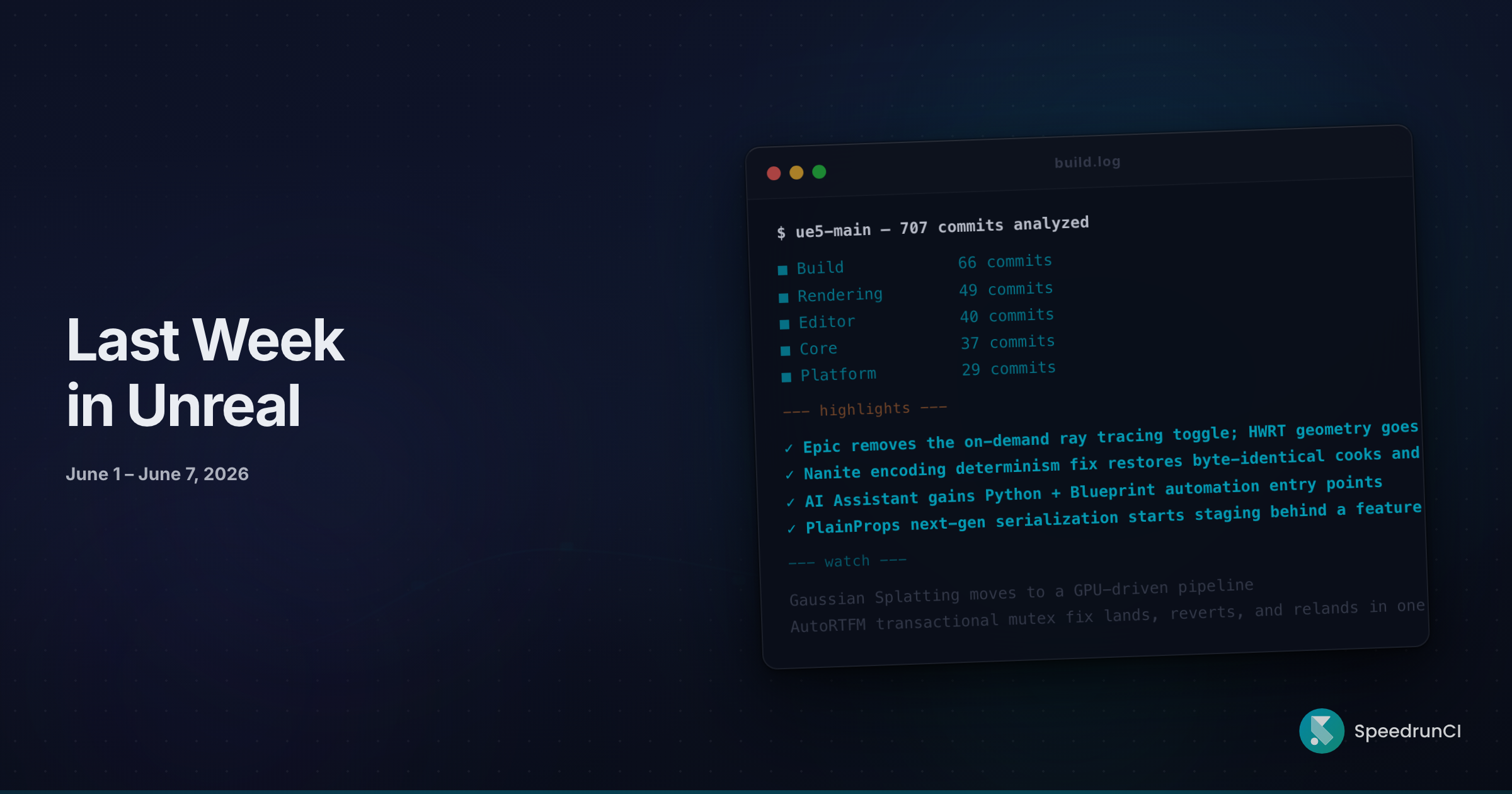
Week of June 1 to 7, 2026 | 707 commits analyzed | Branch: ue5-main
Overview
This was a hardening week, not a feature week. Most of the volume is crash fixes, build-system plumbing, and gitdeps bumps. Underneath the maintenance, several foundational arcs kept moving quietly: ray tracing edging toward always-on, a next-gen serialization format staged behind feature flags, and a Scene Data render-thread refactor laying down scaffolding for a multi-release migration.
Development Trends
Ray tracing is being promoted from opt-in to default. Epic removed the r.RayTracing.EnableOnDemand cvar outright this week, making on-demand RT geometry default-on rather than a gated path, and backed it with production-grade plumbing: a pre-allocated streaming staging pool (roughly 10% lower streaming-request overhead on the MegaLights load), HWRT memory throttling, and a skinned Nanite RT fallback per-LOD correctness fix. Epic only deletes a toggle once it trusts the machinery behind it to be the default. This is the same rendering-modernization arc that ran through MIR and the material translator for 15 weeks, now expressed through RT defaults while MIR itself drops to minor translator asserts as the arc winds toward complete.
The next-gen serialization format moved from incidental hardening to active staging. What was a quiet property-system cleanup two weeks ago became a dedicated Serialization theme: the NSS loading-path redirect went live behind a feature flag (three benign-unless-opted-in hooks), alongside a fourteen-commit PlainProps push adding decimal and numeral types, static arrays, schema-binding ref-counting, and an upgrade API. PlainProps is the next-gen property serialization format and NSS is the seam that lets it intercept the existing flow without breaking current loads. Staging save and load infrastructure behind a flag keeps a change this invasive from touching current cooks until someone opts in.
The AI Assistant is graduating from a chat box into a scriptable engine service. Fourteenth consecutive week of AI-tooling work, now shifting from internal toolset plumbing to external automation surface: a UAIAssistantInstance entry point for driving the Assistant from Python and Blueprints, an EConversationUpdateType Blueprint UENUM, and a per-widget context mechanism that lets individual Slate widgets attach metadata the Assistant harvests along the widget path. Wiring it into Python and Blueprints plus the ongoing toolset diff-test hardening reads as Epic preparing it for studio-facing automation, not demos.
Build work has settled into reproducibility and observability polish. Build volume fell to 66 on a light 707-commit week, but the character is unchanged from the post-cut polish phase. The standout is a Nanite encoding determinism fix (a non-associative float reduction in the crack-free tessellator replaced with a sorted-key deterministic reduction, plus a general parallel deterministic sort) that restores byte-identical cooks and DDC hit rates. Around it: Linux reached Windows link parity via UbaObjTool, UnrealBuildTool consolidated tracing onto OpenTelemetry across roughly 60 files, zenserver hit v5.8.15 with OTel hub metrics, and UBA saw 30-plus commits. This is a release branch being made reproducible and observable, not feature work.
TL;DR
- Epic deleted the on-demand ray tracing toggle entirely, which means the runtime now treats on-demand RT geometry as default-on rather than an opt-in path. If you ship HWRT or hardware Lumen, this is the most consequential change of the week.
- A Nanite encoding determinism fix landed that should restore DDC hit rates for anyone on shared cache or byte-identical cooks. This is the most CI-relevant commit of the week.
- Nothing here is an emergency. The serialization, Scene Data, and AI Assistant work is staged behind flags or still scaffolding. Worth reading, not worth dropping anything for.
Highlights
Rendering & Performance
What changed
The r.RayTracing.EnableOnDemand cvar was removed outright, with Epic noting the functionality will now be always available. On-demand RT geometry was previously a gated path. The same week added a pre-allocated staging pool for ray tracing geometry streaming (new r.RayTracing.Streaming.StagingPoolSizeMB cvar with a temp-allocation fallback), measured at roughly 10% lower streaming-request overhead on the MegaLights demo’s initial load. A correctness fix landed in skinned Nanite RT fallback materials, where mismatched LODs between raster and ray tracing could select the wrong material or crash. Separately, HWRT streaming gained memory-throttling work.
Why this is important
Deleting the on-demand path means Epic now assumes the build and streaming machinery behind it is robust enough to be the default. The staging pool and per-LOD fix back that up: the path is being treated as production infrastructure, not an experiment.
Who should care
Rendering engineers, and anyone shipping HWRT or hardware Lumen on console and high-end PC.
Urgency
Track. If you carried local assumptions about EnableOnDemand existing, verify before you pull this. Otherwise low risk.
Build & Tooling
What changed
A Nanite determinism fix replaced a non-associative float reduction in the adaptive crack-free tessellator. It had been averaging vertex displacements in hash-table chain order, so insertion order changed the result and the same mesh could encode to different bytes across machines or runs. The fix uses a sorted-key deterministic reduction and ships a general-purpose parallel deterministic sort as a drop-in for Algo::Sort where reproducibility matters.
On the toolchain side, the Linux build path reached Windows parity: import-lib linking now goes through UbaObjTool to create an ELF stub, removing the separate relink path. UnrealBuildTool consolidated all of its tracing onto OpenTelemetry across roughly 60 files, and zenserver v5.8.15 added OTel hub metrics. A glibc static-initializer deadlock in AssetRegistry registration on Linux was fixed. UBA saw a major week of activity across more than 30 commits.
Why this is important
Non-deterministic Nanite encoding quietly destroys DDC hit rates, and the symptom (cache misses, slower cooks) rarely points back at the cause. That fix alone justifies the week for build engineers. The Linux parity and OTel consolidation are the slower-burn story: Linux build farms behave more like Windows now, and build telemetry is standardizing on one format.
Who should care
Build and CI engineers, anyone relying on shared DDC or byte-identical cooks, and teams running Linux build farms.
Urgency
Track. Pull the Nanite determinism fix if you have been chasing unexplained DDC misses.
Stability & Fixes
What changed
SavePackage’s default error handler switched from GError (asserts and crashes) to GWarn (logs), with a new LogSavePackage category. The stated principle is that the editor should never crash except where data loss is possible, and procedural or cook saves should report errors through logs. Note the churn: it landed, was backed out, and re-landed within three days.
A cluster of crash and memory-safety fixes was pulled up from low-interest because the bodies told a real story: a DynamicWind cook-path race condition, an uninitialized FGeneratedKey in Mutable that produced duplicated parameters, a null-deref guard in the animation runtime’s BlendStackCoreTrait where AllocateInstance could return nullptr, a Nanite proxy crash on meshes with no sections, a shader preprocessor assert on variadic macros that crashed legitimate HLSL compiles, and several MIR material translator asserts (mesh-paint virtual textures, custom HLSL scene-texture lookups) that were blocking the legacy-to-MIR migration.
Why this is important
The SavePackage change is meaningful for CI: it is the difference between a cook that fails loudly with a categorized log line and one that dies on an assert. The Mutable and DynamicWind fixes matter because both are shipped, customer-facing systems, and an uninitialized-memory bug producing duplicated data is the kind of failure that slips through testing and surfaces in a shipped build.
Who should care
Build and cook engineers, CI maintainers, and anyone who depends on save-failure semantics.
Urgency
Track. If you rely on save-failure behavior, verify against the re-landed SavePackage change given the land-backout-reland cycle.
Serialization
What changed
The NSS serialization redirect started going live: three commits added minimally intrusive hooks into the loading path to redirect serialization to NSS payloads, described as intentionally benign unless opted into. In parallel, a fourteen-commit PlainProps push added decimal and numeral types, static-array support, C-array static_array<T,N> UPROPERTY wrappers, schema-binding ref-counting, and an upgrade API. A stray assert (meta structs always have members) that falsely fired on valid void() UFunctions was also removed.
Why this is important
PlainProps is the next-gen property serialization format, and the NSS hooks are the integration seam that lets it intercept the existing serialization flow without breaking current loads. The hooks stay dormant until something opts in, so the new format can land in the branch long before any cook depends on it.
Who should care
Engine maintainers and anyone with custom serialization paths who should know this seam now exists.
Urgency
Low. Benign unless opted into. Worth knowing it is happening.
Editor & Tools
What changed
The AI Assistant gained an external entry point (UAIAssistantInstance) for driving it from Python and Blueprints, exposed EConversationUpdateType as a Blueprint UENUM, and added a per-widget context metadata mechanism so individual Slate widgets can attach context the Assistant harvests along the widget path when a user queries that widget. Alongside it, the AI EditorToolset and ToolsetRegistry saw diff-test churn. One smaller QoL win: the material editor now color-codes half vs full precision on graph wires and shows primitive types in hover text.
Why this is important
The Assistant is graduating from a chat box into a scriptable engine service with structured UI context and external automation hooks. Wiring it into Python and Blueprints, plus the toolset hardening, reads as Epic preparing it for studio-facing use rather than demos.
Who should care
Tools engineers and studios thinking about editor automation. Shader authors get the material-editor precision cue.
Urgency
Track.
Animation & Audio
What changed
The Unreal Animation Framework continued an active push (roughly 18 commits) across DeadBlend, Freeze, and inertial transitions, StateTree task integration, and ControlRig and Verse routing. On the audio side, MetaSound landed a Variant Node Facade: TVariantNodeFacade collapses N templated variant registrations into one registered node per data-type family, resolving the concrete type at operator-creation time (for example the per-type Int32/Float/Bool/String value nodes and the per-type Add nodes become single nodes). Audio Insights also saw 11 commits of fixes and UI polish with little fanfare.
Why this is important
The MetaSound facade is an architectural change to how nodes are registered and dispatched, not a bug fix. For anyone authoring MetaSound nodes, it restructures the registration model and is the foundational piece for a broader node-config rollout.
Who should care
Animation engineers, and anyone authoring custom MetaSound nodes.
Urgency
Track for MetaSound node authors. The animation work is normal ongoing development.
Platform
What changed
Mobile and UEFN preview-to-device fidelity got attention from three authors moving in the same direction. A UEFN submenu now lists per-device Android and iOS JSONs so creators can launch a session matching a real device’s profile, fragments, and aspect ratio, backed by a new SetOverrideDeviceProfile(Profile, Fragments) engine API for cooked-editor callers. Android also gained native gesture API integration (a rotation detector with angle slop) and in-app store review via the Play Review API (a generic RequestStoreReview on FPlatformMisc).
Why this is important
The preview-to-device gap is a long-standing source of “looked fine in editor, broke on hardware” surprises for mobile and UEFN creators. Closing it inside the cooked editor is a practical fidelity improvement, not a cosmetic one.
Who should care
Mobile and UEFN creators.
Urgency
Low. Useful when you next touch mobile preview.
Worth Tracking
Gaussian Splatting moved to a GPU-driven pipeline. A six-commit cluster shifted splat rendering off CPU dispatch onto indirect GPU dispatch, extended the GPU Radix Sort for indirect dispatch, and added GPUSort automated tests. It is rated low and the files were partly truncated, but the direction is unambiguous: this is the groundwork for a real perf and scalability step in radiance-field and splat content, and a sign Gaussian Splatting is maturing past experimental. Worth watching if you have splat content on the roadmap.
Scene Data refactor, curve skinning, and AutoRTFM churn. Initial Scene Data and skeleton Primitive Scene Data managers landed as early scaffolding for a larger render-thread refactor of per-primitive scene data, the kind of change that migrates over several releases. A new provider-agnostic curve-skinning scene extension deforms geometry along an animated curve, with Nanite groom as the first POC consumer; it is groom-only and O(NumRegistered) per frame today, so it is a thing to watch, not adopt. Separately, the AutoRTFM transactionally-safe mutex work (making locks abort and retry the entire transaction nest to break deadlocks) was committed, backed out, and re-committed several times this week. The commit message calls the retry “the costly price,” and the land-revert cycle says Epic is still wrestling with the tradeoff. If you are on AutoRTFM transactional paths, track this one closely.
What We Ignored
We dropped roughly 7 commits as outright noise, plus around 400 low-interest entries: localization passes, UBA and gitdeps binary bumps with empty commit bodies, formatting, and internal refactors. The low-interest catch-all was overloaded this week (382 of 403 sat in the “other” subsystem), so the analysts pulled several items up where a cluster told a real story: the DynamicWind cook race, the Mutable uninitialized-memory bug, the animation null-deref guard, the Gaussian Splatting GPU pipeline, the MIR translator compile fixes, and the MetaSound variant facade. One clarification for anyone scanning the raw data: “UAF” here means Unreal Animation Framework, not use-after-free.
Closing
A maintenance week is a good week to read carefully, because the changes that quietly reset defaults and cache behavior are exactly the ones that cost you later if you miss them.
Quiet Systems Worth Watching
Systems that didn’t show up this week, but are worth tracking. Each has been at its current status for 2+ releases and has gone calm for 3+ weeks. These are the systems most likely to graduate in the next release.
- Mover (Beta, Stability Age 2 releases). Calm since the 5.8 development cycle. The networking-aware movement system has held Beta since 5.6 and its recent updates were feature additions, not crash fixes, which is the usual shape of a system being lined up for a Production-Ready flip.
Commit References
| Claim | SHA |
|---|---|
r.RayTracing.EnableOnDemand cvar removed, on-demand path now mandatory |
1ee9fc9c |
| RT geometry streaming staging pool, ~10% streaming overhead reduction on MegaLights load | 533efbde |
| Skinned Nanite RT fallback per-LOD material fix | e4da77f3 |
| HWRT streaming memory throttling | 7136cc68 |
| HWRT streaming request ordering fix | 84192939 |
| HWRT streaming stats improvements | c23860b9 |
| Nanite tessellator deterministic reduction + parallel deterministic sort | 5bc3af5e |
| Nanite proxy crash fix on meshes with no sections | b9131963 |
| Linux import-lib linking via UbaObjTool (ELF stub) | 68199817 |
| Linux import-lib linking prep | 169faff6 |
| UnrealBuildTool tracing consolidated on OpenTelemetry | d7bc4f71 |
| zenserver v5.8.15 OTel hub metrics | f7bf67f1 |
| glibc static-initializer deadlock in AssetRegistry on Linux fixed | 5740c703 |
| SavePackage default handler GError to GWarn, new LogSavePackage category | 79d78b9b |
| SavePackage backout | f16d13da |
| SavePackage re-land | 2c29abcd |
| DynamicWind cook-path race condition fix | a46c59ca |
| Mutable uninitialized FGeneratedKey causing duplicated parameters | f1b2f2d1 |
| Animation BlendStackCoreTrait null-deref guard (AllocateInstance nullptr) | bbe08306 |
| Shader preprocessor assert fix on variadic macros | 546c9bb3 |
| MIR translator assert fix on mesh-paint virtual textures | 3ec40c43 |
| MIR custom HLSL scene-texture lookup compile fix | 6bc1546e |
| NSS loading-path serialization redirect hooks | b0a4ce71 |
| NSS loading-path serialization redirect hooks | af2caed1 |
| NSS loading-path serialization redirect hooks | 283f9656 |
| PlainProps decimal/numeral types, static-array, schema-binding, upgrade API | f9a6b953 |
| PlainProps additions | 086ea422 |
| PlainProps additions | 1218a041 |
| PlainProps incorrect meta-struct assert removed (void() UFunctions) | 8bb3cea8 |
| AI Assistant UAIAssistantInstance, Python/Blueprint entry point | 45858e64 |
| AI Assistant EConversationUpdateType exposed as Blueprint UENUM | ccd41702 |
| AI Assistant: pass FWebApplication to conversation-update subscribers | 114cd91d |
| AI Assistant: WithWebApplication returns callback-ran status | 1e979ffb |
| AI Assistant per-widget context metadata (FAIWidgetContextMetaData) | c1c5ec2b |
| Material editor half/full precision wire color-coding + primitive hover | 37fd9b9a |
| MetaSound TVariantNodeFacade (UE-382202) | 87c7ec32 |
| Gaussian Splatting moved to GPU-driven pipeline | 350207a7 |
| GPU Radix Sort extended for indirect dispatch | 56045fa7 |
| GPUSort automated tests | 8b98317c |
| Scene Data manager + skeleton Primitive Scene Data manager scaffolding | 5ab18b63 |
| Provider-agnostic curve-skinning scene extension | 36e22526 |
| Curve-skinning scene extension | da55a287 |
| Curve-skinning scene extension | 6d2161d0 |
| RHI device analytics provider scaffolding | b150ab46 |
| AutoRTFM transactionally-safe mutex abort-and-retry | 417b20a5 |
| AutoRTFM mutex churn | 4c6a7326 |
| AutoRTFM mutex churn | 9a360bf6 |
| AutoRTFM mutex churn | c271382c |
| UEFN mobile preview JSON + SetOverrideDeviceProfile API | 2b99b1a9 |
| Android native gesture API (rotation detector) | 254ba0bc |
| Android in-app store review via Play Review API | 42651599 |
| Horde agent self-reported health robustness | 3e2afb70 |
All SHAs reference the ue5-main branch of EpicGames/UnrealEngine.
Never miss a ue5-main update.
Get them delivered straight to your inbox.