Last Week in Unreal: C++23 Becomes the Default and the Editor’s AI Agent Gets Bolted Down (July 13 to 19, 2026)
Unreal Engine Weekly: The Build System Grows Up and the Agent Gets Bolted Down
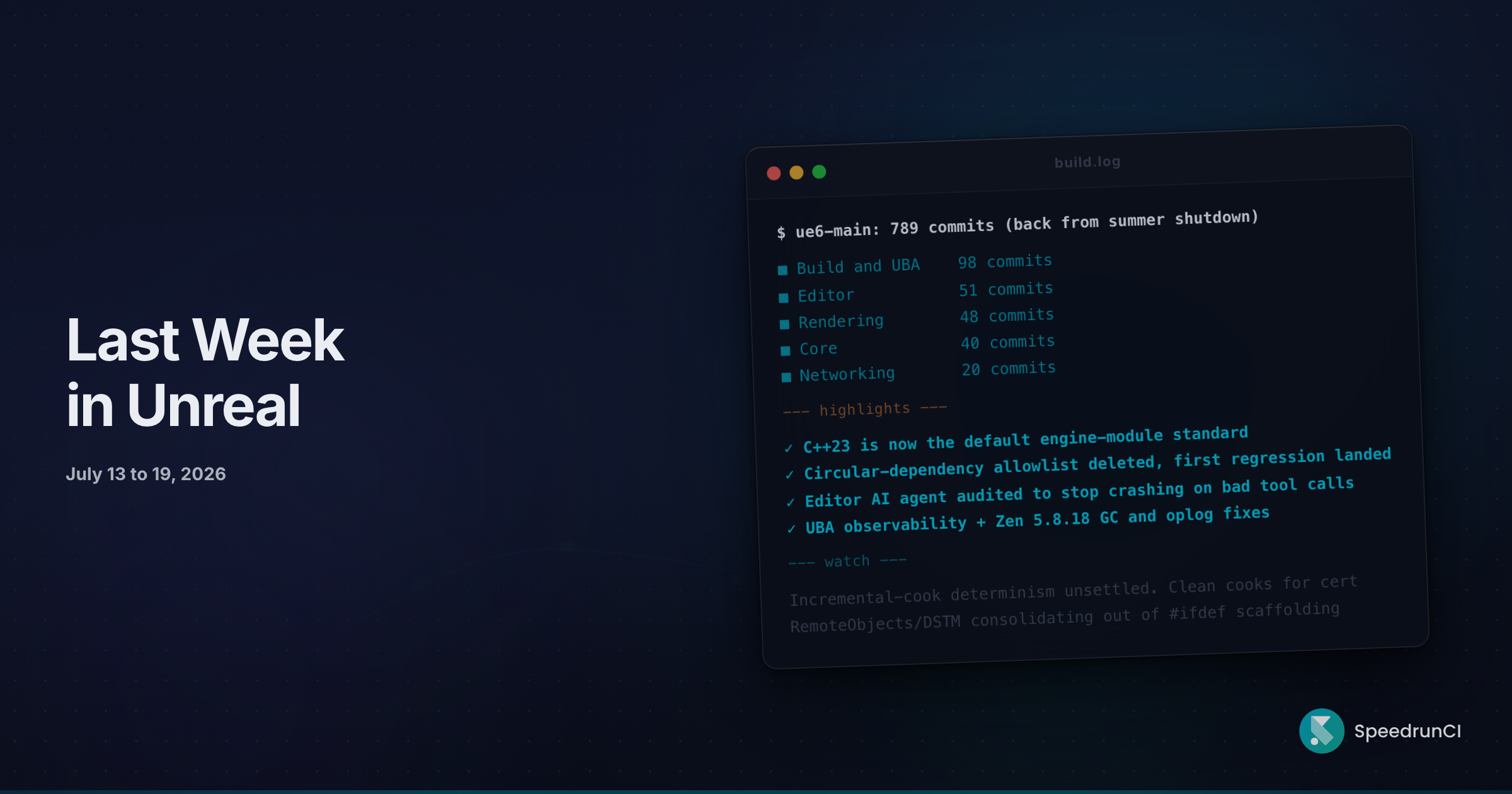
Week of July 13 – 19, 2026 | 789 commits on ue6-main, 48 on ue5-main | Branch: ue6-main
Overview
This was a systems-plumbing week more than a feature week, and the graph snapped back from Epic’s summer shutdown: 789 commits on ue6-main, and ue5-main off zero to 48 as 5.x maintenance resumed. The dominant thread is Epic hardening its in-editor LLM agent toolsets and, underneath them, modernizing UnrealBuildTool (C++23 by default, circular dependencies gone) and the distributed build cache. The renderer’s FScene continued its slow decomposition into modular Scene Extensions, and a steady stream of crash-class and data-race fixes landed across Mutable, Iris, audio, and material graphs.
Development Trends
Editor AI tooling shifts from buildout to hardening. The in-editor LLM agent toolset thread that first earned its own editorial theme in mid-June has not slowed; this week it entered a defensive audit phase, systematically converting agent-callable entry points from crash-on-bad-input to graceful failure. That Epic is spending a dedicated audit making these paths non-fatal is the strongest signal yet that the agent is live enough for bad tool calls to routinely take down the editor. Roughly four months into this initiative, the direction is unambiguous: the editor is becoming a first-party target for an LLM agent, and the plumbing underneath it is being made production-safe.
Build and toolchain modernization is the sustained through-line on ue6-main. What read as post-cut “polish” earlier in the year has, on ue6-main, become outright modernization: C++23 is now the default standard for engine modules, module circular dependencies are fully eliminated, and UnrealBuildTool’s incremental detection and manifest handling moved onto modern .NET. In parallel, the distributed build cache (UBA observability, Zen 5.8.18 with GC and oplog-import correctness fixes) keeps maturing week over week. This is the most consistent multi-month thread in the data, and its character has moved from cleanup to structural change, so source-build studios should expect real validation work rather than passive upgrades.
Renderer internals are being decomposed into modular Scene Extensions. A Scene Data refactor that looked like single-week scaffolding in early June has returned as a sustained effort to move state off the monolithic FScene into self-contained, dirty-tracking Scene Extensions. Velocity, runtime virtual texture, capsule shadows, and GPUScene invalidation are all being pulled out along the same pattern, with the stated goal of decoupling input from scene updates so the pipeline can eventually be driven by a state stream. This is invisible to shipping behavior but high-blast-radius for anyone carrying custom renderer patches, and its steady cadence points to an architectural direction rather than a one-off cleanup.
Distributed world-sim substrate is quietly firming up its API. RemoteObjects/DSTM transactional infrastructure is consolidating out of #ifdef scaffolding into public functions, the usual tell that a subsystem is stabilizing its surface ahead of wider internal use, and networking activity ticked up to a window high alongside Iris replication hardening. Taken together this reads as investment in server-authoritative large-world and multi-server simulation as a forward substrate. It is early and low-volume, but worth tracking for any studio with large-world or distributed-sim ambitions.
TL;DR
- Engine modules now compile as C++23 by default (
48648dad). If you build UE6 from source or pin an older standard, validate now. This is a real state change, not activity noise. - Epic’s in-editor AI agent toolsets are real enough that bad tool calls were crashing the editor. A systematic audit is converting agent-callable entry points from check()-and-crash to graceful failure, and each fix protects every caller, not just the agent.
- Module circular dependencies are fully removed (
8a03506c,8bc993b6), a structural milestone that is already producing regressions (Engine to UnrealEd decouple crashed on editor exit,585044e5). - IoStore On-Demand install/streaming got a full week of production hardening. Studios shipping partial-install titles on write-constrained consoles should expect materially different install pacing.
- Incremental-cook determinism looks unsettled on this branch (a cluster of “native change not picked up” bumps). Lean on clean cooks for cert builds until the cadence quiets.
Highlights
Epic’s in-editor AI agent toolsets and the crash-hardening audit behind them
What changed: Epic is exposing the editor to an LLM agent through Python toolsets (SceneTools, MaterialTools, CurveTableTools, BlueprintToolset, UMGToolSet, PluginToolset, AssetTools) plus a reversible Blueprint-graph text DSL that decompiles a Blueprint to text and recompiles it (read_graph_dsl / write_graph_dsl). Most visible this week is a defensive audit tagged “Audit follow-up to CL 55439527 / UE-385503”: every agent-callable entry point that could feed bad input into an engine subsystem is being converted from check()-and-crash to graceful failure. DSL round-trip correctness landed for comment-box geometry on cold loads (25dac488), native member-function calls resolving to a creatable type_id (5f688b16, 54be5e06), and multi-output pure nodes like Map/Find binding to the right pin (4e43382e, 752be542). Crash-to-non-fatal fixes covered StaticMesh merge with no renderable mesh (7e639551), adding a simple curve to a rich-curve CurveTable (0b346e7e), null material-expression iteration (74f0089a), and find_actors with an interface filter (e54c1a73). New capabilities include containment-checked download_file into a virtual path (b6c25c80) and MaterialTools get_statistics shader-stat exposure (8573def5).
Why this is important: The fact that Epic is spending a full audit making these paths non-fatal tells you the agent is live enough that bad tool calls were routinely taking down the editor. Each hardening fix protects every existing caller, including hand-authored Blueprints, not just the agent. Note that much of this lands as Commit.gitdeps.xml-only changes because the Python toolset code is virtualized, so any “build” classification here is misleading.
Who should care: Tools engineers, technical designers, and anyone tracking Epic’s LLM-in-editor direction.
Urgency: Track. Not something to adopt, but the clearest signal yet of where the editor is heading.
UnrealBuildTool modernization: C++23 by default, circular dependencies eliminated
What changed: The default C++ standard for engine modules is now C++23 (48648dad), with C++26 enum staged (626319cb). Epic finished removing module circular dependencies: the CircularDependenciesAllowList is deleted (8a03506c) and the remaining circular-dependency check is gone (8bc993b6). On Windows, the external cl-filter.exe is replaced by inbuilt MSVC timing parsing (f2e0d9a1, removal 0ccd35f8), and UBT now serializes precompiled manifests and command-line handling through modern .NET (e6c8239f, 958dd158). Incremental detection got smarter: source-file working sets driven by EpicLore indexing, Perforce-opened files, and Horde preflight state (9211ee27, 18da622f), with action ordering partially randomized to raise cross-host cache-hit rates (3f5c9c7d). GraphEditor was decoupled from BlueprintGraph (ba1df3c0).
Why this is important: The C++23 default is a genuine state change that source builds and older-standard projects need to validate against now. The circular-dependency removal is a structural milestone, but it is already producing regressions: the Engine to UnrealEd decouple caused an editor-exit crash (585044e5). Toolchain wrappers that shell out to cl-filter need to adapt. One instability signal worth noting: UHT input/output caching was disabled, re-enabled, then disabled again within the week (dc083352, 709218a9, d4a6c530), so that path is not settled.
Who should care: Build engineers and engine programmers, especially anyone on tip-of-tree or building UE6 from source.
Urgency: Act now if you build from source. Validate your standard-pinning and any cl-filter-dependent tooling.
Distributed build cache grows up: UBA observability and Zen 5.8.18
What changed: UBA got a week of cache-service stats-page work (hit percentage, per-client TCP/NIC stats, crypto-failure counts with remote IPs, hit-rate graphs, CAS download/delete) alongside reliability fixes: agent crash and recovery when the in-process storage proxy goes bad (abd9dc83), the scheduler no longer over-requesting remote help (e799aa8b), and shutdown crashes (174e6431, 751079e9). The Zen storage server jumped to 5.8.18 (67d8080d) with OpenTelemetry throughout, a single-record zen cache drop, and GC and oplog-import correctness fixes that previously could leave a committed op referencing an already-deleted chunk. Per-client bottleneck visibility (81a94db4, b3cbb1bf, 3a19570e) and sortable client history (a72416ff) landed too, and Zen hub mode now scales past its ~1024-instance limit.
Why this is important: The Zen GC and oplog-import fixes are correctness, not cosmetics: a committed op referencing a deleted chunk is a data-integrity hazard for a shared cache. The observability work makes per-client bottlenecks visible for the first time.
Who should care: Build and infra engineers, and studios running shared Zen/DDC or UBA cache farms.
Urgency: Track, and act now if you operate a shared cache farm. The Zen bump is worth scheduling.
FScene decomposition into modular Scene Extensions
What changed: A sustained renderer refactor continues moving state off the monolithic FScene into self-contained Scene Extensions driven by dirty-tracking rather than the scene-update pass. The core change moves instance data out of FPrimitiveSceneInfo into FScenePrimitiveDataEngine/Renderer arrays and switches GPUScene, VSM cache invalidation, and SceneCulling to dirty-flag-driven updates (fd2022a6). Per-system extractions include velocity data to FVelocitySceneExtension (db26d90c), runtime virtual texture to its own extension (55ddf77d), and capsule-shadow caster primitives to an extension (7da3df1b). Skinning gained provider phases so dynamic wind can skin during the render phase while the normal path skins during scene update (f38e3f39). Measured win: roughly 150us off the critical path in CitySample from avoiding FPrimitiveSceneInfo and proxy hits in GPUScene.
Why this is important: This is internal plumbing with no behavior change, but it touches GPUScene, VSM invalidation, SceneCulling, and primitive data layout. The stated goal is decoupling input from scene updates so it can eventually be replaced by a state stream.
Who should care: Graphics and engine programmers maintaining custom render paths.
Urgency: Track. Anyone carrying renderer patches should expect merge pain.
Slate rounded-box shader rewrite
What changed: A significant rewrite of the Slate rounded-box shader landed (3154d3b3, PR #14958).
Why this is important: The rounded-box shader is the primitive behind nearly every Slate and UMG element with a corner radius: buttons, panels, cards, borders. A shader-level quality and performance change here has a broader blast radius than most individual rendering commits, touching essentially the entire editor and every shipping UMG UI. It arrived flagged as low-interest, which undersells it.
Who should care: UI programmers, tools engineers, and anyone shipping custom UMG.
Urgency: Track. Low risk, but visually and performance-relevant everywhere, so worth a smoke test on custom UI.
Hardware ray tracing and Nanite RT continue maturing
What changed: HWRT hardening continued: the ray-tracing instance buffer builder moved to RDG (ebb0d147), Nanite ray tracing gained assembly support in streaming traversal and stream-out (37b99ff2, e6418a54), and D3D12 opacity micromap support got index-format and index-only-linking improvements (20183afa). Several null and stale-pointer crashes were patched (Nanite RayTracingProxy 35c13cd6, GPULightmass 5daa01e0).
Why this is important: The OMM improvements matter for foliage and alpha-tested geometry cost in RT. Nanite-in-ray-tracing assembly transforms close a correctness gap that otherwise blocks HWRT adoption on instanced and assembly-heavy scenes.
Who should care: Graphics programmers and studios evaluating HWRT or Lumen-HWRT.
Urgency: Track.
IoStore On-Demand install and streaming hardening
What changed: The IAD/IAX subsystem (on-demand container mounting, chunk install/eviction, platform write-throttling) saw a coordinated cluster. Eager-defrag correctness now prevents pending defrag chunks from pinning CAS blocks (e44bc911), a dedup path that failed to locate the right chunk was fixed (e83f0e7b), and installer back-pressure was rewritten so “pressure” is driven by estimated time-to-write the download queue to disk rather than raw item or byte count (4088fc55). Write-budget accounting was simplified so subscribers see the full platform rate against a live budget counter instead of static bias-weighted fractions that starved solo subscribers (0332d1fa), plus a Cycles vs Cycles64 mismatch in throttle-delay math was corrected (cb490d5a). New histogram buckets and persistence analytics (231871e5, 5be99bf5) and an iax.DumpMountedContainersToLog diagnostic (009d795c) rounded it out.
Why this is important: This is the runtime that decides what installs, what stays resident, and how aggressively the game writes to disk mid-session. The back-pressure rewrite changes install pacing behavior on write-limited targets.
Who should care: Studios shipping partial-install or streaming-install titles, especially on write-constrained consoles.
Urgency: Track. Worth reading before pinning an engine version for a title heading into cert.
Stability and crash-class fixes
What changed: Two genuine memory-safety fixes stand out: a data race in the Mutable runtime around Task_Mutable_GetMaterials (81bba34e), and a recursion guard threaded through IsResultMaterialAttributes to prevent a stack-overflow crash on cyclic material graphs (2f015c20), a user-reachable content path. Iris fixed a use-after-free class bug where RPCs referenced dynamic replicated objects destroyed the same frame (ad3ce764). A wave-intrinsics undefined-behavior fix corrected GroupMemoryBarrierWithGroupSync executing in divergent control flow when the wave is narrower than the threadgroup (819dbd72), a correctness landmine that can work on one GPU and corrupt or hang on another. Also landed: a StaticMesh async-build fix eliminating a roughly 219-second cook stall behind DDC fetches (69f0d76d), a thread-safe dynamic-import registry on FLinkerLoad fixing load failures for legacy Control Rig override assets (b5f0409e, UE-381080), an AsyncPhysics RootCounts leak (0ec43389), and audio hardening of TCircularAudioBuffer (669ddbba).
Why this is important: The Mutable data race and the cyclic-material-graph stack overflow are both reachable from normal content workflows. The wave-intrinsics fix is the kind of bug that passes on your hardware and fails on a customer’s. The 219-second cook-stall fix is a straight cook-time win.
Who should care: Anyone on tip-of-tree, plus graphics programmers writing compute shaders and studios using Mutable or Iris replication.
Urgency: Act now if you are pinning a build. These are the fixes you want in.
Worth Tracking
Incremental-cook determinism looks unsettled. Multiple standalone “bump cookincrementalversion / native change not picked up” commits landed this week (325468c1, 79de0d09, 852c286f, fc2e7259), plus an IoStore DDC version bump (fff1af6c) and an editor-domain digest lock-contention fix (1a845c10). Each is trivial on its own, but a cluster of “native change not invalidating content that uses it” fixes in a single week points at cook-key and invalidation gaps surfacing during parallel-incremental-cook work. On a build farm these produce stale cooked output without an obvious error. Treat incremental-cook determinism on this branch as not-yet-settled and lean on clean cooks for cert builds until the cadence quiets.
RemoteObjects / DSTM transactional infrastructure is stabilizing its API surface. RemoteExecutor now exposes ConditionalExecuteTransactional so callers stop #ifdef-ing UE_WITH_DSTM (161f9be7), the libpas Remote Object Handle case was removed from CoreUObject because the Remote Heap no longer uses it (e01274f1), and remote-object-id globalization and server-id lifecycle continued tightening (565258b2, e991093a). Consolidating out of #ifdef scaffolding into a public function is the usual tell that a subsystem is firming up its API ahead of wider internal use. This is substrate for large distributed and multi-server world simulation. Track it if server-authoritative large-world sim is on your roadmap.
What We Ignored
Roughly 20 commits were filtered as pure noise (formatting, typo, trivial reverts) before analysis. Beyond that, we set aside several clusters as low-signal for this audience: an animation-runtime allocation-elimination sweep (per-frame heap allocations stripped from anim evaluation, e.g. d0a3ca2d, b0ab9e74) that is a free gain on character-dense scenes with no action needed; a Control Rig Constraints editing UX rewrite gated behind a CVar fallback (f54d5bf1), which is pure UX with the fallback signaling Epic is not yet confident; and a large body of uncategorized Verse, Solaris, and AutoRTFM churn (roughly 37 Verse and 17 AutoRTFM commits), SceneGraph/Entity/Prefab work, and Interchange and Audio Insights activity that did not carry a clear this-week decision for most studios. Skipping these is deliberate.
The 5.x Stabilization Sidebar: ue5-main
ue5-main came back from the shutdown at 48 commits, and the character is exactly what a post-final-release maintenance branch should look like. There was no installer version bump this week, so no structural release event to report, and the single largest cluster (roughly 19 commits) was internal revision-control and backout-restore tooling rather than engine code. A handful of fixes are worth a cherry-pick if you ship on 5.8 today:
- Lumen irradiance field gather got a real optimization: probe interpolation dropped from 0.93ms to 0.76ms (
9c140e9e), alongside a correctness fix for miscomputed probe sample-position offsets (26b898da). Free performance for anyone on the irradiance-field path. - A misaligned read in the stable PSO cache serialization was fixed, triggered by the FShaderHash change from SHA1 to XXH3 (
cb1bef43). If you ship a bundled PSO cache, this is the class of serialization bug that fails quietly. - IOStore chunk install:
-createchunkinstallno longer wrongly includes non-chunk-0.utoc/.ucas/.sig/.uondemandtocfiles (f4567b10), relevant to anyone building chunked installs on 5.8. - FPaths::IsStaged() had its
RequiresCookedData()clause restored (b34bd752), a staged-build path-resolution fix worth noting if you saw oddities there. - Platform fixes: a corrupted-mouse-image fix from a stride miscalculation in FMacCursor on Apple platforms (
5305bce1), and a Linux fix for plugin builds against an installed engine failing to link (0e5b877b).
A few changes landed on both branches: the Dynamic Wind work (cardinal batched-animation culling a740c504, reduced low-speed vibration 2dbaec56, and skinning provider phases 8550ce34, the last mirroring the ue6-main skinning-extension change above). Separately, the Composite editor kept gaining virtual-production tooling on 5.x, including a Transform 2D pass with a viewport gizmo (61515299) and per-layer pass-selection persistence (30baf551). Low, fix-and-trickle volume is exactly what 5.x should be doing now.
Closing
A quiet week on the surface, but the build system moved a real notch forward and a handful of the crash fixes are ones you want in before you pin a build.
Commit SHAs are cited inline, in parentheses, next to each claim. They reference the ue6-main branch of EpicGames/UnrealEngine, except the 5.x Stabilization Sidebar, whose SHAs reference ue5-main. Many of the highest-interest entries resolve to Commit.gitdeps.xml binary-manifest blobs: the commit message is real, but the code lives in Epic’s internal binaries, which we cannot see.
Never miss a ue5-main update.
Get them delivered straight to your inbox.