Last Week in Unreal — Feb 9-16, 2026
Unreal Engine Weekly — What Changed and What Matters
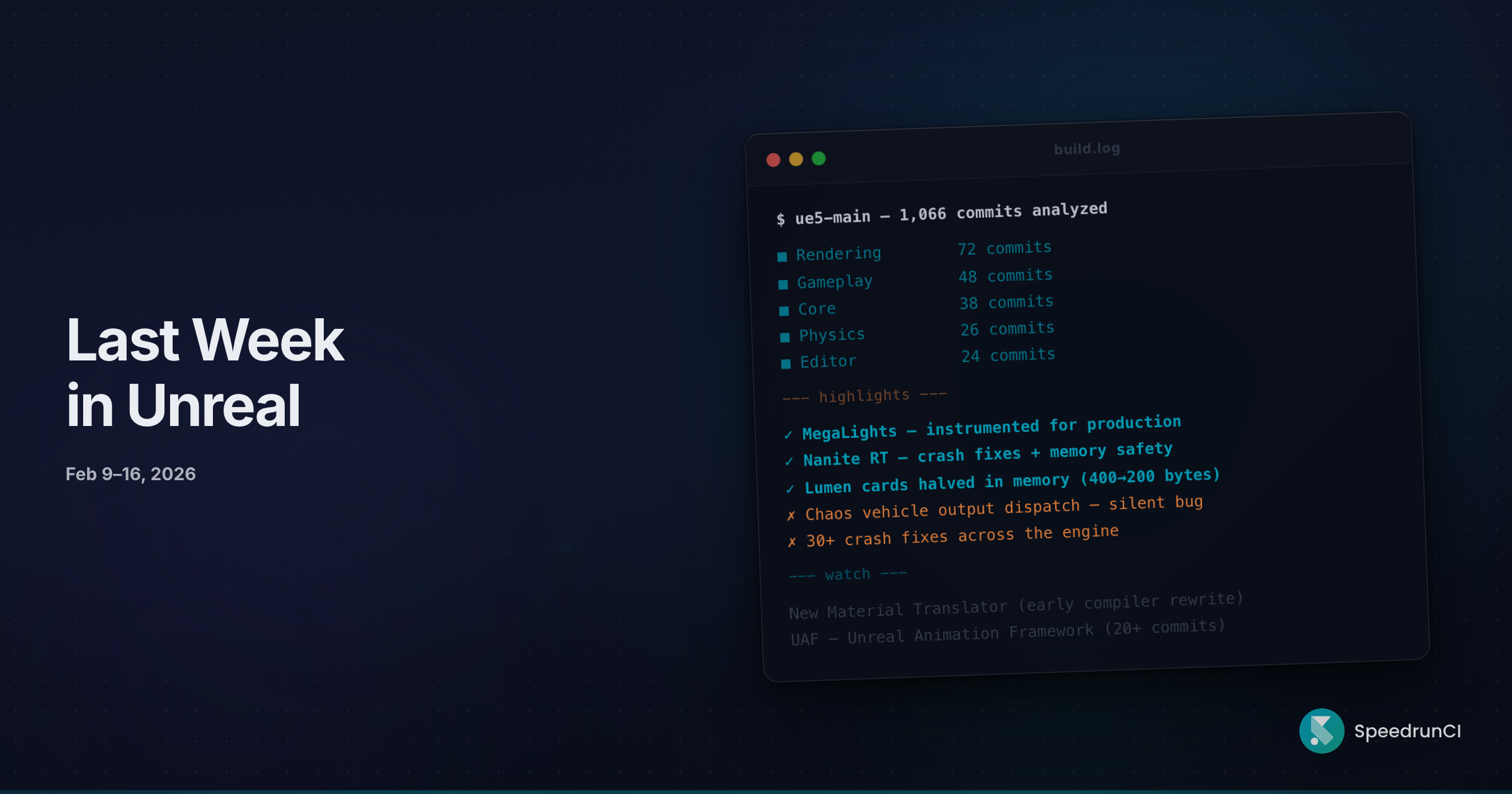
Week of Feb 9–16, 2026 | 1,066 commits analyzed | Branch: ue5-main
Overview
A high-volume week on ue5-main — 1,066 commits, 228 flagged as high interest, roughly 60-70 genuinely worth your time. MegaLights crossed from “experimental feature” into “feature being instrumented for production,” with a burst of debug tooling and scalability controls that looks like pre-stabilization work. Nanite RT continued its reliability push with crash-grade fixes to the CLAS allocator and stale page handling. Thread safety cleanup hit the renderer systematically. On the gameplay side, a delegate lifetime tracking overhaul changes fundamental engine patterns, and a Chaos vehicle bug was silently sending wrong output data to most vehicles.
PCG got a quiet hardening sprint. Lumen cards shed half their memory footprint. Vulkan picked up specialization constants and a Qualcomm XR extension. Over 30 crash fixes landed across the engine.
TL;DR
- MegaLights got unified debug CVars, scalability controls, and visualization modes. Old per-feature debug CVars are gone — automation scripts will break.
- Nanite RT fixed a GPU crash when toggling
r.RayTracing.Nanite.Mode 2at runtime, hardened the CLAS allocator to atomic-per-page allocation, and added use-after-free detection. - Lumen cards halved in memory — from 400 to 200 bytes on CPU. Meaningful at scale.
- Delegate lifetime tracking was overhauled. Multicast delegates are now trivially relocatable, automatic unregistration of stale delegates is removed. Behavioral change to a foundational pattern.
- Chaos modular vehicle output dispatch was sending wrong data to most vehicles. Fixed.
- HWRT scratch buffers exceeding 2GB now split into batches instead of silently failing. Teams scaling up RT geometry counts should pick this up.
- PCG had 10-12 commits focused on stability — the system is approaching production trustworthiness.
Rendering & GPU
MegaLights — Instrumented for Production
What changed. Krzysztof Narkowicz and Tiago Costa pushed a concentrated burst: r.MegaLights.Debug now replaces all per-feature debug CVars (r.MegaLights.Volume.Debug and variants) with a single unified control. New visualization modes were added for denoiser history clamp, shadow caster mismatches, and an overview mode. Screen trace quality is now exposed via r.MegaLights.ScreenTraces.Quality for scalability settings. A fast-clear fix for rect light tiles also landed.
Why this is important. This is the instrumentation you ship right before a feature goes from experimental to production. Debug unification, scalability hooks, and diagnostic visualization in the same week is a clear pattern. Teams relying on MegaLights for dynamic lighting should expect the API surface to stabilize soon — but should also expect current debug CVar names to break right now.
Who should care. Lighting artists and graphics programmers using MegaLights. Anyone with automation or debug scripts referencing the old per-feature CVars.
Urgency. Track. Update any CVar references immediately.
Nanite Ray Tracing — Crash Fixes and Memory Safety
What changed. The CLAS allocator now operates atomically per page: it either succeeds for the entire page or fails cleanly. Previously, partial page allocations could leave the acceleration structure in an inconsistent state. Stale pages in PendingInstalledPages were fixed — toggling r.RayTracing.Nanite.Mode 2 at runtime could reference freed pages, producing a hard GPU crash. FGeometryHandle and FGeometryGroupHandle were converted from raw typedefs to proper structs for type safety. A use-after-free detector was added to FRayTracingGeometryManager via feedback shaders.
Why this is important. These are production-readiness fixes, not experiments. The GPU crash from toggling Nanite RT mode at runtime is the kind of bug that blocks shipping. The use-after-free detector signals active investment in catching memory safety issues before they reach end users.
Who should care. Anyone testing or shipping Nanite RT. Graphics programmers maintaining custom RT integrations.
Urgency. Act now if you are testing Nanite RT in production. The stale page crash fix alone justifies a sync.
HWRT Large Scratch Buffer Fix
What changed. Dynamic geometry updates for hardware ray tracing could silently fail when scratch buffer allocations exceeded 2GB. The fix splits geometry builds into smaller batches when they hit this ceiling.
Why this is important. This was a silent scaling limit. Teams adding more RT geometry would hit an invisible wall with no useful diagnostic. Now it works.
Who should care. Teams pushing RT geometry counts in production scenes.
Urgency. Act now if you have been hitting unexplained HWRT issues at scale.
Lumen Memory Optimization
What changed. FLumenCard was halved from 400 bytes to 200 bytes on CPU and from 10 to 7 float4s on GPU. FLumenPrimitiveGroup went from 64 to 48 bytes.
Why this is important. For scenes with tens of thousands of Lumen cards, this is reduced memory pressure and better cache utilization. Custom Lumen shader modifications that reference the old GPU layout will need updating.
Who should care. Graphics programmers with custom Lumen shader work. Large-scale scene developers where Lumen memory is a concern.
Urgency. Track. Check your custom shaders if you touch Lumen data directly.
Thread Safety Cleanup in the Renderer
What changed. Zach Bethel systematically hunted TSAN errors: the FViewInfo shadow view copy was fixed (submitted, backed out, resubmitted correctly — skips copying members the shadow view never reads). GRDGAllowRHIAccess was made atomic, with the RDG pass bit moved to the correct async setup queue union. GRHIPresentCounter was moved from the render thread to the RHI thread, touching MetalRHI, D3D12RHI, VulkanRHI, and D3D11RHI. An unsynchronized stat counter increment was also fixed.
Why this is important. Systematic TSAN cleanup across the renderer is the kind of unsexy work that prevents intermittent crashes and data corruption in shipping titles. The breadth of this pass — touching four RHI backends — suggests a serious effort to clean up accumulated thread-safety debt.
Who should care. Engine programmers. Anyone seeing intermittent rendering glitches or crashes that smell like race conditions.
Urgency. Track. These are the fixes you want to have but rarely know you need.
Vulkan — Specialization Constants and XR Extensions
What changed. Vulkan specialization constant support landed across the shader compiler and pipeline infrastructure, enabling shader variant reduction by baking compile-time constants into SPIR-V. A community PR from Qualcomm added VK_EXT_fragment_density_map_offset support for XR/VR. Swapchain robustness improvements include delayed creation and leaked surface fixes.
Why this is important. Specialization constants are the long-game play for reducing permutation explosion on Vulkan. The Qualcomm FDM offset extension is immediately actionable for XR teams shipping on Qualcomm hardware.
Who should care. Graphics engine programmers (spec constants). XR developers on Qualcomm (FDM offset).
Urgency. Track for specialization constants. Act now if shipping XR on Qualcomm.
Other Rendering Changes
- Bindless descriptor ranges (
FRHIDescriptorRange) landed for D3D12 — new abstraction for contiguous descriptor allocation. Was backed out and resubmitted. - HLSLcc removal continues — legacy GLES-era shader cross-compiler being stripped from the Android path.
- Async D3D12 pool allocation — asynchronous strategy for upload/default buffer pools.
- SingleLayerWater silhouette artifacts fixed.
- Volumetric Cloud late fog on translucent fix, behind an opt-in.
- Substrate infinite loop with material topology preview fixed.
Physics & Vehicles
Chaos Modular Vehicle Output Dispatch Bug
What changed. A bug in the output dispatch system was sending incorrect output data to most vehicles. The fix corrects data routing so each vehicle receives its own output.
Why this is important. This was a correctness bug affecting every Chaos modular vehicle except possibly the first one initialized. If you have been seeing unexpected vehicle behavior and could not pin down the cause, this is likely it.
Who should care. Anyone using Chaos modular vehicles.
Urgency. Act now. This is a silent correctness bug.
Gameplay & Frameworks
Delegate Lifetime Tracking Overhaul
What changed. The entire delegate lifetime checking system was reworked. Multicast delegates are now trivially relocatable. Automatic unregistration of stale delegates has been removed.
Why this is important. Delegates are one of the most fundamental engine patterns. Removing automatic stale-delegate unregistration is a behavioral change that could surface as bugs in code that previously relied on that safety net. This needs attention from any team with complex delegate usage.
Who should care. Gameplay programmers, anyone with delegate-heavy architectures, plugin developers.
Urgency. Track closely. Test delegate-heavy systems after syncing past this change.
PCG System Hardening
What changed. Ten to twelve commits focused on stabilizing PCG for production use. The ISM reuse fix addresses missing or phantom instances from the static mesh spawner. Spline improvements add proper interpolation. SPCGEditorNodeSource was renamed to SPCGCodeEditor, signaling that the HLSL compute path in PCG is maturing.
Why this is important. If you have been evaluating PCG for production open-world content, this week suggests it is getting close to trustworthy. The ISM reuse fix in particular addresses a class of bug that makes PCG outputs unreliable.
Who should care. Teams building procedural content pipelines, open-world developers evaluating PCG.
Urgency. Track. The trajectory is positive.
Memory Stomp in ServerMoveClientError
What changed. ServerPredictionData could be nullified mid-function via a delegate call, causing a memory stomp. This was a real shipping crash.
Who should care. Anyone shipping networked games with client prediction.
Urgency. Act now if you have seen unexplained crashes in networked movement.
Stability & Memory Safety
A heavy week for crash and memory safety fixes. Over 30 crash fixes landed. The most significant:
- Heap-use-after-free in JSON schema visitor —
FJsonSchemaMetadataVisitorreading freed memory when processing UFunctions with many parameters. - World Partition crash on async actor load during destroy — race condition between actor loading and world destruction.
- World Partition HLOD infinite loop in
LoadSourceActorsstreaming wait. - Level streaming FlushAsyncLoading before AddToWorld — prevents entity addition before load completion.
- FPyReferenceCollector reading wrong address for Optional properties — memory safety fix in the Python integration.
- Constraints compact set ASAN violations — actual sanitizer-detected memory errors.
- FBX SDK import crashing the editor on malformed data.
- Subtitle crash from incomplete initialization.
- HWRT geometry memory leak when
FStaticMeshRenderDatainitialized twice. - Unsafe raw reference in dataflow skeleton debug draw — use-after-free class bug.
- UEnum underlying type causing bad memory overrides in Verse/Blueprint VM.
Urgency. The use-after-free and ASAN fixes are the most serious. If you are on a branch near these changes, pick them up.
Worth Tracking
1. New Material Translator. Three commits reference a “new material translator” — adding debug logging, removing duplicate template outputs. This looks like early stages of a material compiler rewrite being tested against real content. If the material translator changes how shader code is generated, the downstream effects on custom materials and shader debugging are significant. Still early, but the kind of thing that matters if it lands.
2. UAF (Unreal Animation Framework). Twenty-plus commits building a layering system with montage support, blend modes, and workspace preview. This is a major new animation feature being built largely invisible to automated categorization. The volume of work suggests this is not a prototype — it is being systematically constructed. Animation-focused teams should start paying attention.
What We Ignored
- Horde CI/CD churn (15+ commits including a .NET 10 upgrade — internal infrastructure)
- TEDS (Typed Elements Data Storage) outliner and hierarchy work (8+ commits, still settling)
- StateTree property binding and debugger fixes (7+ commits, incremental)
- Audio Insights / TruePeak metering infrastructure (8+ commits — interesting but narrow audience for now)
- Procedural Vegetation seed generators and grower presets (5+ commits, early-stage)
- AutoRTFM expansion into VersePrototypes and sanitizer fixes (internal transactional memory plumbing)
- Build machine automation: localization, UBA binary updates, gitdeps-only changes
- Backouts that cancel themselves out within the week
- Sequencer camera cut track state bugs (minor)
- Aftermath resource residency reporting and NvAPI refactor (driver-level diagnostics)
- Linux symbol visibility for monolithic builds (narrow)
- Landscape visibility layer enforcement on load (minor)
Closing
MegaLights getting production instrumentation and Nanite RT getting crash-grade fixes in the same week tells a clear story: Epic is pushing dynamic lighting and hardware ray tracing toward shippable quality for 5.8. The MegaLights debug CVar unification is a small signal with large implications — you unify debug tools when you are done adding features and start hardening what you have.
The delegate lifetime tracking overhaul is the change most likely to quietly break things in gameplay code. It removes a safety net that many codebases implicitly relied on. If you do nothing else after reading this, test your delegate-heavy systems.
The Chaos vehicle output dispatch fix is the kind of bug that makes you wonder how long it has been shipping. If your vehicles have been behaving strangely, now you know.
1,066 commits. The engine is not slowing down.
Never miss a ue5-main update.
Get them delivered straight to your inbox.