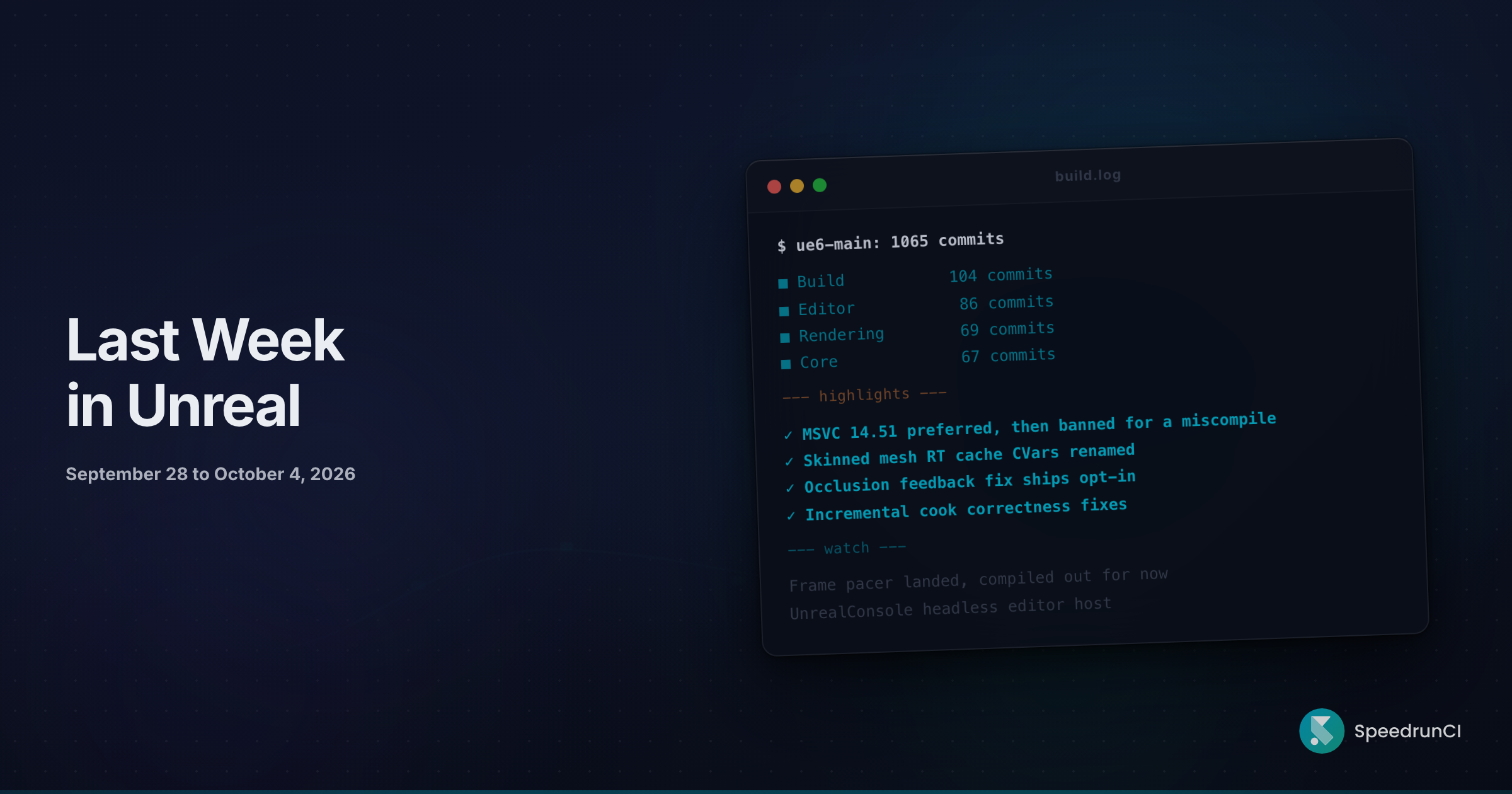
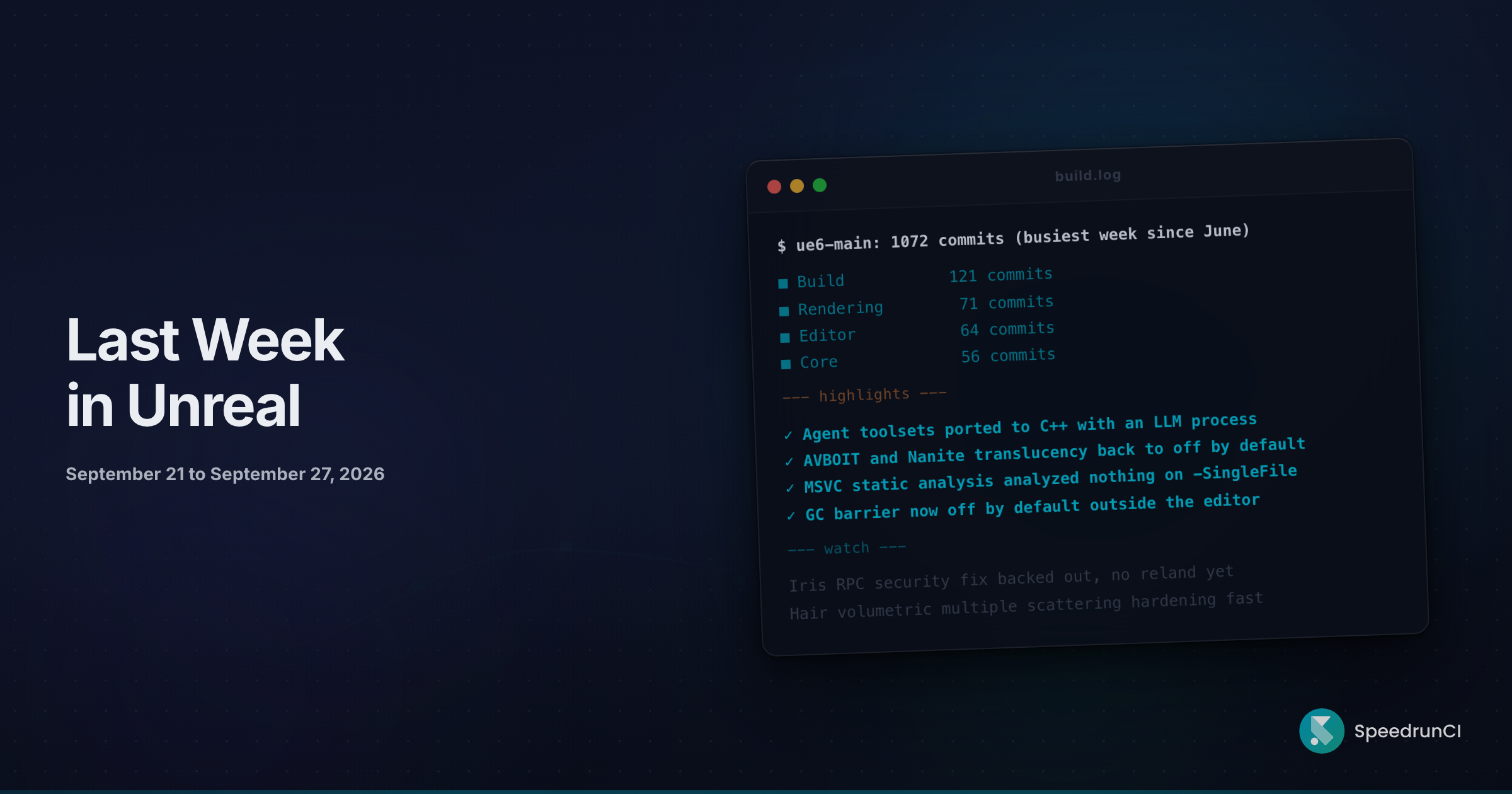
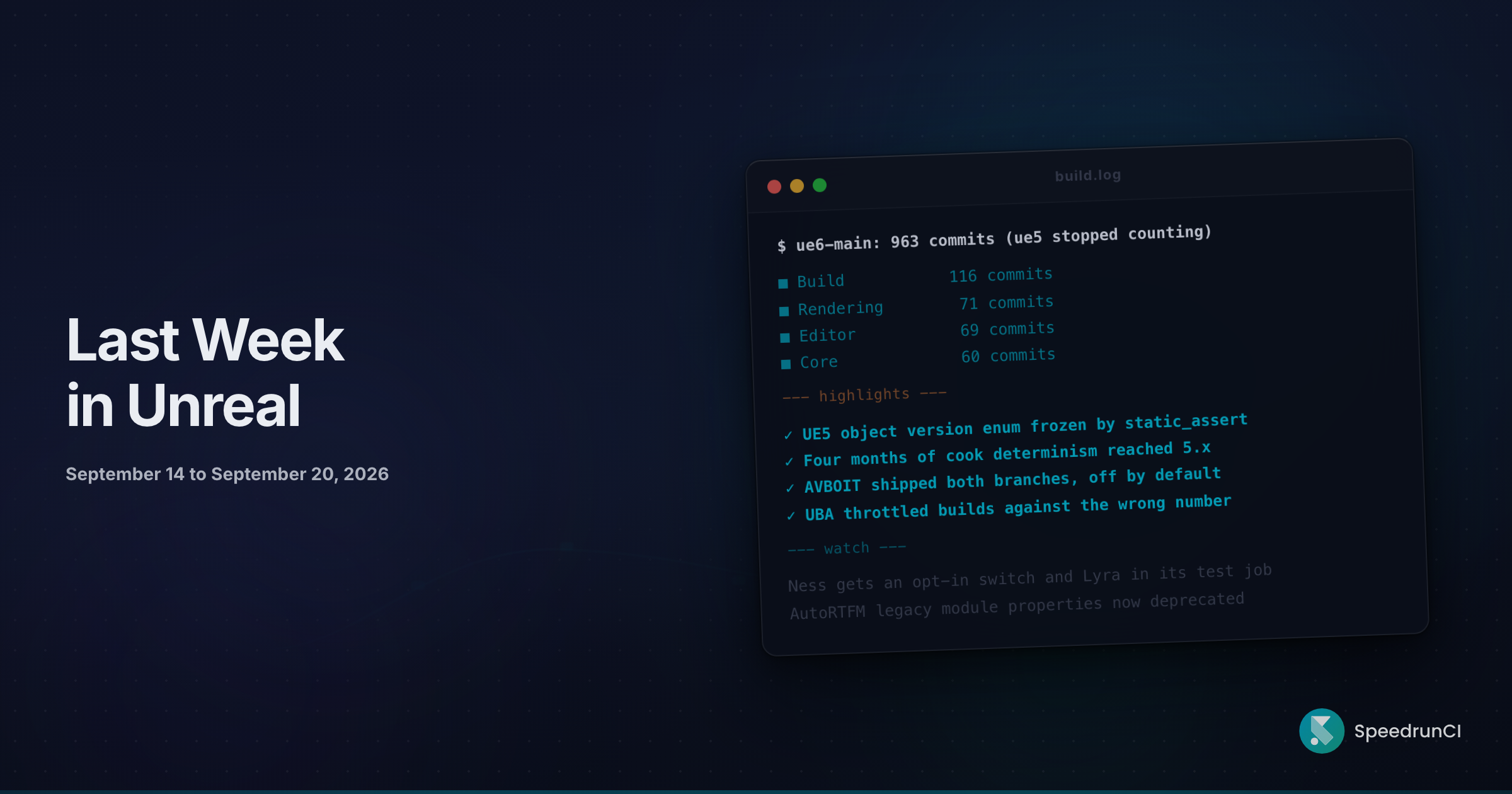
Last Week in Unreal — Feb 2-8, 2026
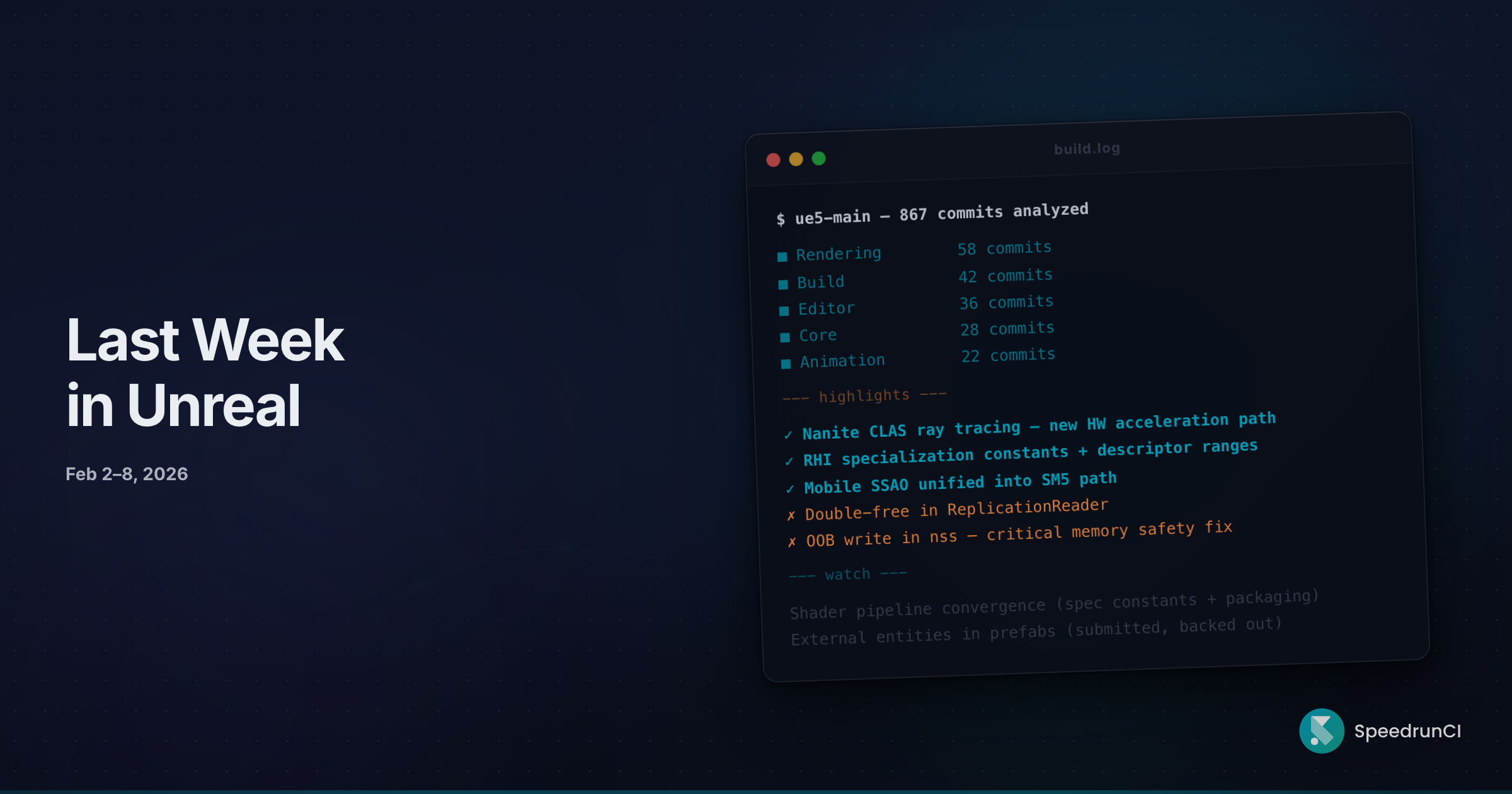
Unreal Engine Weekly — What Changed and What Matters
Week of Feb 2-8, 2026 | 867 commits analyzed | Branch: ue5-main
Overview
A dense week on ue5-main, dominated by a new hardware ray tracing path for Nanite, foundational RHI plumbing for specialization constants and bindless descriptors, and a quiet but significant mobile rendering quality push. Shader packaging got a major overhaul for on-demand install scenarios. Memory and stability fixes are scattered throughout, several of them serious (double-free, OOB write, race conditions). The Control Rig BP-independence refactor landed, got backed out, and landed again — treat it as volatile.
142 commits flagged as high interest. 15 filtered as noise. The rest is the usual churn of a live engine branch approaching 5.8.
TL;DR
- Nanite CLAS ray tracing is the headline. A new cluster-level acceleration structure path is being built for Nanite geometry in hardware RT, with production-grade memory management. This is not incremental.
- Specialization constants and descriptor ranges landed in the RHI layer — early plumbing for reducing shader permutation counts and enabling bindless rendering patterns.
- Mobile SSAO was unified into the desktop SM5 path. The separate mobile GTAO codepath is gone (1,300+ lines removed).
- Shader chunk re-assignment now works at packaging time for on-demand install. If you ship with streaming installs, this matters now.
- Asset Registry memory optimization claims multi-GB editor memory savings on large projects. Was backed out and resubmitted — worth watching.
- MegaLights / stochastic lighting continues hardening: batched tile classification, SSS transmission, first-person BVH support. Production-readiness work, not new features.
Rendering & GPU
Nanite CLAS Ray Tracing — A New Hardware Acceleration Path
What changed. Epic is building Cluster-Level Acceleration Structure (CLAS) support for Nanite ray tracing. The system builds and manages CLAS at page install time using a custom pool allocator with contiguous-fit allocation, staging buffers, and persistent storage. Over 2,400 lines were added to the core ray tracing path alone, with new PLATFORM_SUPPORTS_RAYTRACING_CLUSTER_OPS preprocessor branches throughout. Supporting work removes hardcoded group sizes, adds a cluster visualization mode, and unifies debug visualization colors.
Why this is important. This is a fundamentally different approach to how Nanite geometry participates in hardware RT — not a refinement of the existing path, but a new one designed around per-page CLAS granularity. The allocation strategy (contiguous fits, fragmentation-aware) signals this is being built for production workloads with real memory pressure, not prototype validation.
Who should care. Graphics programmers, anyone maintaining custom RT integrations, tech artists whose pipelines depend on Nanite + RT interaction. The API surface and data flow are changing substantially.
Urgency. Track. If you have custom RT integrations touching Nanite, start reading the new code now.
RHI Infrastructure — Specialization Constants and Descriptor Ranges
What changed. Two foundational RHI features landed. Specialization constants add infrastructure to compile shader variants at PSO creation time rather than at cook time. Descriptor ranges allow features to allocate contiguous blocks of descriptors for bindless rendering. Both are partial — specialization constants lack implementations on all platforms, and descriptor ranges are missing some bindless backends. But the plumbing is extensive: new types in RHIDefinitions, changes to ShaderPermutation.h, integration into PSO precaching hashes, and D3D12-specific implementations.
Why this is important. Specialization constants are a long-requested capability that will eventually reduce shader permutation explosion. Combined with concurrent work on shader chunk deduplication during packaging, this signals Epic is rethinking how shader libraries are structured for both compilation and distribution.
Who should care. Graphics engine programmers, anyone maintaining custom RHI backends or writing low-level rendering code.
Urgency. Track. Not actionable yet, but the direction is clear.
MegaLights / Stochastic Lighting Hardening
What changed. Tile classification logic was refactored to support batched runs across views. Frame temporaries were decoupled from Lumen scene data. First-person geometry now works correctly in BVH traces. SSS transmission was added for Substrate Format=1. TSR antiflickering for thin geometry was improved — functionally part of this cluster since MegaLights output quality depends on temporal stability.
Why this is important. This is completeness and hardening work, not new features. The system is being made production-ready for 5.8.
Who should care. Graphics programmers and lighting artists evaluating MegaLights for production use.
Urgency. Low. Positive signal, no action required.
Mobile Rendering Quality — SSAO Unification and Diffuse Ambient Captures
What changed. The separate mobile GTAO codepath was eliminated entirely (1,328 lines removed) and merged into the SM5 SSAO implementation. Mobile now gets GBuffer-normal-aware SSAO, blur passes when TAA is off, and a new shading model exclude mask. Separately, a “Diffuse Ambient Captures” feature introduces runtime time-sliced reflection captures with diffuse irradiance stored in low cube map mips, targeting interior lighting on low-end platforms without a bake step. The commit message explicitly mentions UEFN compatibility as a goal.
Why this is important. Mobile rendering quality is getting serious investment heading into 5.8. The SSAO unification reduces maintenance burden while raising the quality floor. Diffuse Ambient Captures solves a real pain point — interior lighting on mobile without lightmap bakes.
Who should care. Mobile graphics programmers, UEFN developers, anyone working on mobile visual quality or unbaked interior lighting.
Urgency. Track. The SSAO change could affect existing mobile rendering behavior if you had tuned around the old path.
Other Rendering Changes
- Lumen “visible in reflections” property — new per-primitive control over reflection visibility. Miscategorized as low interest; it is a meaningful artist-facing feature.
- Height fog in sky light captures — sky light capture now affects distant height fog, gated behind a CVar.
- HDR Paper White rework —
r.HDR.UI.UseOSPaperWhiteis replaced byr.HDR.UI.Luminance.Mode, with newr.HDR.ReferenceWhiteCVars. If you reference the old CVars, they will break. - HWRT
FRayTracingGeometryinitializer deprecated — public API break for anyone using the ray tracing geometry API directly. - Vulkan SDK headers updated to 1.4.341.0 for
VK_EXT_descriptor_heap. Significant platform event.
Build, Packaging & Tooling
Shader Library Chunk Re-Assignment for On-Demand Content
What changed. Shaders can now be re-assigned to their correct pakchunks during packaging based on asset associations. The implementation loads all cooked shader archives into a monolithic archive per format, then creates reassigned subsets per container. A 4GB size limit fix prevents crashes when shader containers exceed TArray capacity.
Why this is important. Previously, chunk assignment was only done at cook time, and PakFile rules could silently override those assignments without the shader library knowing. For on-demand install or streaming download scenarios, this was a real source of bugs — shaders ending up in the wrong chunk, missing at runtime.
Who should care. Build engineers, packaging pipeline owners, anyone using IoStore with on-demand content delivery.
Urgency. Act now if you have shader library packaging issues or use on-demand install. Track otherwise.
PCH Chaining Disabled
What changed. UBT disables PCH chaining due to mismatched preprocessor state.
Why this is important. This is likely to cause a build performance regression. Worth measuring on your project if incremental build times matter to you (they do).
Urgency. Low. Be aware.
ARM64 Build Variations
What changed. Initial support for arm64, arm64ec, and multi-architecture x64+arm64 variations for Win64.
Who should care. Anyone targeting Windows on ARM or evaluating Qualcomm Snapdragon X hardware for development.
Urgency. Track. Early days.
Editor & Workflow
Asset Registry Memory Optimization
What changed. Tag store data in the Asset Registry cache is now memory-mapped, claiming to save “GBs of editor memory usage” on large projects. This was submitted, backed out, and resubmitted within the week.
Why this is important. Multi-gigabyte memory reduction in the editor is a first-order quality-of-life improvement for any team working at scale. The submit-backout-resubmit pattern warrants some caution, but the potential upside is significant.
Who should care. Anyone working on large projects where editor memory pressure is a problem — which is most teams past a certain scale.
Urgency. Track. Let it stabilize before relying on it.
Slate Dynamic Invalidation Rollout
What changed. Four commits systematically added dynamic invalidation TypeTraits to SSpinBox, SEditableText, graph editor pins, material editor nodes, comment bubbles, and more. A companion commit fixes compilation when UE_SLATE_WITH_DYNAMIC_INVALIDATION is disabled.
Why this is important. Dynamic invalidation means Slate widgets only repaint when their state actually changes rather than every frame tick. The breadth of widget coverage suggests Epic is preparing to make this the default path, which would meaningfully improve editor UI performance.
Who should care. Anyone writing custom Slate widgets or editor extensions.
Urgency. Low. Positive trend, no action needed unless you maintain custom Slate code that might need the same treatment.
5.8 Gizmos Turned On by Default
What changed. The new gizmo system is now the default for 5.8.
Who should care. Every UE developer. This is a behavior change that affects daily interaction with the editor.
Urgency. Low, but be aware. If the new gizmos cause workflow friction, file feedback early.
Overridable Landscape Grass Types
What changed. A substantial refactor (~1,400 lines across 25 files) changes how landscape grass types are addressed: from being bound to a specific ULandscapeGrassType asset to being addressed by declared input name in the landscape material. This enables per-proxy grass type overrides, decouples grass map export from requiring a concrete grass type (useful for PCG integration), and allows multiple grass maps to point at the same grass type. The override UX is deliberately hidden for now.
Who should care. Teams doing procedural landscape work or Landscape + PCG integration.
Urgency. Track. The architectural change is meaningful even if the UX is not yet exposed.
Animation & Character
Control Rig BP-Independent Asset
What changed. A large refactor (100+ files across ControlRig, RigVM, and editor modules) introduces ControlRigRuntimeAsset and ControlRigAssetReference, decoupling Control Rig from Blueprint dependency. However, this was backed out and re-submitted within the same week.
Why this is important. Decoupling from Blueprint is architecturally significant for runtime performance and asset management. But the backout-resubmit pattern means the API surface is not stable.
Who should care. Animation programmers, Control Rig tool developers.
Urgency. Track only. Do not build against this API yet.
GPU Skinning Optimization
What changed. Single-pass optimization for meshes with 32 or fewer bones, plus 32-to-16 bit index conversion.
Who should care. Anyone with performance-sensitive skinned mesh workloads, particularly on mobile or with large crowd scenes.
Urgency. Low. Free performance, no action needed.
Stability & Memory Safety
Several serious fixes landed this week that deserve explicit mention:
- Double-free in ReplicationReader — a memory safety bug in the networking replication path. If you have been seeing intermittent crashes in replicated sessions, this may be the cause.
- Out-of-bounds write in nss — critical memory safety fix.
- Infinite recursion in AutoRTFMSan debug builds — stack overflow in transactional memory sanitizer.
- Allocation alignment in AutoRTFM BlockAllocator — alignment bugs cause undefined behavior; this was a correctness fix.
- Race condition in SoundWave::PostLoad — race in asset loading, attempted fix (may need follow-up).
- PSO checking on wrong thread — was running on a worker thread instead of the game thread, a thread-safety violation.
- Editor hang during debug viewmode shader compilation — functionally a deadlock, now fixed.
- Divide by zero in DMXGDTF — minor but indicative of missing guard checks.
- Landscape sculpt/paint performance fix — stops propagating Update_All from component to actor unless explicitly requested. If you have seen landscape editing hitches, this is likely the fix.
Urgency. The double-free and OOB write are the most serious. If you are on a branch near these changes, pick them up.
Frameworks & Runtime
Verse and Remote Objects Stabilization
Several commits tighten VerseVM and Remote Objects infrastructure: avoiding stub lookups when checking remote object residence, deprecating MarkAsLocal()/MarkAsRemote() in favor of unified SetResidence(), guarding against constructing two objects with the same remote ID, fixing null GetWorld() breaking material replication, and rejecting accidental case-insensitive function overrides. A concerted push to harden the Verse runtime for real-world usage.
Urgency. Low unless you are actively developing with Verse.
Mass Entity: Sparse Elements
What changed. Sparse elements support added to Mass Entity, along with query, command buffer, and entity builder integration.
Who should care. Teams using Mass Entity for large-scale simulation or AI.
Urgency. Track. This is a meaningful architectural addition to the framework.
Mover: Prediction on Rollback Blackboard
What changed. The Mover system now supports prediction on the rollback blackboard — a significant networked movement architecture change.
Who should care. Anyone using Mover for networked character movement.
Urgency. Track.
Worth Tracking
1. Shader Pipeline Convergence. Specialization constants, descriptor ranges, chunk deduplication, and shader library re-assignment are all landing in the same timeframe. Taken together, they signal a broader rethink of how shaders are compiled, stored, and distributed. The individual pieces are not yet actionable, but the trajectory matters. Watch for follow-up commits on Vulkan and Metal backends for specialization constants — that is when this becomes real for cross-platform projects.
2. External Entities in Prefabs. A ~1,400-line change adding support for external entities in prefabs and non-root world entities was submitted and backed out. This would enable one-file-per-entity in prefabs and world instances — a significant workflow change for level design at scale. The CVars Entity.OneFilePerPrefabEntityEnabled and Entity.OneFilePerEntityOnAllInstancesEnabled are the canaries. If you see them stabilize in a future week, pay attention.
What We Ignored
- Routine Dataflow framework iteration (10+ commits, internal plumbing)
- AutoRTFM transactional memory bookkeeping (7 commits, mostly internal metrics and state management)
- Mutable/CustomizableObject morph and UV fixes (8 commits, niche)
- AI Assistant / ToolsetRegistry scaffolding (8 commits, early-stage internal tooling)
- TEDS re-enablement and outliner changes (4 commits, still settling)
- Camera system framing logic refactor (4 commits, minor)
- FViewMatrices member rename (80+ files touched, pure mechanical rename with no behavior change — will cause merge conflicts if you are carrying patches, but is otherwise uninteresting)
- libcurl 8.17.0 activation (security-relevant but routine third-party update)
SlateIMlarge table performance improvement (good fix, narrow audience)- Configurable dynamic loading range for faster PIE startup on large maps (nice-to-have, low risk)
Closing
The Nanite CLAS work is the most architecturally significant change this week and likely for several weeks to come. It represents a genuine shift in how Nanite geometry interacts with hardware ray tracing, and the allocation design choices suggest Epic is building this for production scale, not just conference demos. If you work anywhere near the RT pipeline, start reading the code now rather than waiting for documentation.
The rest of the week is a mix of infrastructure investment (RHI specialization constants, shader packaging) and quality-of-life work (mobile SSAO unification, Asset Registry memory, Slate invalidation). The stability fixes are more numerous and more serious than a typical week — the double-free in ReplicationReader and the OOB write in nss in particular deserve attention.
5.8 is taking shape. The pieces are moving in coherent directions.
Never miss a ue5-main update.
Get them delivered straight to your inbox.