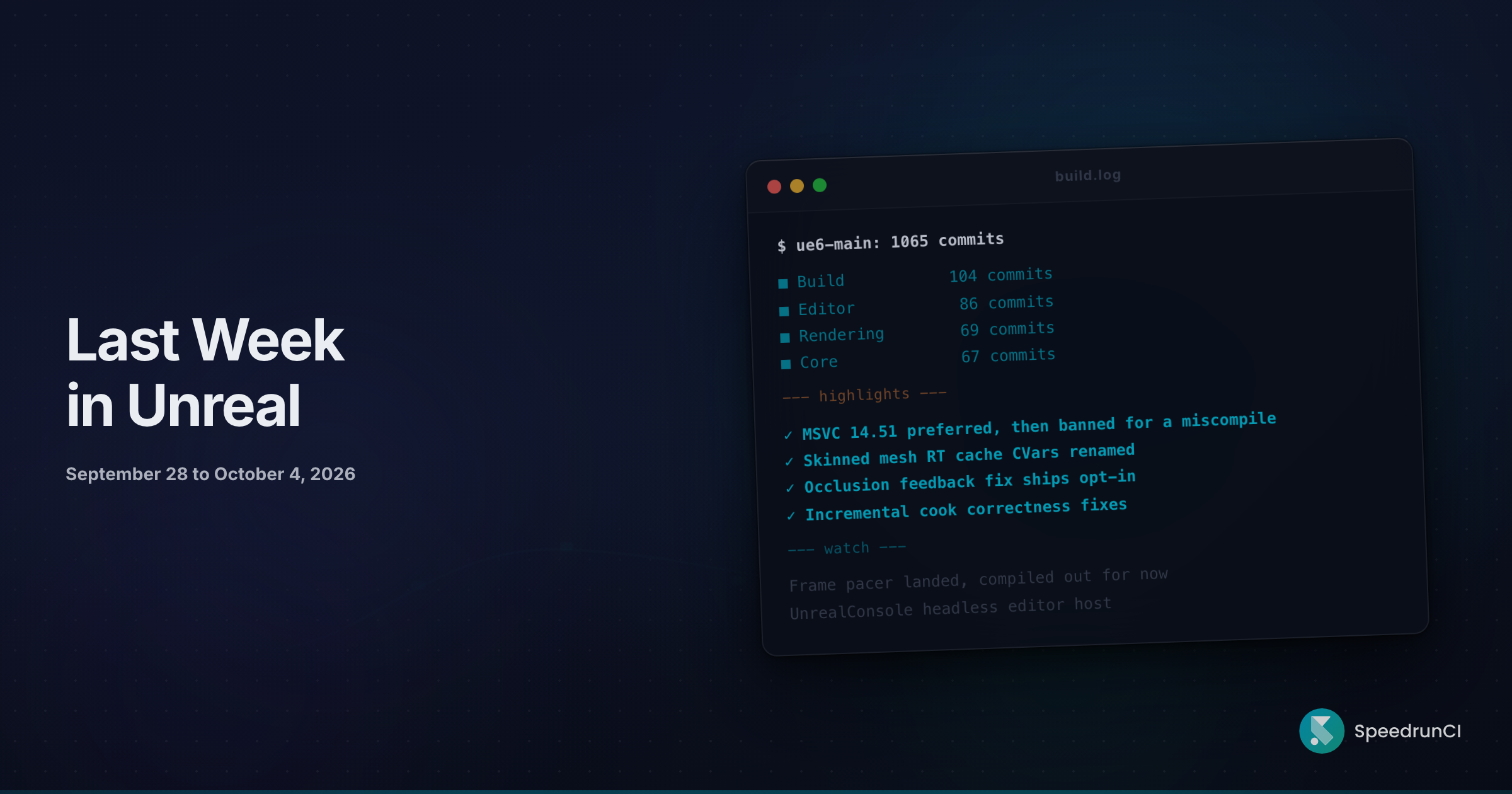
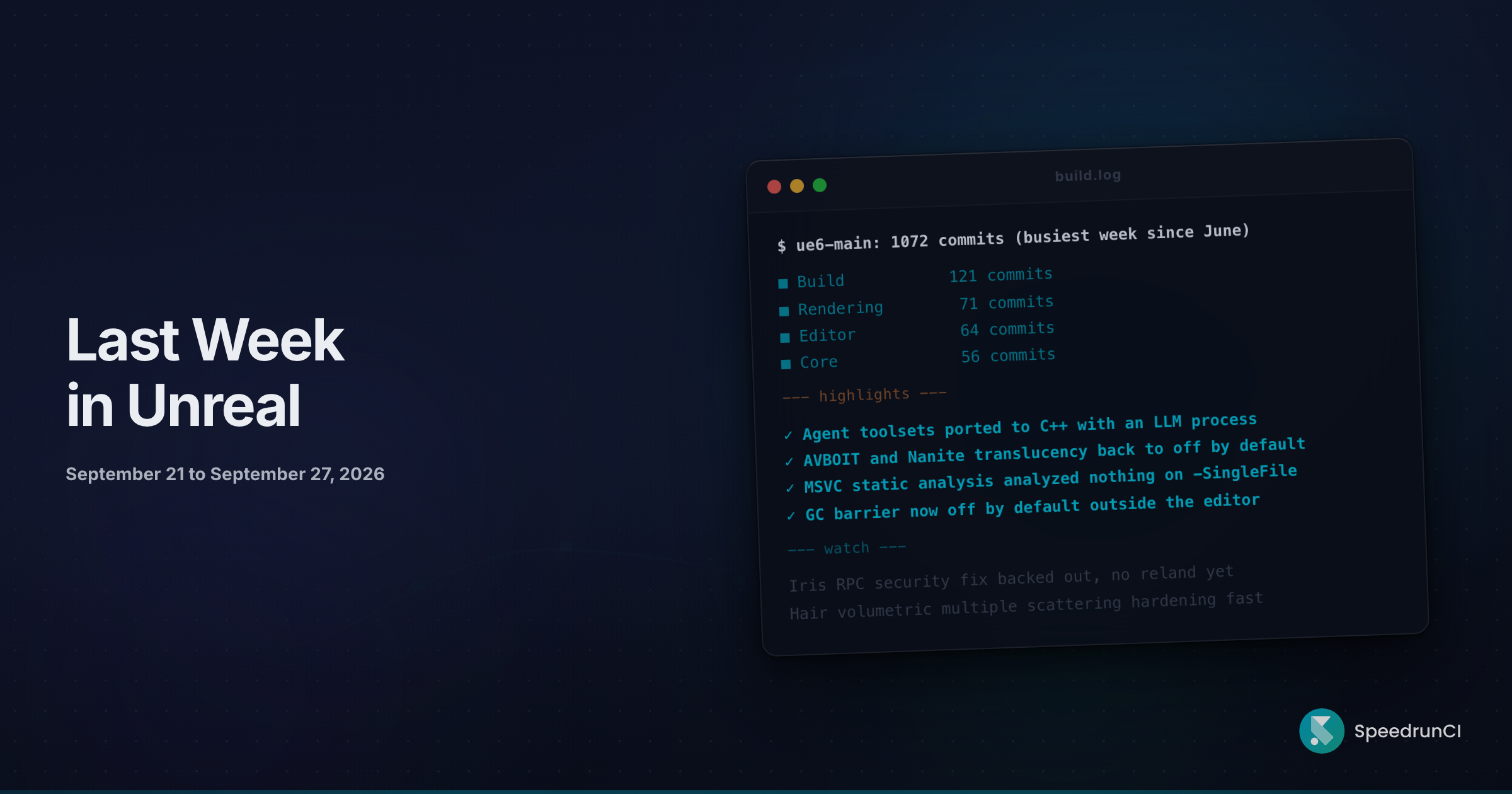
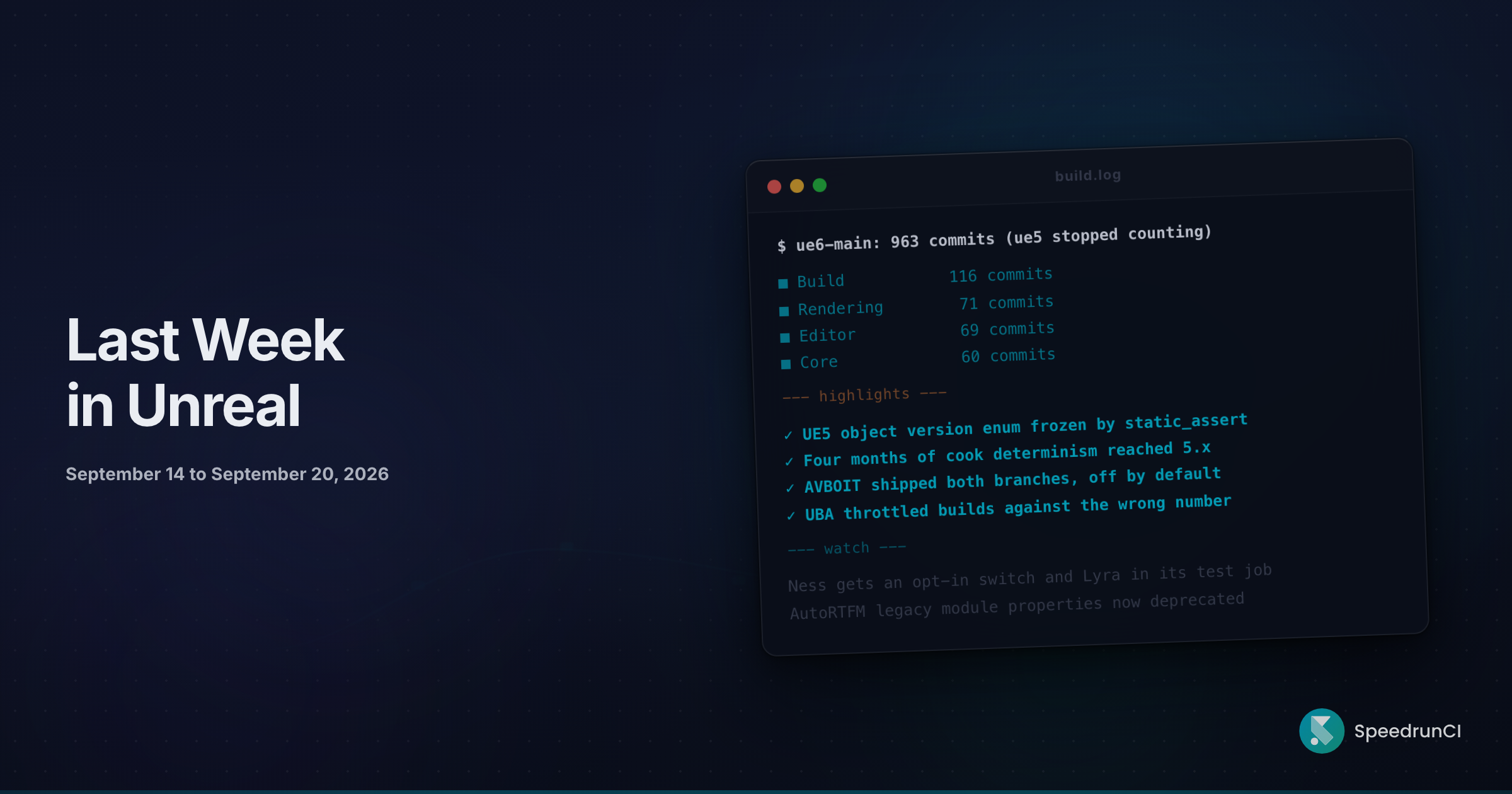
Last Week in Unreal: The Defaults Moved (August 31 to September 6, 2026)
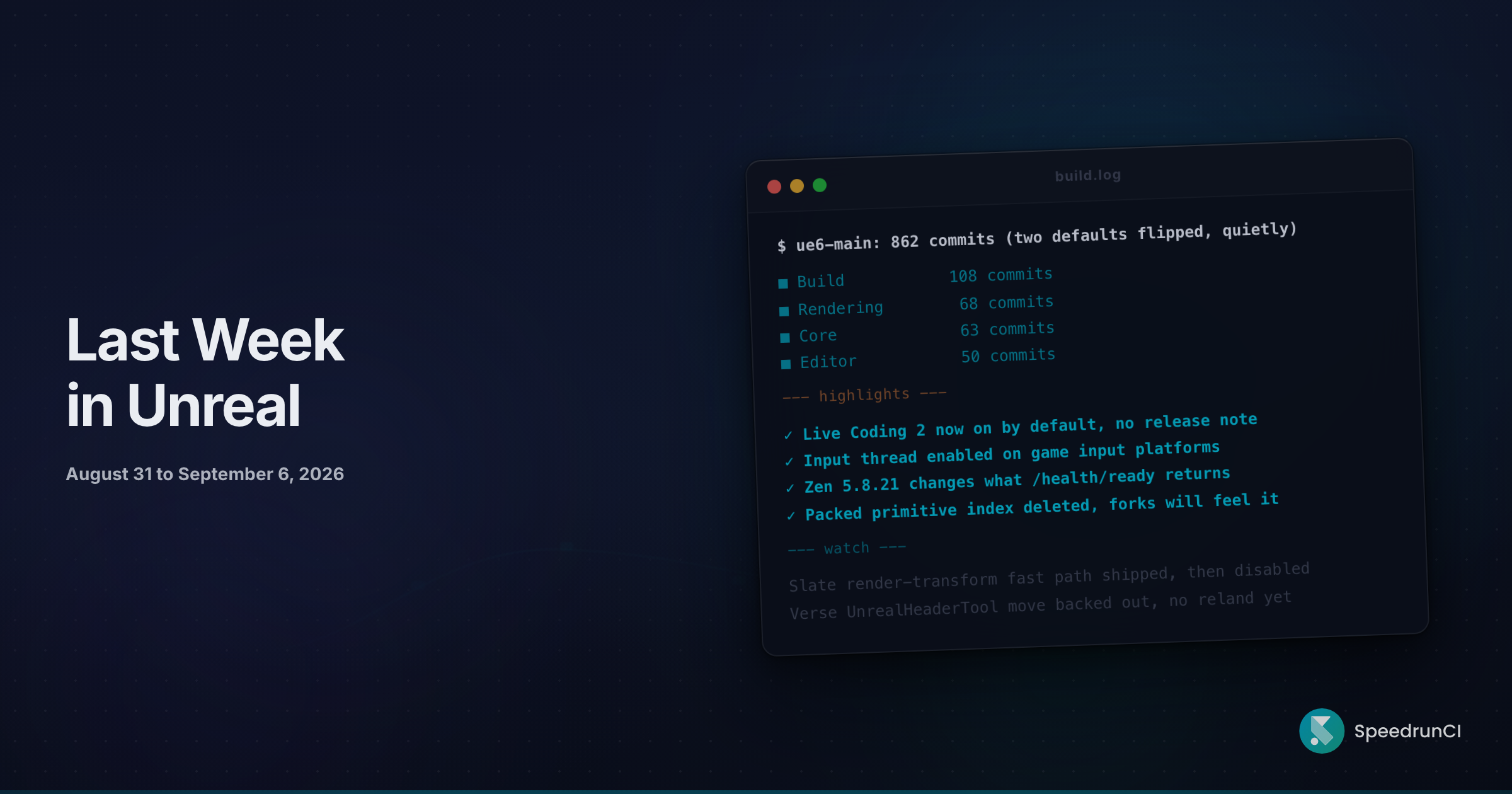
Unreal Engine Weekly: The Defaults Moved
Week of August 31 to September 6, 2026 | 862 commits on ue6-main, 110 on ue5-main | Branch: ue6-main
Overview
The two most consequential changes this week have one-line commit messages and no release note. Live Coding 2 became the default, and the input thread was enabled on game input platforms. Neither was announced, both change how the editor behaves on your machine, and both have commit bodies shorter than their titles. Around them, build and cache infrastructure kept consolidating: distributed ThinLTO landed end to end, the DDC backend inventory started getting cut down to Zen for 6.0, and Zen turned server lifecycle into a documented contract, including one change that breaks health probes. On the rendering side, the SceneData migration stopped converting call sites and started deleting the old ones, which is the week renderer forks feel.
Development Trends
Build is the product surface in UE6
Pattern: build has been the top high-interest subsystem for eight weeks running, and this week it accounts for 108 of the 197 commits worth reading. Over the same window it has held a narrow band (98, 87, 61, 85, 121, 117, 98, 108) instead of spiking and decaying like a push.
Interpretation: the composition has shifted. Cache-server firefighting dominated earlier weeks. This week is feature work with contracts attached: a distributed link step, machine-readable lifecycle results from Zen, a deprecation warning wired into BaseEngine.ini. The work has moved from stabilizing the build to deciding what 6.0’s build story is allowed to depend on.
Who cares: build and CI engineers, anyone maintaining an internal fork of UBT or BuildGraph.
Signal strength: Strong.
Unreal Build Accelerator is still one person
Pattern: 38 of this week’s 39 UBA commits carry a single author. Checking the four prior weeks in the same way: 26 of 28, 43 of 50, 37 of 37, and 20 of 20. Five weeks running.
Interpretation: we have flagged this for a month now and the concentration has not loosened. The work continues to check out as careful, well-reasoned engineering, and this week includes the single best root-cause writeup in the window. The risk here is structural, not a quality problem. A build accelerator that a growing number of studios depend on has one person holding its correctness surface.
Who cares: studios adopting UBA as core CI infrastructure.
Signal strength: Strong.
The renderer decomposition moved from converting to deleting
Pattern: the SceneData and scene-extension migration has produced a fresh cluster every week since mid-July, and this week the character of it changed: FPrimitiveSceneInfo::PackedIndex was removed outright along with the sorted-order machinery in FScene, rather than another round of call sites being converted.
Interpretation: deprecation shims protect you from a renamed function. They do not protect you from a removed invariant. The prior seven weeks were survivable for a fork by fixing compile errors. This one requires knowing whether your code assumed FScene‘s arrays were kept in sorted order.
Who cares: graphics programmers maintaining custom renderer code or engine forks.
Signal strength: Strong.
Epic is shaping editor tool APIs around language-model cost
Pattern: one commit names token cost as its engineering motivation, in those words, rewriting property addressing because the old shape “routinely cost tens of thousands of tokens.” Two more are shaped by the same pressure without naming it: a log toolset now caps each returned entry so a single engine line cannot swamp a caller’s budget, and typed toolset returns replaced JSON strings so the model reads results directly instead of writing a throwaway script to parse them. A fourth preserves an explicit Claude Code override in the experimental terminal plugin’s keyboard negotiation.
Interpretation: the in-editor agent work has moved past plumbing. When a team rewrites a reflection API because of what it costs a model to read, the agent has become a consumer the engine API is designed around. One commit saying so plainly is a weaker signal than a trend, which is why this is worth watching rather than concluding.
Who cares: tools engineers, anyone building editor automation.
Signal strength: Moderate.
TL;DR
- Live Coding 2 is on by default, and so is the input thread on game input platforms. Both landed with a one-line commit message and no announcement, and both change local editor behavior after your next sync.
- Zen 5.8.21 changes what
/health/readymeans. It now answers 503 between route registration and actual readiness, where the catch-all previously answered 200. If your CI treats that path as a liveness probe, it will start reporting a healthy server as down. FPrimitiveSceneInfo::PackedIndexandFScene‘s sorted-order maintenance are gone. Renderer forks that index into scene arrays by packed index break here, and the deprecation shim does not cover the removed sort invariant.- Three unrelated systems hit the same worker-starvation deadlock in the same week: AssetRegistry, the shader code archive, and UBA’s macOS process supervision.
- If you ship on 5.8 rather than tracking
ue6-main, four fixes are worth cherry-picking this week, including a Mac process-tree bug that leaves an orphaned UnrealBuildTool holding the global mutex until you reboot. See the 5.8 section at the end.
Highlights
Live Coding 2 and the input thread are on by default
What changed: Live Coding 2 was enabled by default in a commit whose entire body is one bullet point, touching a single build file (b3de9a0e). Supporting work the same week enabled its target build, on-demand cross-process activation, and a compile-readiness query (c8d36548), and skipped the Live Coding hotkey listener thread in commandlets (0ff624e6). Separately, the input thread was turned on for game input platforms, moving input off the game thread, with -NoInputThread as the escape hatch (ee858a9b). Two same-week fixes back it: stuck controller input on disconnect (14a1830b) and a re-entrancy ensure in the async input consumer drain, itself called out as a regression (ac09c713). A third default flip enabled Verse access-specifier authoring and enforcement (40ff6c4e).
Why this is important: these are the changes most likely to alter what you experience next week, and the least likely to be noticed. Live Coding 2 becoming the default is an iteration-time change for every programmer on Windows. Moving input off the game thread changes timing characteristics for input-sensitive gameplay code, and the two follow-up fixes show it is finding real edges. Downstream, LiveCodingConsole was removed from the installed-engine build because Live Coding 2 brings its own broker (53fc59a2), so an installed engine you produce now ships different artifacts.
Who should care: everyone. Programmers for the iteration change, gameplay engineers for input timing, and build engineers for the installed-engine artifact difference.
Urgency: Act now. Not because anything is broken, but because you should know your defaults changed before you debug a timing difference you did not introduce.
Distributed ThinLTO lands end to end, and the linker keeps changing underneath it
What changed: UnrealBuildTool can now hand ThinLTO backend compilations to UBA as distributed jobs instead of running them inside the linker, behind -ThinLTODistributed and off by default (20efe89f). The UBA-side implementation followed: distributor JSON parsing, path conversion, argument quoting, linker temp files registered as virtual inputs without copying, and the waiting linker’s scheduler weight released during backend execution (17ece9ab). Two follow-ups fixed what a real farm exposed. Virtual basenames were normalizing into invalid paths in the job manifest, and because ThinLTO uses the input path as the module identifier, substituting a physical alias broke index lookup and crashed the backend (6ef3b91c). Backends exiting zero had all output except lines containing “error” silently dropped, so distributed warnings were invisible unless something failed (7d9ffd56).
Why this is important: the link step is often the last serial bottleneck in a shipping build, and this is the first credible path to distributing it. The pace matters as much as the feature: implementation, manifest contract, path-identity fix, and diagnostics fix inside four days. A farm is setting that schedule, not a design document. Underneath it, Epic dropped five Radlinker binary revisions in four days (bcc3b1cd, b9f958b9, e0244a88, deffbde0, b93cddc7), which means a Commit.gitdeps.xml sync is now potentially a linker change.
Who should care: build engineers, toolchain owners, anyone whose shipping link step is the long pole.
Urgency: Track, and act now if you already run LTO builds on a UBA farm. It is off by default, so nothing changes until you opt in.
UBA’s hardest bugs this week were on macOS and Linux
What changed: 39 high-interest commits carry the UBA tag, and 19 of them are Visualizer work. The new Visualizer was added as a parallel tree, improved twice, then dropped on top of the original directory with files overwritten and reconciled, and the shim target deleted, all on the same day (aabd63fa, 31989735, 4ec26bb6, ad444118, 88a3f651). The important work is elsewhere. On macOS there is no PR_SET_CHILD_SUBREAPER, so waitid on a grandchild returns ECHILD whether it is alive or dead, and UBA treated that plus zero received messages as an exit (13b4f0ea). Since UBT spawns clang++ which spawns cc1 and ld, every compile and link child is a grandchild. The host was destroying a live process’s shared events and returning its communication slot to the allocator, which handed the same slot straight back out. Two more: fixed-address snapshot collisions are now rejected on Mac rather than mapped over live child mappings, and POSIX fatal-signal reporting now exits without RPC cleanup to break a deadlock where clang’s crash handler waits on an RPC while the host waits for clang to exit (cb4a3a1c). Network-layer work covered connection-loss handling during cancellation (0369c997), an agent-listen race with a 15 to 45 second reaction window (84dfad3a), and asynchronous handshakes so a stalled one stops blocking later connections (2bbbd6b2).
Why this is important: the grandchild fix is the most useful commit in the window to read in full. The failure it describes is invisible in exactly the way distributed build failures usually are: a live process’s slot gets recycled, and the corruption surfaces somewhere unrelated. If you run UBA agents on macOS or Linux and have been writing off intermittent farm failures as flakiness, this is a plausible mechanism. The fixed-address collision commit hedges carefully: the unsafe mapping is a possible initial corruption source, not a proven cause of that particular farm failure. Read it with the hedge intact.
Who should care: build engineers and CI operators running distributed compile farms, especially cross-platform ones.
Urgency: Act now if your agents run on macOS or Linux.
Zen 5.8.21 turns server lifecycle into a contract, and changes what a health probe means
What changed: a one-line Commit.gitdeps.xml bump carries the longest release note in the window (84ae3c43). zen up, zen status, and zen service status accept --output-path and write a structured result carrying effective port, pid, session id, readiness, and data directory, so callers stop scraping console text. Exit codes now identify causes, and the full contract is documented. The behavior changes matter more than the features. /health/ready answers 200 only once the server can serve requests, 503 before that and again once shutdown begins, where the catch-all previously answered 200 as soon as the health routes existed. And an unrecognized path under /health/ now answers 404 instead of 200. Lifecycle semantics tightened too: zen up reuses a server that is already starting rather than racing it, and zen down refuses --pid 0 and -p 0, which previously let an unset script variable expanding to zero stop an arbitrary server. There is also a real security fix: the oidc-exe-path request field is now ignored, closing a local privilege-escalation hole where a client could name an executable for the server to launch.
Why this is important: this release closes the gap between “my script ran zen” and “my script knows what zen did,” and it closes it by making previously permissive responses strict. The health-probe change is the one that bites without warning, because a probe pointed at /health/ready used to succeed for the wrong reason. Probe /health for liveness. The --pid 0 refusal is worth checking your own scripts against.
Who should care: build and CI engineers, DevOps, anyone scripting zenserver lifecycle or cook infrastructure.
Urgency: Act now if you script zenserver in CI.
The DDC backend inventory is being cut down for 6.0
What changed: eight commits from one engineer, all sharing a synced changelist, systematically retire DDC backends. S3 DDC was deleted outright, with the commit stating that for 6.0 its users can move to Cloud DDC or build on the pak file cache or its forthcoming replacement (e5a7f7b4). The FileSystem cache store now emits a deprecation warning when used, wired into BaseEngine.ini and ShaderCompileWorker’s DefaultEngine.ini (761cd96c). Deprecated graphs and stores were removed from configs (8fb6585c), 5.8-deprecated code removed (2962e510), the DDC IO thread pool is created lazily only when a store needs it (7d6e0e25), and Jupiter access-token races were fixed (31611935).
Why this is important: the FileSystem cache store is the shared-DDC-on-a-network-share setup plenty of studios still run, and a deprecation warning is the first shot rather than the last. Read alongside the S3 removal and the Zen investment, the practical direction for 6.0 is Zen or Cloud DDC. Nothing this week removes the FileSystem cache store. It warns.
Who should care: build engineers, studio IT, anyone running a shared DDC.
Urgency: Track. Start the conversation about what replaces a network-share DDC before it becomes a 6.0 upgrade blocker.
The packed primitive index is gone from the renderer
What changed: FPrimitiveSceneInfo::PackedIndex was removed, GetIndex() deprecated and redirected to the persistent primitive id, and the machinery that kept FScene in sorted order removed along with the extra copies of added and removed primitives and TScenePrimitiveArray (c281fdce). A companion commit folded FPrimitiveSceneInfo::AddToScene into FScene::ProcessPendingAddToScene (1c348679). Conversions feeding it landed the same week for Nanite custom-depth visibility (c799f3cd), mobile CSM subject primitives (86f9b991), and ray tracing group ids moving into the ray tracing scene extension (8861cfe5). Two real races were fixed on the way through: the uniform-buffer update path was decoupled from GPUScene dirty state, fixing a race where light map allocations raced the update (85df40a2), and dirty-mask marking now validates its access context the same way per-element writes do (b21d5926).
Why this is important: code that assumed FScene‘s arrays were maintained in sorted order will compile and then be wrong. The previous seven weeks of this migration announced themselves as compile errors. A removed invariant does not. A batch of deprecated includes was also removed from RenderCore and Renderer headers the same week (5e2a1be7), so expect merge conflicts on top of the semantic change.
Who should care: graphics programmers, engine-fork maintainers, anyone with plugins that reach into scene arrays.
Urgency: Act now if you maintain a renderer fork.
Nanite hardware ray tracing stops guessing at memory, and the light paths are being unified
What changed: two Nanite fixes undo the same class of mistake, using a proxy for a number instead of the number. The CLAS address reservation was a worst-case product of BLAS count and resident clusters, which caused out-of-memory failures on large assemblies; it is now a per-part capacity vector fed by readback of the cluster count hierarchy traversal actually emitted, with the base mesh BLAS still using the old value so it is never skipped (f837c054). The BLAS cache-hit test was per-BLAS when only the base BLAS seeds traversal, so a part could miss the cache, get a null address, and have no path to rebuild; a new pass now folds per-slot cache-miss results into a per-geometry rebuild flag (eea475df). Separately, FRTLightingData was removed in favor of FForwardLightData, unifying ray-traced hit lighting with the forward light path (eaff98e0), and LumenRef’s direct lighting now routes through MegaLights material and shading functions, fixing wrong hair appearance and bad subsurface demodulation (f826d845).
Why this is important: the Nanite memory work makes assemblies with hardware ray tracing materially more usable than a week ago. The commit says the change significantly reduces memory overhead on large assemblies that previously caused out-of-memory issues, and it does not quote a figure, so neither will we. The light-path unification is the theme most likely to produce visual diffs in a fork: lights are no longer skipped from ray tracing when “affect ray traced reflections” is disabled, because they may still be used by GI or ray-traced translucency. That behavior change is deliberate.
Who should care: graphics programmers shipping hardware ray tracing, lighting and look-dev teams comparing offline reference against realtime.
Urgency: Track, and benchmark before integrating if you ship Nanite assemblies with hardware ray tracing.
Worker starvation was the bug of the week, in three unrelated systems
What changed: three systems independently hit the same failure. A thread that is itself a task worker blocks waiting on another task, and with enough concurrent waiters no worker remains to run the thing being waited on. AssetRegistry’s mount register and unload paths were converted to continuations instead of waits, with per-provider state replacing a registration critical section and a new join built on task retraction so the synchronous wrappers cannot deadlock when called from a task thread (8070e00e, 26cae9d1). FShaderCodeArchive::WaitForPreload was waiting on the task completion event alone, and now waits on the reads and retracts and executes when done, tested at 16 preloads against 6 workers (a86de5f6). UBA’s macOS process supervision, covered above, is the third (13b4f0ea). Alongside them, a set of use-after-free fixes with real root causes: a Slate render-thread use-after-free of cached clip states, with release deferred to the render thread (e7640b2a), a dangling reference when initializing maps from a tuple with converting element types, which touches core container headers and so reaches everything (c76e7d6b), and a FastGeo async render-state job outliving its container where the previous guard was itself the use-after-free, because testing the object read it (9623ab20).
Why this is important: the pattern is more useful than any individual fix. If your codebase calls a blocking wait from anything that could be running on a task thread, that is this week’s homework, and three separate Epic teams just paid for the lesson. The FastGeo case is the one to internalize: a validity check that dereferences the thing it is validating is not a guard.
Who should care: everyone touching runtime, editor, or tools code with task-graph usage.
Urgency: Act now on the pattern, track the individual fixes.
Cook determinism: the bytes matched, the metadata did not
What changed: a numbered seven-part series is landing fixes for non-deterministic cook metadata, meaning the recorded build dependencies rather than the cooked output. Three of the seven appear in this window. An anim sequence sync-marker refresh is now skipped under the cook commandlet, because the package access tracker was attributing blend-space sample reads to whichever asset happened to be post-loading (0b4e3fb9). Shader-symbol config queries were wrapped in an ignore scope (a806e358). Static mesh ray tracing config access was replaced with an explicit per-platform cook dependency function (ea91bf83).
Why this is important: the commit bodies quantify it from a real oplog diff. 46,377 anim sequence packages, 28 percent of the 168,009 affected, had byte-identical cooked output but different recorded dependencies. Shader symbol settings accounted for another 8,820, and static mesh ray tracing for 13,334, where most meshes never recorded the dependency at all and so would not have been recooked when the setting changed. Recorded dependencies are what decides whether an incremental cook or a shared DDC hit is valid. If you have watched an incremental cook rebuild a third of your content for no visible reason, this is a mechanism that explains it. The static mesh fix also names a specific multi-platform failure, where Linux ray tracing settings bled into Windows client artifacts on shared cook workers because editor config reads are recorded platform-agnostically.
Who should care: build engineers, anyone running incremental cooks or a shared DDC across platforms.
Urgency: Track. Four of the seven fixes are not in this window, so the series is not finished.
Worth Tracking
The Slate render-transform fast path is written, fixed twice, and still switched off. The optimization landed with its cvar enabled after testing across several titles (27cc168f), an always-clip ancestor edge case followed (9e12c736), and then the cvar was turned back off, described as temporary (87b84a83). Two fixes landed after that: a guard against a non-invertible accumulated transform producing NaN (7ab7a263) and the render-thread use-after-free noted above (e7640b2a). Nothing in this window turns it back on. If it re-enables next week, it is a real Slate invalidation win for heavy HUD and menu hierarchies.
Verse’s move to UnrealHeaderTool did not ship, whatever a changelog implies. The conversion from Verse’s native interop generator to UHT landed on September 1 (70a84c52) and was backed out on September 4 (adef434b), later by changelist number, with no reland in this window. Worth a line only because the net state is easy to get wrong: the preparation work landed and stayed (3d7c9488, 72262635, 9bfa3fa9), so the surrounding commits read like a shipped migration. It is not one yet.
An experimental UV parameterization and atlas system is getting optimization passes nobody is discussing. The JOULE plugin tree carries atlas packing, genus cuts, seam opening, quadric collapse reduction, and a voxel lattice core. Four commits this week, all from one author under one ticket, cover a seam-aware field transfer (c80b5540), quadric collapse optimization with cached edge partners (eb3f8c4a), a caching pass for mesh traversal patterns (2e835f31), and disabling static analysis on the build target (7495b514). That last one is routine for a fast-moving experimental target and should not be read as a quality signal. The reason to watch: the plugin is about four weeks old and already receiving cache-locality work, which is not what a shelved prototype gets. A first-party automatic UV unwrap and atlas generator in the engine would displace a category of DCC and third-party tooling.
What We Ignored
We ignored 427 low-interest commits and 36 filtered as noise. The bulk was routine: localization automation against Commit.gitdeps.xml, template fixes, content drops with no engineering signal, cosmetic robomerge commits, and a long tail of narrow editor crash fixes each affecting one repro. We also set aside 26 commits that touch only Commit.gitdeps.xml, where the change lives in the binary manifest rather than in anything readable. Two were opaque enough to name rather than summarize: a commit enabling divergence emission and one turning off a debug visualization, neither attributable to a named system.
For teams shipping on 5.8
ue5-main saw 110 commits this week, and it was not pure maintenance. Several fixes are worth a cherry-pick if you ship on 5.8 today, and the rest is editor-tooling crash cleanup plus localization and template churn.
- Two runtime regressions worth cherry-picking. A per-frame memory leak in Vulkan parallel render passes under dynamic rendering, merged from a community pull request (
9f7521b8). And a Nanite LOD scaling regression where HZB sizing fed the temporal upscale factor into LOD selection, and split-screen used the whole view family width instead of the per-view width (37bf9329). - A World Partition data-drift fix. Actor descriptors now serialize root component absolute transform flags, so saving a parent no longer drifts children using absolute location, rotation, or scale (
53fdc035). - Two packaging and build-farm blockers. iPhonePackager now signs frameworks embedded in the app bundle before the app itself, each with its own bundle identifier and resources, with a flag to fall back (
739e7143). On Mac, terminating a process tree walked only one level of children, so a canceled editor package left an orphaned UnrealBuildTool holding the global mutex and every later package failed until reboot (6b110837). - A crash-report sweep. Eight crash fixes carry adjacent ticket numbers, covering the accumulation depth-of-field viewport preview (
0f00e5be), Control Rig keying after teardown (2747b9ce), a RigVM pin lookup (527d596f), two PCG crashes (7a256025,902082dd), skeletal mesh reduction and conversion (d1ab8e1c,4cf4f905), and SVG import (13e5bb9d). Separately, TextureGraph export no longer crashes under-nullrhi, which is how build machines run it (db794640). - One fix took three tries, one change did not ship. Ordered by changelist trailer: the Sequencer curve editor delete crash landed (
8716261c), was backed out (c76fe104), then relanded a day later with a note that the fix has to stay header-defined or the animation tests fail to link (bcb68395). The FK Control Rig quadratic-initialization fix relanded after two prior backouts (884772cd). Control Rig variable overrides landed and were backed out the same day (49d9136f, thendd3e0b00), with no reland in the window, so that one did not ship. - Epic is still landing deprecations in 5.x. Using the FileSystem DDC cache store now emits a deprecation warning here too (
80d04074), which matters if your shared DDC sits on a network share.
Closing
The headline changes this week were the ones nobody wrote a release note for. Two defaults flipped, a health probe changed meaning, and a renderer invariant disappeared, all in commits short enough to scroll past. Read the commits. The changelog will not have any of it.
Commit SHAs are cited inline, in parentheses, next to each claim. They reference the ue6-main branch of EpicGames/UnrealEngine unless the claim is in the “For teams shipping on 5.8” section, which references ue5-main. Many of the highest-interest entries resolve to Commit.gitdeps.xml binary-manifest blobs: the commit message is real, but the code lives in Epic’s internal binaries, which we cannot see.
Never miss a ue5-main update.
Get them delivered straight to your inbox.