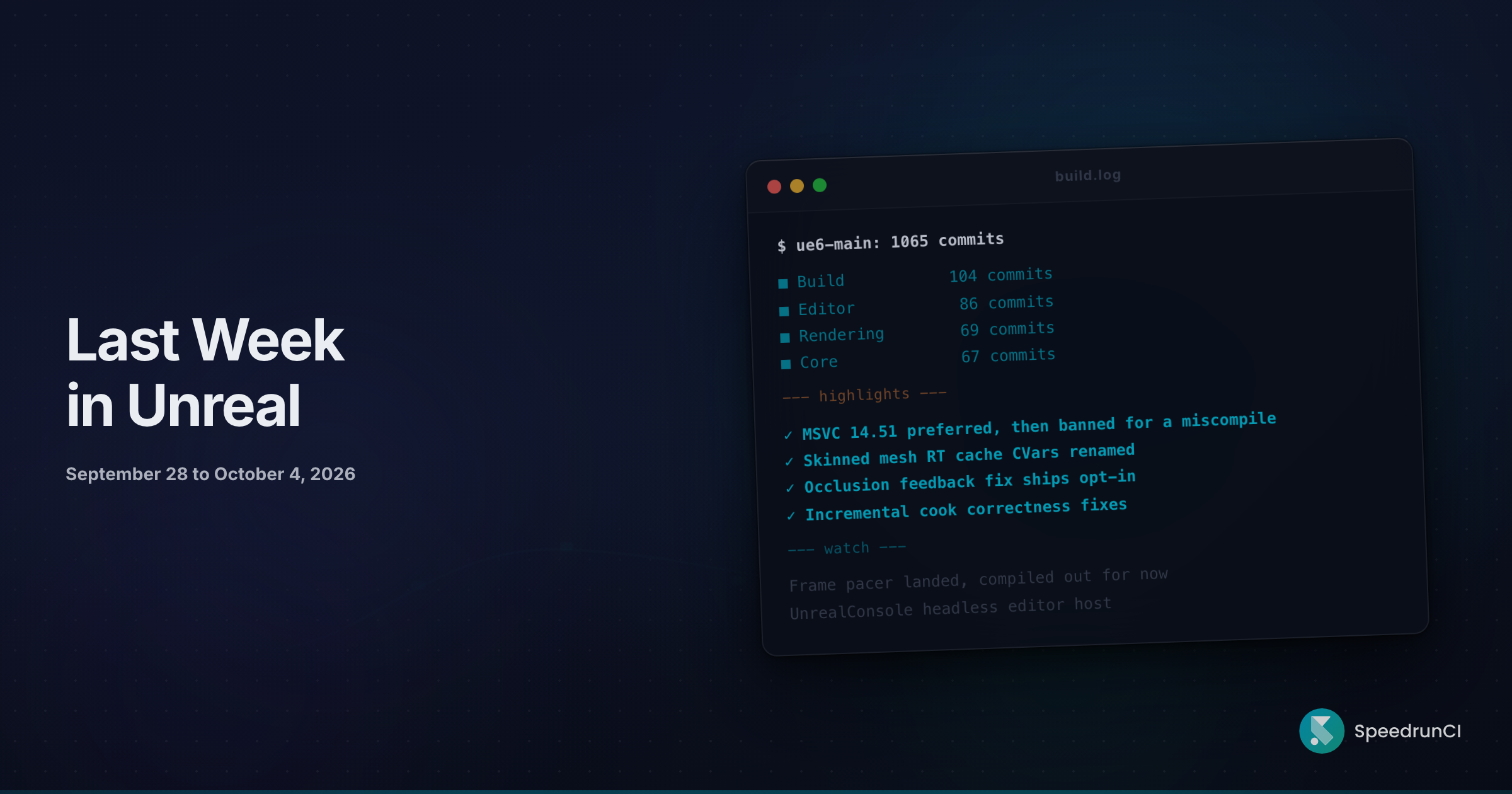
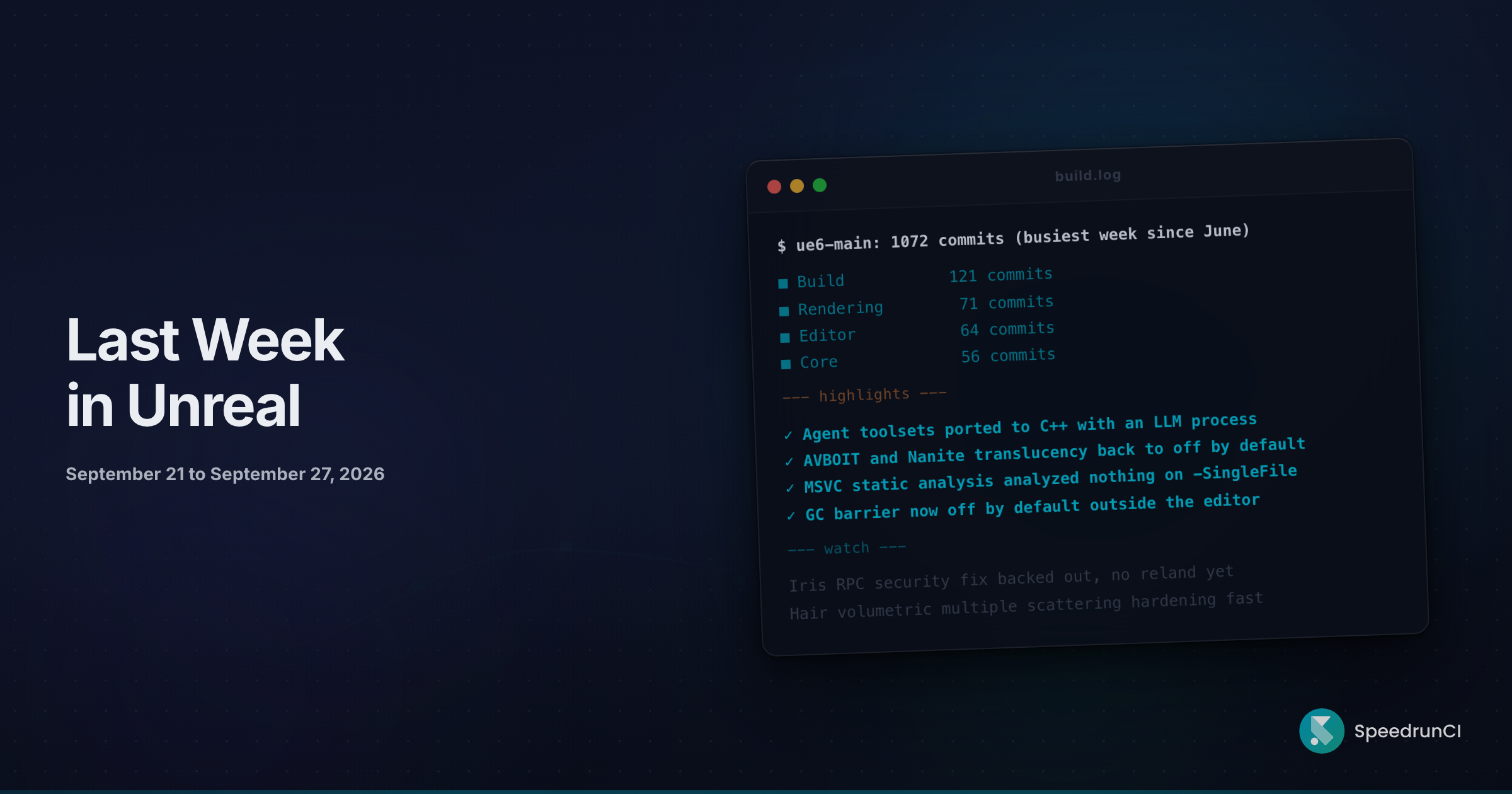
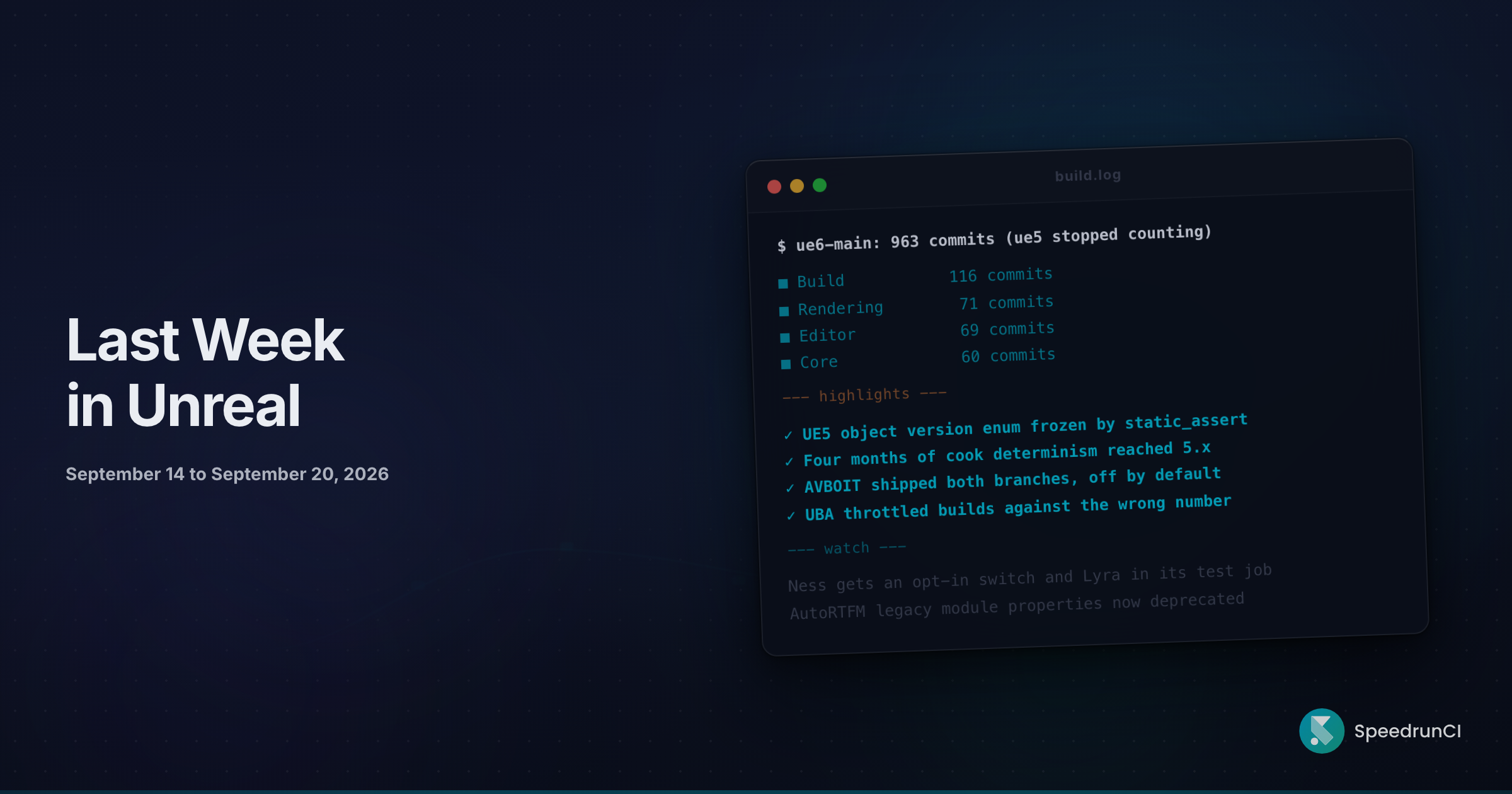
Last Week in Unreal: Same Fix, Different Branch (August 24 to 30, 2026)
Unreal Engine Weekly: Same Fix, Different Branch
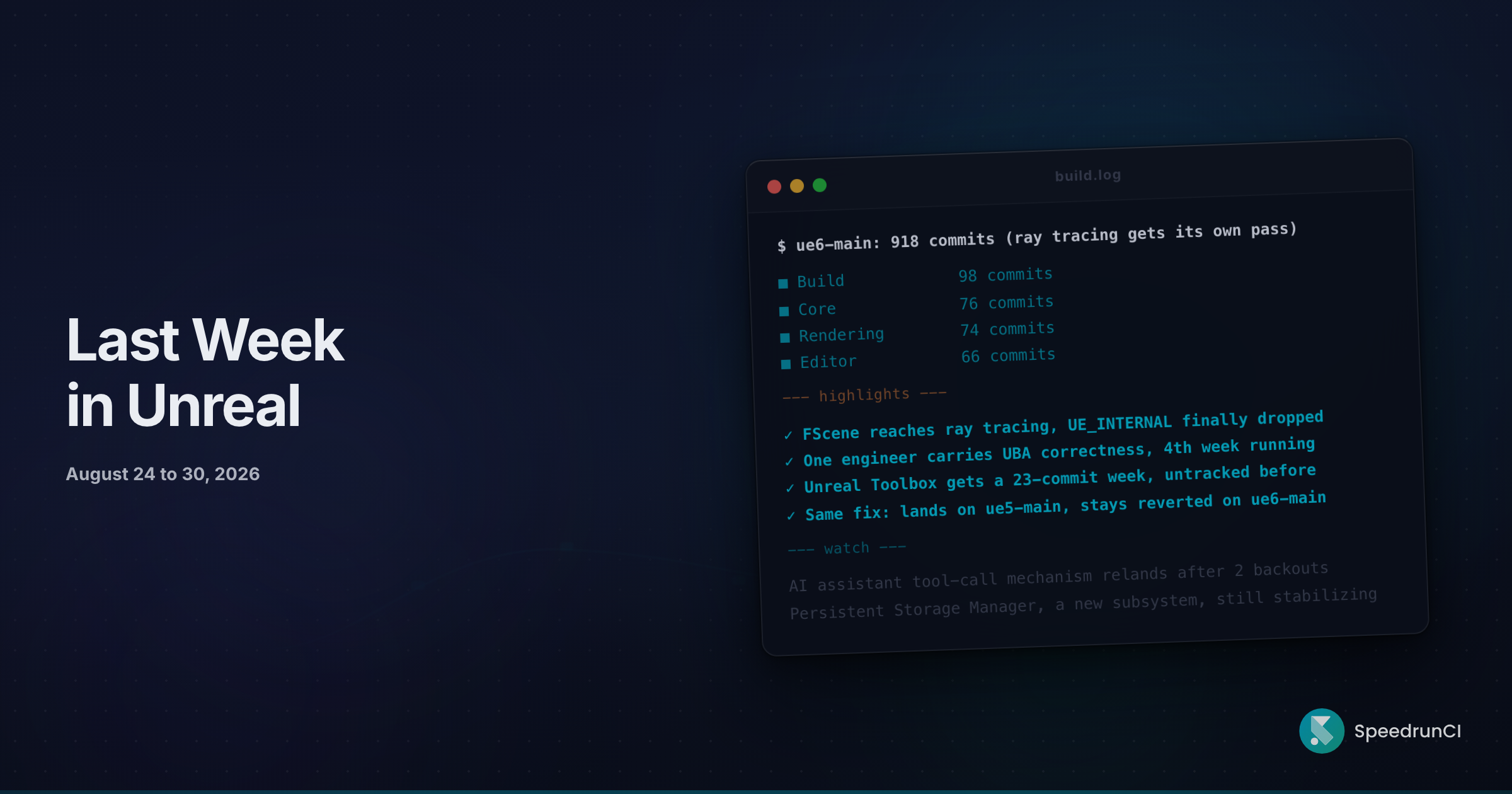
Week of August 24 – 30, 2026 | 918 commits on ue6-main, 174 on ue5-main | Branch: ue6-main
Overview
This was a rendering-and-tooling week more than a rendering-and-crashes week: the FScene-to-Scene-Extensions decomposition reached ray tracing specifically for a second straight arc, LumenRef kept building out its direct-lighting path, and a chunk of legacy rendering code (SSGI among it) got deleted outright. Away from rendering, a single engineer carried Unreal Build Accelerator’s correctness work for a fourth consecutive week, and a second engineer shipped a large, previously untracked campaign on Unreal Toolbox (the internal developer-tool distribution app). The AI editor assistant’s background tool-call mechanism relanded after repeated backouts. Nothing here is an emergency for most teams, but the ray-tracing API surface is visibly stabilizing and worth reading if you maintain a renderer fork.
Development Trends
Renderer Decomposition Reaches Ray Tracing Directly, Seventh Consecutive Week
Pattern: FScene’s split into modular Scene Extensions has produced a fresh cluster every week since reopening July 19. This week the target is explicitly ray tracing: static mesh cache data and machinery moved out of FScene/FPrimitiveSceneInfo into a new FStaticMeshSceneExtension (4a8f93d6), NativeInstances was renamed to TLASInstances (967e1001), FGeometryManagerHandle was refactored “to simplify upcoming changes” (41fadeba), Nanite-tagged ray tracing instance processing moved into Nanite::FRayTracingManager (a34192d5), and PrimitiveRayTracingFlags/PrimitiveRayTracingDatas plus path-tracing invalidation moved into FRayTracingSceneExtension (26233121). UE_INTERNAL was dropped from RayTracingInstanceBufferUtil.h (767182ba), which reads as the API settling into something other teams are meant to build against. The same arc produced a real fix: skeletal meshes were dropping out of the TLAS entirely when r.RayTracing.DynamicGeometry.MaxUpdatePrimitivesPerFrame was enabled (8a51a944).
Interpretation: seven straight weeks of continuous evidence, with this week narrowing from general scene-storage refactoring to ray tracing specifically. The UE_INTERNAL removal is the clearest signal yet that a chunk of this surface is stabilizing rather than still churning.
Who cares: renderer and engine-core teams, especially anyone maintaining hardware ray tracing or Lumen HWRT in a fork.
Signal strength: Strong. Seven weeks of continuous, substantive evidence since reopening July 19.
Build Infrastructure: UBA Correctness Work Continues, One Engineer Still Carrying It
Pattern: Build stayed elevated at 98 commits (down from 121 and 117 the prior two weeks, still well above the pre-July baseline). Unlike the last three weeks’ architecture passes (multi-tenancy, then a three-front rebuild), this week is a return to smaller, numerous correctness fixes, nearly all from the same engineer: a known-inputs streaming feature for the scheduler’s YAML config (f0365f92, e605db48), a compression double-encode fix for RAD OBJ files (29c9b0ef), a COFF-writer padding fix specifically so RAD Linker stops choking on the output (ab784a2a), removable-cache memory-leak diagnostics (31eece04), invisible folders and per-process overlay directories (422e38eb), a POSIX stat fix for leading parent-relative paths (643b90af), and exact cache-entry offset-vector reallocation during maintenance (541ed2ff).
Interpretation: the same single-engineer concentration flagged the last two weeks continues into a fourth week. The work itself keeps checking out as sound, narrowly-scoped correctness fixes, but the bus-factor risk is now a month-long pattern, not a one-week anomaly.
Who cares: build and tools teams running distributed builds through UBA.
Signal strength: Strong. Fourth consecutive week of concentrated single-author UBA activity.
AI Editor Assistant: Background Tool-Call Mechanism Relands After Repeated Backouts
Pattern: The AI assistant’s mechanism for backgrounding a long-running tool call (running it in a bounded window, then posting the result back to the conversation once it finishes) shipped this week at da58b851ec, citing a prior backout, and again at a515a8f521, citing two prior backouts (tracked under UE-390053). A related crash fix landed cleanly: the test spec backing this feature held its tool promise as a plain member that a background-static destructor tried to fulfill, crashing any process that loaded the plugin without running the test (fc4f1566b5). Separately, AIAssistant and MCPClientToolset were split into standalone EditorAndProgram/editor module pairs (4bff8240d1), and MetaSound’s agent-tooling integration was promoted out of an internal FortTech plugin into a standalone experimental engine toolset registered to load by default (ec883d85aa).
Interpretation: this is the same Agent Tooling arc that has read as cooling for two weeks, and it isn’t silent. A feature that needed three attempts to land, plus two module splits that widen its footprint into audio tooling, reads as continued, if lower-volume, investment rather than a wind-down.
Who cares: editor and tools teams following Epic’s in-editor AI agent work.
Signal strength: Moderate. One concrete cluster after two quieter weeks; worth another week of data before calling it reactivated.
A New, Previously Untracked Story: Unreal Toolbox Gets a Major Investment Week
Pattern: One engineer authored at least 23 commits this week entirely inside Unreal Toolbox, the managed developer-tool distribution and self-update application. The work spans a full self-update UX overhaul with staged versions, deferred updates, and shutdown-race handling, validated with “33 passing tests and clean Development and Analyze builds” by the commit’s own description (b54af79f), structured telemetry with bounded delivery retries and privacy safeguards (53777fd5), deduplicated Horde authentication so marketplace and settings auth share one interactive login instead of racing (1f2a2563), persisted launch profiles with Check Now progress reporting (172a2c8a), and a full branding pass replacing the Unreal Engine logo with a dedicated Toolbox icon across tray, window, and macOS packaging (2e43a4f3).
Interpretation: this is not part of any previously tracked pattern, and the volume (23+ commits, one engineer, one week) is large enough to flag on its own rather than folding it into general editor and tooling activity. Whether it recurs next week decides if this becomes a sustained story.
Who cares: anyone whose studio uses Unreal Toolbox for managed tool distribution or UGS integration.
Signal strength: Single week. Worth watching for a second week of data.
TL;DR
- The FScene-to-Scene-Extensions decomposition reached ray tracing specifically this week (static mesh cache data,
NativeInstancesrenamed toTLASInstances,Nanite::FRayTracingManager), withUE_INTERNALdropped from a key header, a signal the API is stabilizing. A real bug in the same arc: skeletal meshes could drop out of the ray-tracing TLAS entirely under a common cvar. - Unreal Build Accelerator’s correctness work continues into a fourth straight week, still carried almost entirely by one engineer: a known-inputs streaming feature, a RAD Linker compatibility fix, and several cache and diagnostics fixes.
- A Sequencer camera-shake-preview teardown fix shipped successfully on
ue5-mainthis week after one backout, but remains reverted onue6-main, where it was submitted twice and backed out with no reland in this week’s window. Same patch, opposite outcome by branch.
Highlights
Ray tracing gets its own Scene Extensions pass, and a real TLAS bug gets fixed
What changed: Static mesh cache data and machinery moved out of FScene/FPrimitiveSceneInfo into a new FStaticMeshSceneExtension (4a8f93d6). Elsewhere in the same arc: NativeInstances renamed to TLASInstances (967e1001), FGeometryManagerHandle refactored ahead of upcoming changes (41fadeba), Nanite-tagged ray tracing instance processing consolidated into Nanite::FRayTracingManager (a34192d5), PrimitiveRayTracingFlags/PrimitiveRayTracingDatas and path-tracing invalidation moved into FRayTracingSceneExtension (26233121), and UE_INTERNAL was dropped from RayTracingInstanceBufferUtil.h (767182ba). The real bug fix riding along: skeletal meshes were dropping out of the ray tracing TLAS entirely when r.RayTracing.DynamicGeometry.MaxUpdatePrimitivesPerFrame was enabled (8a51a944).
Why this is important: this is the seventh straight week of the FScene decomposition producing a fresh cluster, and it has now narrowed specifically to ray tracing storage. The UE_INTERNAL removal reads as an API stabilizing rather than still under construction. The TLAS dropout bug is a real correctness issue for anyone using that cvar with skeletal meshes and hardware ray tracing.
Who should care: renderer and engine-core teams, anyone maintaining a hardware-ray-tracing or Lumen HWRT fork.
Urgency: Act now if you run r.RayTracing.DynamicGeometry.MaxUpdatePrimitivesPerFrame with skeletal meshes and hardware ray tracing. Track the broader decomposition.
LumenRef keeps building toward a usable reference path
What changed: LumenRef (Epic’s in-progress hardware-ray-traced Lumen reference path) picked up Light Function, IES profile, and light-end-bias support (29253461), an initial direct-lighting pass (87a30b90), replaced light-miss shaders with the LF atlas (8c748501), added error-diffusion sampling for screen-space sampling (1138bb46), and consolidated shared code across LumenRef, MegaLights, and hardware-ray-traced lighting generally (08eeb37c). Separately, Lumen’s radiance cache got a hardware-ray-tracing performance win by decoupling two passes that no longer need to run in sequence, saving 0.06ms on console at a 100-probe trace budget (cc537df5).
Why this is important: this continues the multi-week hardware ray tracing reopening from the prior two weeks, now in its third consecutive week. LumenRef is explicitly still a prototype, not usable yet, but the pace of feature additions (lighting, sampling quality, shared code with production paths) says Epic is actively building it out rather than letting it sit.
Who should care: graphics and rendering teams tracking hardware-ray-traced Lumen.
Urgency: Track.
Legacy rendering code gets deleted, not just deprecated
What changed: Screen Space Global Illumination (SSGI) was removed entirely (5ca9c633). Hair strands lost their dual-scattering roughness override (d38baa8d). Deprecated code was purged from the RHI, focused on Metal (9cd86845). Shader-system deprecated code was removed “past required window” (52861013).
Why this is important: these are deletions, not deprecation warnings. Anything still calling the removed SSGI path, the hair override, or the purged RHI and shader entry points breaks on sync, not on a future release.
Who should care: teams maintaining renderer forks, especially anyone still using SSGI instead of Lumen screen-space GI, or the removed hair dual-scattering path.
Urgency: Act now if you depend on any of the four removed paths. Otherwise ignore.
UBA correctness work continues into a fourth week, still one engineer
What changed: Unreal Build Accelerator picked up a known-inputs streaming feature for the scheduler’s YAML config, letting common inputs stream to clients ahead of process payloads (f0365f92, e605db48), a fix for RAD OBJ files getting double-compressed on write (29c9b0ef), a COFF-writer padding fix specifically so RAD Linker stops rejecting the output (ab784a2a), removable-cache memory-leak diagnostics (31eece04), invisible folders and per-process overlay directories (422e38eb), a POSIX stat fix for leading parent-relative paths (643b90af), and exact cache-entry offset-vector reallocation during maintenance, replacing an approximation that over- or under-allocated (541ed2ff). All of the above are from the same engineer.
Why this is important: this is the fourth straight week UBA’s correctness surface has rested substantially on one person. The work continues to check out as sound, but a month of concentration in one system, one author, is worth flagging as a standing risk independent of the quality of any individual fix.
Who should care: build and tools teams running distributed builds through UBA, especially anyone tracking RAD Linker and RAD OBJ readiness.
Urgency: Track.
AI assistant’s background tool-call mechanism relands after repeated backouts, plus two module splits
What changed: The AI editor assistant’s mechanism for backgrounding a long-running tool call, letting it keep running past a bounded window while the agent carries on, then posting the result back once it finishes, landed this week at da58b851ec (citing one prior backout) and again at a515a8f521 (citing two prior backouts), under UE-390053. A related crash fix landed cleanly: the test spec backing this feature held its tool promise as a plain member, and a file-scope static destructor tried to fulfill an unset promise in any process that loaded the plugin without running the test, crashing on exit (fc4f1566b5). Separately, AIAssistant and MCPClientToolset were split into standalone editor and runtime module pairs (4bff8240d1), and MetaSound’s agent-tooling integration moved out of an internal FortTech plugin into a standalone experimental engine toolset that loads by default (ec883d85aa).
Why this is important: a feature needing three submission attempts before landing, combined with two module splits widening the toolset’s footprint into audio tooling, says this area is still actively worked, not winding down, even though weekly volume has been lower the last two weeks.
Who should care: editor and tools teams tracking Epic’s in-editor AI agent work.
Urgency: Track.
A crash-guard fix ships to both branches, and a Sequencer fix diverges between them
What changed: An nDisplay crash fix for unresolvable config data, cluster nodes, or viewports (deleting a cluster node could leave a null entry that consumers assumed was always valid) landed, was backed out, and relanded on ue6-main (8f2487ff then backed out bb69dd51 then relanded 55f805e8), tagged as a temporary fix for 5.8.3. The same fix went through an identical land-backout-reland cycle on ue5-main this week (see the 5.8 section below). Separately, a fix releasing Sequencer camera-shake previews on world teardown (previously nothing dropped the FGCObject references, leaving the outgoing world and its package reachable after a map change) was submitted twice and backed out on ue6-main, with no reland anywhere in this week’s commit data (3ebdd277 then ae892dbb6 then backed out at ed25dfc9). The same fix landed successfully on ue5-main this week after one backout (see the 5.8 section below).
Why this is important: the nDisplay fix is confirmed live on both branches as of this week. The camera-shake fix is not live on ue6-main despite two submission attempts, but is live on ue5-main. Anyone checking whether this was fixed needs to check the actual branch, not assume parity between them.
Who should care: nDisplay and virtual-production teams for the crash fix; Sequencer and animation teams tracking the camera-shake preview leak specifically on ue6-main.
Urgency: Track. The camera-shake leak is still present on ue6-main as of August 30.
Worth Tracking
- Persistent Storage Manager, a new quota and budget subsystem tracked under
UE-392423, picked up path-conversion fixes for platforms requiringConvertToAbsolutePathForExternalAppForWriteand CSV-metadata budget stats this week (911d3878,882f652e,519d547f,45fc7d40). Still stabilizing; watch for a broader rollout signal. - A dynamic-logging refactor continued under
UE-392122: tracing support for dynamic logging, a log-category lookup-by-name API, and an atomic-counter-assigned trace log category and log point (5bb0b384,dc6ee08b). Feeds into the multi-weekFMsg::LogfandLogVdeprecation push from prior weeks. - AutoRTFM and Verse’s
VArrayBasehierarchy went through a same-day (August 28) triple backout and reland loop from one engineer, annotating the type as fullyAUTORTFM_DISABLE. Final state as of week’s end: landed (29d26a0b49), after two same-day backouts. - Ness, the still-unexplained serialization runtime, picked up 26 commits this week, its highest weekly count yet. New this week: a standalone
NessRoundtripcontinuous-integration test (f3addab8), a “SPOT” table concept with an enumeration API, disabled by default when compiled in (51a9ae20,73bc73a1), and a real crash fix for aFNativeStringoptimization-induced nullptr in Verse string binding (ef8fde29). The old table-of-contents implementation was deleted as unused (057110cf), which reads as a migration completing rather than starting. - The categorizer’s “other” bucket caught 460 of this week’s 885 analyzable commits (52%), including entire real clusters it doesn’t subsystem-tag: Procedural Vegetation Editor (25 commits, a module-move campaign under
UE-393874), Mass entity-framework hardening (18 commits), and the Ness serialization work above.
What We Ignored
The bulk of this week’s low-interest volume was routine: single-line dependency and localization-automation bumps against Engine/Build/Commit.gitdeps.xml, Gauntlet and AutomationTool test-infrastructure tuning (device timeouts, coverage-target skipping, RPC relay swaps), a long tail of individual Niagara and Control Rig editor crash fixes each affecting a narrow repro case, and UnrealBuildTool dead-define cleanup, seven commits removing unreferenced global defines like USE_VORBIS_FOR_STREAMING and USE_XMA2_FOR_STREAMING. None of these change runtime behavior, build reliability, or upgrade risk for production teams.
For teams shipping on 5.8
ue5-main saw 174 commits this week (172 analyzable, 35 high-interest). No 5.8.x point release is confirmed as shipping in this week’s commit messages: “5.8.3” appears only as a target label on the nDisplay temporary fix and as a risk note on an unrelated Nanite-landscape material fix, not as a release that has actually gone out. Seven commits carry enough detail to call out:
- The nDisplay config, cluster, and viewport crash-guard fix (see above) landed, was backed out, and relanded this week, tagged as a temporary fix for 5.8.3 (
74817dcc,6a3ef366,5fb9bb44). Same fix as theue6-mainversion. - The Sequencer camera-shake-preview teardown fix shipped successfully on
ue5-mainafter one backout (0422764dthen backed out6890eb8athen relanded1262dc72), unlikeue6-mainwhere the same fix remains reverted with no reland this week. - A Curve Table crash on undo (
af9ec00c, CL 57546368): stale pointers to rich curve models after an undo operation now resolve by handle instead, fixing a crash native to this branch. - A Nanite material-preview crash (
46a36579, CL 57538920): selecting an unsupported material domain or blend mode while previewing a Nanite mesh in the material editor no longer crashes. - A Constraints use-after-free during animation evaluation (
00f014cb, CL 57510985):FAnimationEvaluatorcould be freed while the constraints evaluation graph was invalidated mid-evaluation; now guarded. - Material Parameter Collections now use persistent shared uniform buffers keyed by ID rather than one buffer per collection instance (
0ae1658d, CL 57393741), fixing crashes when the same collection appeared in multiple packages and one was unloaded, leaving stale uniform-buffer references in cached mesh draw commands. - A Chaos memory leak on copying and scaling geometry was fixed (
2ce60b05, CL 57364031). - A Control Rig crash assigning a Pose Asset to a connected Get Pose Cache node was fixed via an index-swap bug in
FRigUnit_PoseAsset(1e883465, CL 57496812).
Closing
A rendering week and a tooling week at the same time: the ray-tracing scene-extension work is visibly heading toward a stable API, and Unreal Build Accelerator and Unreal Toolbox both got a month’s and a week’s worth of concentrated single-author investment respectively. The branch-divergent Sequencer fix is a reminder that “fixed” needs a branch name attached to it.
Commit SHAs are cited inline, in parentheses, next to each claim. They reference the ue6-main branch of EpicGames/UnrealEngine unless the claim is in the “For teams shipping on 5.8” section, which references ue5-main. Some of the highest-interest entries resolve to Commit.gitdeps.xml binary-manifest blobs: the commit message is real, but the code lives in Epic’s internal binaries, which we cannot see.
Never miss a ue5-main update.
Get them delivered straight to your inbox.