Last Week in Unreal — Apr 6-12, 2026
Unreal Engine Weekly — What Changed and What Matters
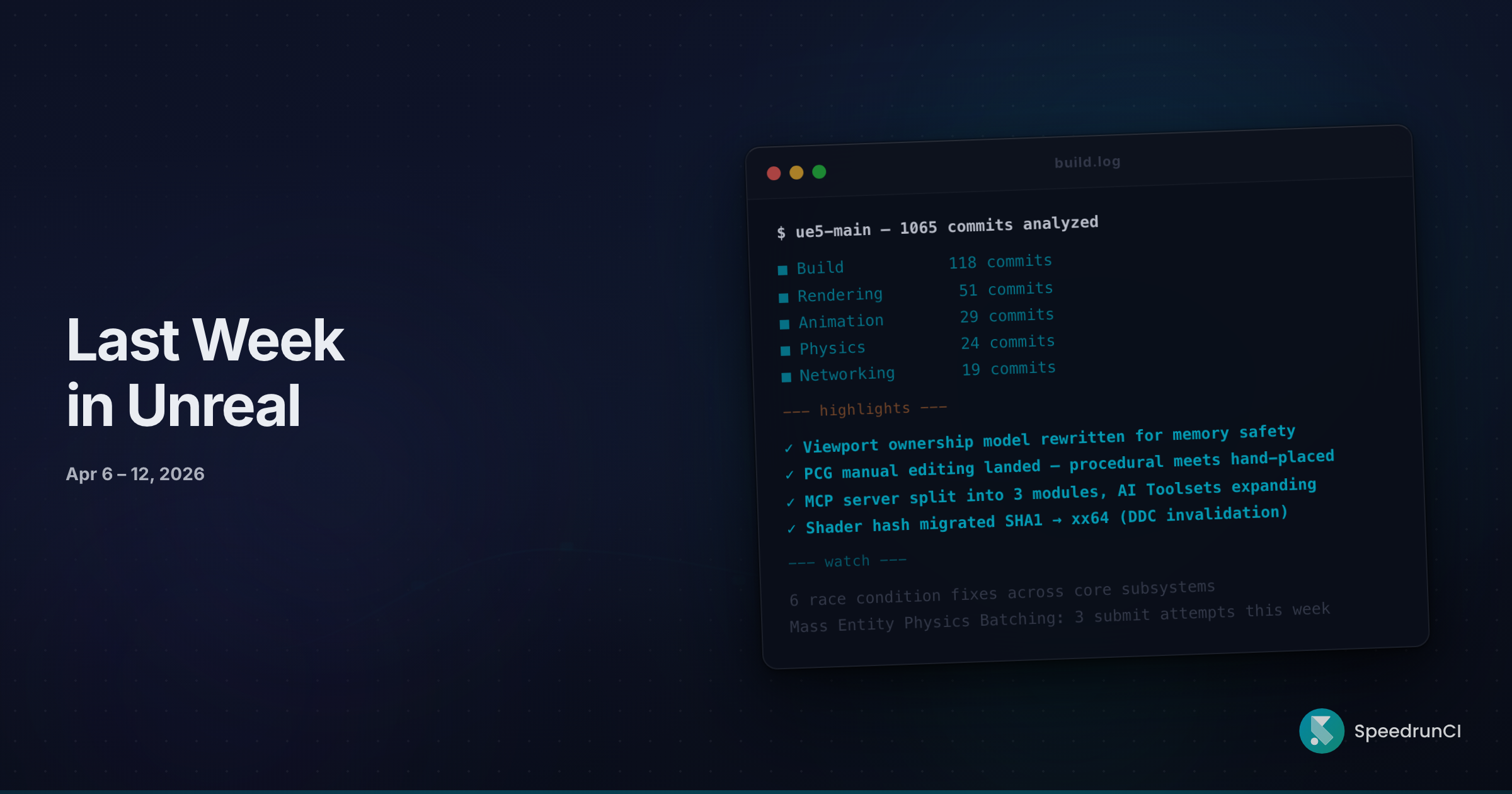
Week of April 6-12, 2026 | 1065 commits analyzed | Branch: ue5-main
Overview
A week defined by two parallel storylines: deep memory safety and stability work across core systems, and an accelerating push to embed AI/LLM tooling directly into the editor. The Viewport ownership model got a significant rewrite to eliminate use-after-free crashes, PCG gained manual editing capabilities that fundamentally change the procedural-vs-manual tradeoff, and Epic landed 15+ commits building out MCP server infrastructure and AI Toolsets. Rendering saw targeted quality improvements to MegaLights and early mobile local exposure work. Multiple race condition fixes across distance fields, navigation, and Sequencer suggest late-cycle stabilization ahead of a release milestone.
Development Trends
Multi-week patterns from 8 weeks of commit data and subsystem momentum analysis.
Build Infrastructure Surge: Largest Spike in Eight Weeks
Pattern: Build commits jumped to 118 this week, a 62% increase from last week’s 73 and the highest level in the tracking window. The 8-week trajectory: [66, 67, 79, 78, 94, 62, 73, 118]. The previous ceiling was 94 (week of Mar 16-22).
Interpretation: Combined with rendering hitting its 8-week low (51), the investment balance has dramatically shifted from runtime features to infrastructure and tooling. This pattern, build surging while rendering declines, is a classic late-cycle signal where the engine is being stabilized and packaged rather than having new features added. The timing aligns with a potential 5.8 milestone.
Who cares: Build engineers, CI/CD teams, studios managing engine forks.
Signal strength: Strong
Animation Pipeline Sustained Breakout
Pattern: Animation commits have risen steadily over 8 weeks: [12, 12, 17, 21, 17, 13, 22, 29]. This week’s 29 commits is the highest observed, a 142% increase from the baseline of ~12. The report dedicates an entire section to skeletal mesh modeling stabilization with deadlock fixes, undo/redo semantics, and morph target workflow improvements.
Interpretation: Animation has been rising for two months and is now producing the kind of stabilization work (deadlock fixes, CIS battle-testing) that precedes a feature shipping. The medial skeleton auto-rigging pipeline, ISKM GPU bone attachments, and morph target workflow improvements suggest Epic is pushing in-editor skeletal editing toward production quality.
Who cares: Character artists, technical animators, rigging teams, studios evaluating in-editor modeling as a DCC replacement.
Signal strength: Strong
AI Agent Infrastructure Enters Production Architecture Phase
Pattern: AI/editor tooling themes have appeared every week since March 8, now six consecutive weeks. This week: MCP server split into three-module architecture, AI Toolsets expanded across 6+ subsystems, semantic search gains Linux support, C++ sandbox bridge landed. 15+ commits.
Interpretation: The progression from single-team prototype to multi-developer platform to architectural decoupling follows a textbook productionization arc. The three-module MCP server split and the breadth of toolset coverage (static meshes, blueprints, data tables, Niagara, Sequencer, GameplayTags) indicate this is being built for distribution, not experimentation.
Who cares: Pipeline/automation engineers, technical artists, anyone building AI-assisted content workflows.
Signal strength: Strong
Runtime Subsystems Activating: Physics, Gameplay, Networking, Audio
Pattern: Four previously quiet subsystems are simultaneously rising: physics [11 to 24], gameplay [2 to 8], networking [14 to 19], audio [4 to 13]. Mass Entity Physics Batching was submitted, backed out, and resubmitted three times this week.
Interpretation: When multiple runtime subsystems activate simultaneously after a sustained period of infrastructure and rendering focus, it typically signals a phase shift toward gameplay-facing features. Combined with the build surge and rendering decline, this paints a picture of an engine approaching a release milestone where runtime gameplay systems receive attention after core infrastructure is stabilized.
Who cares: Gameplay programmers, physics teams, audio engineers, multiplayer teams, Mass Entity users.
Signal strength: Moderate
TL;DR
- Viewport ownership model rewritten. Managed pointers replace raw pointers to prevent use-after-free across 27+ files. Custom FViewportClient subclasses will need updates.
- PCG manual editing is here. Artists can now hand-edit individual procedural points in-viewport. ~5,000 lines of new code.
- Epic is building an AI agent framework into the editor. MCP server split into three modules, AI Toolsets expanding across subsystems, semantic search maturing. 15+ commits this week.
- Slate invalidation performance regression reversed. The per-frame polling approach was reverted in favor of delegate binding.
- Race condition sweep. Six independent fixes across distance fields, navigation, Sequencer, asset loading, and Niagara.
- Shader hash algorithm changed from SHA1 to xx64. Will invalidate your DDC.
Highlights
Memory Safety and Use-After-Free Fixes
What changed
Four independent commits address the same class of bug: reading from freed, uninitialized, or out-of-bounds memory. The largest is the Viewport change (ed9bceec), which converts to managed pointers to prevent use-after-free when a ViewportClient is deleted while still referenced, touching 27 files across compositing, nDisplay, DMX, and multiple editors. A TLS exhaustion fix (7722f281) replaces a silent deadlock during cook with a fatal assert. A Windows process pipe fix (ee2af89f) initializes a Flags variable that was previously reading garbage after a failed GetHandleInformation call. And a material expression fix (d79ba6c6) adds bounds checking to GetConnectedOutput. All reference specific crash tickets.
Why this is important
The Viewport change is a genuine ownership model shift. If you have custom FViewportClient subclasses, the lifetime semantics changed. The rest are the kind of fixes that eliminate intermittent crashes teams spend days debugging.
Who should care
Everyone syncing ue5-main. Editor plugin authors and custom viewport implementers need to audit their FViewportClient code. Cooker pipeline teams benefit from the TLS fix.
Urgency
Act-now for the Viewport ownership change if you extend FViewportClient. Track for the rest.
Race Condition Sweep
What changed
Six race condition fixes landed across unrelated subsystems: a Dataflow crash during async asset loading (9958f281), a distance field queue race between game thread and background workers (21d7ec63, affects every project using Lumen), a NavigationSystem data race in async nav data gathering (19c157f3), a Sequencer scheduling race in TEntityTaskComponents (ac974661), a swapchain pointer validation before enqueueing acquire lambdas (121e4620), and a Niagara GC race during in-flight CPU compilation (9cad68f1).
Why this is important
The distance field race is the most broadly impactful. It affects rendering stability for any project using Lumen or distance fields, which is most projects at this point. The others are harder to hit but represent the kind of bugs that produce unreproducible crashes in CI or during cook.
Who should care
All teams on ue5-main. The distance field fix alone justifies a sync.
Urgency
Track. These are silent stability improvements. You benefit automatically by syncing.
PCG Manual Editing: Procedural Meets Hand-Placed
What changed
PCG now supports data overrides that allow artists to manually edit, insert, and delete individual points directly in the viewport (8a6de7c0). The implementation (~5,000+ lines) includes a new DeltaViewportExtensions system with point edit, deletion, and insertion modes, a DeltaVisualizations system for showing procedural-vs-manual differences, a dedicated SPCGManualEditPanel, and graph editor integration exposing data override status per node.
Why this is important
This closes a long-standing workflow gap. PCG has historically been fully procedural. If you needed to hand-tweak a few tree placements or move a rock, you had to choose between procedural and manual. Now you can do both. For open-world teams, this is the kind of feature that changes pipeline decisions.
Who should care
Level designers, open-world environment teams, PCG pipeline owners.
Urgency
Track. Experimental, but significant enough to start evaluating.
AI Agent Infrastructure: MCP, Toolsets, and Semantic Search
What changed
Three commits split the MCP server into a three-module architecture (580d7dad, separating protocol from editor integration), moved the Terminal plugin to Engine/Plugins/Experimental, and added a console command to generate MCP client configuration files. The AI Toolsets framework expanded with six test infrastructure commits plus concrete additions: static mesh LOD threshold read/write, asset editability checks, project/plugin support, data table schema validation, Event Dispatcher tools, and new toolsets for GameplayTags, Sequencer, logs, Niagara (9d9ea98c), and UMG. Semantic search in the Content Browser got UX polish, a reindex button for missing assets, and Linux support via FAISS/OpenBLAS binaries (1a923c4d). A C++ bridge for AIAssistant sandbox integration (3927bf6d) also landed.
Why this is important
This is the clearest signal yet that Epic is positioning the Unreal Editor as an MCP-compatible tool host for LLM agents. The three-module decoupling suggests production intent, not a prototype. The breadth of toolset coverage, spanning static meshes, blueprints, data tables, Niagara, Sequencer, and more, indicates a coordinated effort to make every major subsystem accessible to AI agents. Combined with semantic search maturing into its third or fourth week of steady commits, this is arguably the biggest story of the week.
Who should care
Pipeline and automation engineers, technical artists, anyone building or evaluating AI-assisted content creation workflows.
Urgency
Track. Not production-ready, but the velocity and breadth suggest this will be a headline feature in a near-future release.
Slate Invalidation: Performance Regression Reversed
What changed
A previous fix for missing paint invalidation on SCompoundWidget foreground colors caused a per-frame performance regression by polling two virtual functions on every widget every tick. This week’s fix (e64625ac) reverts that approach entirely and instead fixes affected widgets individually using delegate binding. A separate commit adds fatal-level logging for invalid parent-child widget relationships.
Why this is important
The new rule: never override GetForegroundColor() directly. Bind a delegate via SetForegroundColor() in Construct instead. GetDisabledForegroundColor() is not tracked by TSlateAttribute, so widgets overriding it must handle their own invalidation. If you have custom SCompoundWidget subclasses, this is a pattern change you need to adopt.
Who should care
Editor/tools teams, anyone with custom Slate widgets, UI-heavy projects.
Urgency
Act-now if you override GetForegroundColor() in custom widgets.
Rendering: MegaLights Quality, Vulkan Bindless, and Shader Hash Migration
What changed
MegaLights re-enables visible light hash filtering (699d50dc) to reduce artifacts around disocclusion, with optimized hash calculations keeping overhead to ~0.01ms at 1080p on console. Vulkan gained bindless uniform buffer support (42a46369) and specialization constants in VULKAN_PCES3_1. Metal disabled native shader library (24a76cb9) in favor of FMetalIoStoreShaderCodeArchive. The shader map layout and content hash algorithm changed from SHA1 to xx64 (f52cea27, FShaderhash). GetPerInstanceRandom() had its shader stage restrictions removed (eeb22884). Mobile local exposure (c50b3a12) was integrated into the tonemap pass but is disabled by default.
Why this is important
The shader hash migration from SHA1 to xx64 will invalidate your DDC. Expect a full reshader on next sync. The MegaLights improvement is a free quality win. Vulkan bindless uniform buffers are a meaningful RHI feature for Vulkan-targeting projects.
Who should care
Graphics programmers, anyone shipping with MegaLights, Vulkan-targeting teams, and everyone (for the DDC invalidation).
Urgency
Act-now to plan for DDC invalidation after syncing. Track for MegaLights and Vulkan changes.
Skeletal Mesh Modeling Tools Stabilization
What changed
An intense burst of commits fixing deadlocks during reimport (0ba1759e), undo/redo semantics for CommitToSkeletalMesh (bc045485), morph target selection decoupled from weight overrides (a802a06e), auto-restarting morph editing tools on target changes, and editor close flow for unapplied changes. Multiple backout-then-resubmit cycles indicate this code is being battle-tested against CIS.
Why this is important
This volume of stabilization work on a single subsystem in one week signals that skeletal mesh in-editor modeling is being pushed toward a shippable state. The deadlock fix, switching from FFunctionGraphTask to ExecuteOnGameThread to avoid dispatch during task graph pumping, is the kind of fix that only surfaces in real production pipelines.
Who should care
Character teams, anyone doing morph target iteration in-editor, studios evaluating whether in-editor modeling can replace DCC round-trips.
Urgency
Track. Evaluate if your character pipeline could benefit.
OpenXR Swapchain Fix
What changed
EnumerateImages() was silently discarding a failed return value and leaving ChainCount uninitialized (565db387), which would crash inside third-party runtimes. All five CreateSwapchain functions (D3D11, D3D12, OpenGL, GLES, Vulkan) now guard against zero-image enumeration.
Why this is important
This is the kind of bug that only manifests with specific third-party XR runtimes, making it extremely difficult to diagnose. If you have been seeing unexplained crashes in XR swapchain creation, this is likely your fix.
Who should care
XR teams, especially those using non-Meta/non-SteamVR runtimes.
Urgency
Act-now if you are experiencing XR swapchain crashes with third-party runtimes.
Worth Tracking
Mass Entity Physics Batching (e59243af). Batched BodyInstance initialization via Mass processors was submitted, backed out, resubmitted, backed out, and resubmitted a third time this week. Three attempts at landing the same CL means they are wrestling with a tricky integration. If this lands cleanly, Mass-based worlds get significantly cheaper physics initialization for large entity counts. Worth checking stability before relying on it.
Async “Open Source Code” Editor Action (c786a3ba). The “open source code” action is now async with a new SourceCodeNavigation.EnableAsync CVar. Previously, clicking it would lock up the editor while waiting for the IDE to launch. A daily-friction fix touching 9 files across BlueprintGraph, LevelEditor, and UnrealEd. Every C++ developer using UE benefits.
Composure/Compositing Overhaul. 10+ commits landing new sky sphere actors, composite mesh management, erosion/dilation passes, analytics, and compute-to-graphics pipeline changes. Looks like a major Composure v2 effort ramping up.
Sandboxed Editing. 7+ commits on a new collaborative editing feature with a sandbox browser, activity lists, and persist operations. Appears to be a new UE 5.8 feature. Early days, but worth watching.
TEDS Outliner Migration. Systematic migration of World Partition columns to the TEDS-based outliner continues. Incremental but consistent.
What We Ignored
- Firefight reintegration (2.8k files from Fortnite Release-40.40 to Main, bulk merge, not a feature)
- Copyright and formatting-only changes (filtered as noise)
- Routine UBT warning flag additions (unreachable code warnings enabled, minor)
- GameplayTags/GameplayCue performance micro-optimizations (real but incremental)
- Navigation memory allocation optimizations (dtLink pool sizing)
- TmvMedia memory reduction (narrow scope)
- Early crash log timestamp additions (nice but minor)
- TEDS outliner column migrations (incremental, covered in Worth Tracking)
Closing
The AI story is the one to watch. Fifteen-plus commits across MCP server architecture, AI Toolsets, semantic search, and sandbox integration represent a coordinated investment that is past the prototype stage. The practical impact this week goes to the memory safety fixes. The Viewport ownership change and the distance field race condition fix improve stability for essentially every project on ue5-main. PCG manual editing is the kind of feature that changes pipeline conversations, even if it is experimental today. Plan for a DDC invalidation from the shader hash migration, and if you have custom Slate widgets or FViewportClient subclasses, set aside time to update your code.
This analysis covers commits to the ue5-main branch of Epic’s Unreal Engine repository for the week of April 6-12, 2026. “Act-now” = likely affects your project, worth investigating this week. “Track” = notable change, no immediate action required.
Built by Speedrun CI — we read every commit so you don’t have to.
Never miss a ue5-main update.
Get them delivered straight to your inbox.