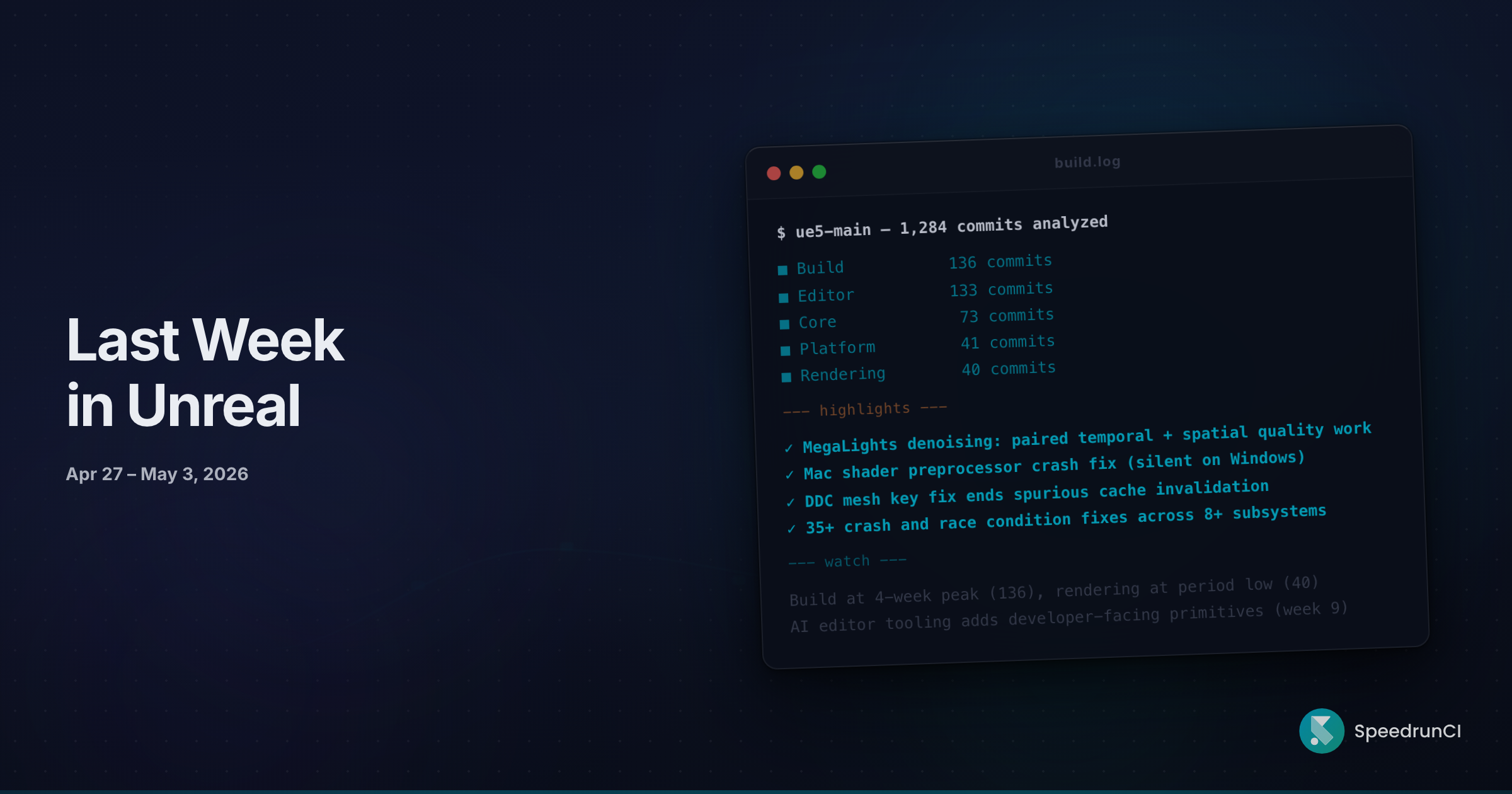
Last Week in Unreal — Apr 27 to May 3, 2026
Unreal Engine Weekly — What Changed and What Matters
Week of April 27 to May 3, 2026 | 1,284 commits analyzed | Branch: ue5-main
Overview
Most of the activity concentrated in rendering infrastructure, shader plumbing, AI editor tooling, and a broad stability sweep across nearly every subsystem. Nothing here forces immediate action for most teams, but a few crash fixes and a Mac shader compilation bug warrant attention if they touch you.
Development Trends
Multi-week patterns based on 8 weeks of commit history, subsystem momentum, and theme continuity.
Post-Cut Pivot: 5.8 in Lockdown, ue5-main Ramps Toward 5.9
Pattern: Build commits hit 136 this week, the highest single-week count in the tracking period and the 4th consecutive week above 100 (118, 109, 107, 136). Rendering dropped from 88 to 40, the lowest in 8 weeks. The build-to-rendering ratio across March averaged about 1.2x and stayed below 1.5x; this week it is 3.4x. Last week’s three breaking removals (GPU Scene legacy, iOS Sim, Android OpenXR) were followed by DDC key generation fixes, shader symbol format genericization for DDC bucket separation, and CEF v147 on by default. Platform stays elevated at 41. Meanwhile the public 5.8 release branch (cut from ue5-main on April 11) received only 12 commits in the same window: 6 Localization Automation runs and 6 surgical cherry-picks (Mac mouse input, nDisplay editor crash, Datasmith plugin crashes, Take Recorder, Control Rig graph reload, uat directory exclusion).
Interpretation: Two parallel signals, one branch each. The 5.8 branch reads as release-candidate lockdown: localization work plus a thin trickle of critical-path fixes is what you see in the last weeks before a release goes out. ue5-main, by contrast, is in post-cut composition flip mode. Rendering wound down because the rendering team finished what it could fit into 5.8 and has handed off to release engineering. Build and tooling are surging because that team is now investing in next-cycle infrastructure (DDC restructuring, shader symbol genericization, CEF major-version jump, MoviePipeline old queue removal) which is exactly the kind of work you land at the start of a development cycle, not the end. The directional read on the trunk is 5.9 ramp.
Who cares: Build engineers, CI/CD teams, engine fork maintainers, anyone planning their 5.8 sync window or watching for 5.9 signal.
Signal strength: Strong. 4 weeks above 100 build commits on ue5-main, rendering at period low, 5.8 branch in localization-dominated lockdown.
AI Editor Tooling Reaches Developer-Facing Maturity
Pattern: AI editor tooling has been a recurring theme across the last two months, with explicit AI/automation themes appearing on weeks 03-08, 04-12, 04-19, and this week. Through that span the work has shifted from infrastructure and registry plumbing to developer-facing primitives. This week: Python decorators that eliminate AgentSkill boilerplate, async coroutine execution on the editor thread separated from the asyncio loop manager, schema-lookup guidance for script authors, Blueprint graph navigation APIs (find_nodes, get_subgraph), and proper error handling for invalid LLM results. MCP gained a tool hash mapping commandlet and stale-session 404 behavior. Semantic search added similarity scores, Lyra integration, and an auto-indexing default toggle.
Interpretation: The shift from internal architecture to developer-facing APIs (decorators, helpful errors, schema guidance) reads as preparation for external exposure. When a team strips boilerplate and adds documentation-adjacent features, they are usually heading toward public launch. The parallel MCP investment positions the editor as both an AI-assisted workspace and a tool-calling endpoint for external agents.
Who cares: Editor tools teams, plugin developers, studios evaluating AI-assisted content workflows, MCP-compatible agent builders.
Signal strength: Moderate. Recurring theme over two months, this week’s shift toward developer ergonomics is the clearest pre-launch signal.
Rendering Shifts from Feature Work to Pipeline Plumbing
Pattern: Rendering dropped from 88 to 40 (55% decline, period low), but the work migrated rather than disappeared. Shader symbol format genericization across OpenColorIO, ComputeFramework, RenderCore, and ShaderCompilerCommon serves the DDC bucket split. MegaLights got coordinated denoising work: quality polish, not new features. The Mac shader preprocessor crash fix and dead instanced stereo path removal are cleanup. Over 8 weeks, rendering themes evolved: Nanite RT infrastructure (March), MegaLights optimization (early April), console hardening (late April), shader/DDC plumbing (this week).
Interpretation: Rendering has handed 5.8 off and is between cycles. The commit count drop reflects rendering work winding down on the trunk now that the 5.8 cut is past, while build and shader infrastructure pick up the next cycle’s plumbing work. MegaLights denoiser polish (two engineers landing coordinated denoiser work in the same week) is most likely the closing push for fixes destined to cherry-pick into 5.8 before it ships, with the underlying pivot then carrying forward into 5.9.
Who cares: Graphics engineers, custom shader pipeline maintainers, DDC-sensitive workflows.
Signal strength: Strong. 8-week theme evolution from features to infrastructure, rendering at period low while shader/DDC work peaks.
Pre-Release Stability Sweep Broadens
Pattern: Stability themes appeared in every summary for 8 consecutive weeks. This week’s breadth stands out: 35+ crash, race condition, and memory fixes spanning CoreUObject, materials, animation, audio, cooking, threading, ECS, and Niagara. Scope widened progressively: isolated crash fixes (March), memory safety sweep (April 12), race condition sweep (April 12), broad-spectrum hardening across 8+ subsystems (this week).
Interpretation: A progressively widening stability net on the trunk, with the most critical fixes likely heading to 5.8 as cherry-picks before it ships. CoreUObject-level fixes (blueprint enum undo crash) and cooker deadlocks are the kind of foundational issues that get pulled into a release branch even late in lockdown. The remainder will ride forward into 5.9.
Who cares: Everyone on recent ue5-main. Editor users, cooking pipeline owners, Niagara users, audio teams.
Signal strength: Strong. 8 consecutive weeks, broadening scope, 35+ fixes across 8+ subsystems in one week.
TL;DR
- MegaLights denoising got coordinated quality work from two engineers, pointing toward production readiness.
- A shader preprocessor bug was crashing Mac builds silently. Fixed. Check your custom shader compilation if you were seeing unexplained failures.
- Over 35 crash and race condition fixes landed in a single week on ue5-main. The most critical will likely cherry-pick into 5.8 before it ships; the rest carry forward into 5.9.
Highlights
Rendering Performance
What changed
MegaLights denoising got paired improvements: spatial filtering now adapts based on variance of neighborhood clamping strength rather than fixed kernels, and the spatial denoiser pass sharpens disocclusion better. Elsewhere, Single Layer Water velocity writes moved from base pass to depth prepass. HWRT got a TLAS residency optimization and smaller ray tracing geometry object sizes on multi-GPU. A new CVar (r.Material.SimulateMobileForLowQuality) lets you test the ES31 shading path on Windows. Substrate toon anisotropic lighting now works correctly in forward rendering with local lights. The BinarySearch shader no longer requires power-of-two list sizes, which affected Nanite cull/raster and scene visibility. Chroma interpolation for 10-bit v210 (AJA/Blackmagic/Electra capture cards) is now correct. Mobile gained VisualizeHDR support.
Why this is important
The MegaLights work targets the two most visible artifact classes: ghosting on camera movement and over-blurred regions where temporal history is unreliable. Two separate engineers landed coordinated denoiser work in the same week, the kind of effort that precedes a “production ready” label. The SLW depth prepass move is a correctness and performance win. The v210 chroma fix matters for anyone doing pro video capture through supported hardware.
Who should care
Graphics engineers evaluating MegaLights for production. Virtual production teams using pro video capture hardware. Mobile rendering teams. Anyone with custom BinarySearch-dependent shader logic.
Urgency
Track (MegaLights, SLW, HWRT) | Act now (v210 chroma fix if using pro video capture)
Shader Infrastructure
What changed
The shader symbol format was genericized across all shader types (OpenColorIO, ComputeFramework, RenderCore, ShaderCompilerCommon) to prep for splitting symbols into a dedicated DDC bucket. A 1-byte null terminator overflow in the shader preprocessor was fixed. It crashed on Mac but Windows silently absorbed it thanks to SSE alignment padding. Dead instanced stereo fallback paths were removed from capsule shadow, mobile deferred, and fullscreen vertex shaders. Nanite occupancy is now tunable per platform via a new config header.
Why this is important
The DDC bucket split is meaningful infrastructure work. It changes how shader symbols are stored and retrieved, which affects iteration time and cache coherence. The Mac crash fix is the kind of subtle platform bug that wastes days of debugging. The dead code removal cuts maintenance burden and compile times for stereo rendering paths nobody uses anymore.
Who should care
Engine programmers maintaining custom shader compilation pipelines. Platform teams, especially Mac. Anyone with custom DDC configurations.
Urgency
Act now (Mac shader crash fix) | Track (DDC restructure, Nanite platform config)
AI Toolset Scene Tools
What changed
A new Python decorator strips most AgentSkill subclass boilerplate. The editor thread now supports async coroutine execution separate from the asyncio loop manager. The Programmatic Toolset surfaces schema-lookup guidance to script authors. Blueprint tools gained find_nodes and get_subgraph for graph navigation. Error handling tightened: invalid LLM result accesses and property-setting parse failures now raise exceptions properly. Separately, MCP (Model Context Protocol) support is being actively built into the editor with tool hash mapping, session ID handling, and port logging. Semantic search in Content Browser gained similarity scores on tiles, Lyra integration, and auto-indexing on startup.
Why this is important
This is infrastructure for AI-assisted content creation inside the editor. The decorator, coroutine support, and error hardening are the kind of primitives that plugin developers and tools teams will build on. MCP support means the editor is being readied as a tool-calling endpoint for external AI agents. Semantic search in Content Browser is a genuinely useful UX improvement for large projects.
Who should care
Editor tools teams. Anyone building AI-assisted UE workflows. Plugin developers. Studios evaluating AI integration strategies.
Urgency
Track
DDC Build Pipeline
What changed
A subtle but high-impact bug in DDC key generation was fixed: mesh render data keys used versioned serialization IDs instead of unversioned ones, which caused unnecessary cache invalidation of static and skeletal meshes whenever the serialization version bumped. Groom and Lumen card dependencies now correctly track actual mesh content changes. Nanite Landscape keeps versioned dependency since it uses transient caching. This fix was backed out once and re-landed. Separately, a new IoStore prioritization plugin (beta, on by default) drives request priorities using config-driven string-expression rules for HTTP-backed requests. The Oplog chunk assigner gained full package and bulkdata parsing for on-demand delivery.
Why this is important
If you have been seeing unexplained DDC invalidation or longer-than-expected cook times after engine updates, this mesh key fix may be the root cause. The backout-and-reland pattern points to careful validation of a change that touches cache coherence across multiple systems. The IoStore prioritization plugin is a significant new control surface for streaming installs and cloud-hosted assets.
Who should care
Build engineers. Anyone suffering from unexplained DDC invalidation. Teams shipping with on-demand content delivery.
Urgency
Track (DDC key fix, IoStore prioritization)
Stability Fixes
What changed
Over 35 distinct crash, race condition, and memory fixes landed this week. The most broadly impactful: undoing changes in blueprint enumerations crashed the editor (CoreUObject-level fix). Force-deleting a UMaterial alongside other assets caused a crash. PoseSearch database triggered async index builds unnecessarily, crashing if dependent animations were garbage collected. AudioMixer had a generic memory leak fix. LayeredBoneBlend crashed from incorrectly sized blend weights. The cooker deadlocked with -cookfirst on CookPackageSplitter generators. Additional threading fixes: a race condition in WindowsCursor dynamic clip tasks, redundant world change callbacks in Audio, and infinite recursion in MassEntity config when parent chains contained cycles. A Niagara signed/unsigned mismatch in data set allocation could cause memory corruption.
Why this is important
The volume and breadth of these fixes (CoreUObject, materials, animation, audio, cooking, threading, ECS) is the kind of broad-spectrum hardening you see between releases on the trunk, with critical entries cherry-picking into the active release branch (5.8 right now). The blueprint enum undo crash affects every project that uses blueprint enumerations. The cooker deadlock matters for anyone with custom cook pipelines. The Niagara memory corruption bug is the kind of silent data hazard that causes intermittent, hard-to-reproduce issues.
Who should care
Everyone. Editor users, animation teams, audio teams, cooking pipeline owners, Niagara users.
Urgency
Act now (blueprint enum undo, material force-delete, cooker deadlock) | Track (the rest)
Notable Updates
What changed
CEF v147 is now on by default. The embedded Chromium version used by the WebBrowser plugin jumped significantly. Mutable SK_Merge landed as a first version, adding skeletal mesh merge support for customizable objects. A Perforce 2025.1 regression was fixed for UGS where the -e flag in change queries did not report changes beyond a stream’s pinned import CL. DLL allocator hooking was added on Windows, which lets you intercept and redirect malloc/free/realloc in runtime-loaded DLLs. The old MoviePipeline queue implementation was removed entirely.
Why this is important
The CEF jump is a breaking-change risk for any in-engine web UI. Test your WebBrowser-based interfaces. SK_Merge is architecturally significant for character customization pipelines, though still early-stage. The MoviePipeline queue removal breaks anyone who customized the old queue.
Who should care
Teams using in-engine web UI (CEF update). Character customization teams (SK_Merge). Virtual production and cinematic teams (MoviePipeline queue removal). Build teams using Perforce with UGS.
Urgency
Act now (CEF update, test your web UI) | Track (SK_Merge, MoviePipeline)
Worth Tracking
Volume Encoded UVs got seven commits this week: a first-order solver with implicit gradients, a custom injectivity term, barycentric welding for split triangle vertices, solver snapshot history with debug playback, sample type debug filter, references, and a default config fix. If this is a volumetric UV solver that avoids traditional unwrapping, it could fundamentally change how Nanite meshes handle texturing, particularly for procedural geometry and runtime mesh operations. The debug tooling investment says this is not a throwaway experiment.
AnimGen, LearningCore, and NNERuntimeBasicCpu collectively got around ten commits covering optimization, PyTorch weight initialization compatibility, ISPC fallbacks, and frame attribute expansion. These are not new features. They are the hardening work that signals a system moving from research toward production. Epic has been building an in-engine neural network runtime and ML-driven animation generation system for multiple cycles. Most developers do not know these modules exist, but if your project does heavy procedural animation, this is worth watching as a potential replacement for hand-authored blend trees in some scenarios.
What We Ignored
We ignored roughly 21 noise commits this week, plus several hundred more covering minor formatting, internal refactors, editor UI polish, and incremental test updates. MetaHuman Creator alone accounted for 27 commits (mostly internal iteration), UBA had 18 (build infra churn), Dataflow had 23 (physics simulation graph system), and PVE had 13 (procedural vegetation editor iteration). None of these affect runtime behavior, performance, build reliability, or upgrade risk for production teams.
Closing
A busy week with a clear post-cut shape: 5.8 in localization-dominated lockdown on its own branch, ue5-main hardening broadly while build and tooling pivot toward 5.9 infrastructure.
This analysis covers commits to the ue5-main branch of Epic’s Unreal Engine repository for the week of April 27 to May 3, 2026. “Act-now” = likely affects your project, worth investigating this week. “Track” = notable change, no immediate action required.
Built by Speedrun CI, we read every commit so you don’t have to.
Never miss a ue5-main update.
Get them delivered straight to your inbox.