Last Week in Unreal — Apr 20-26, 2026
Unreal Engine Weekly — What Changed and What Matters
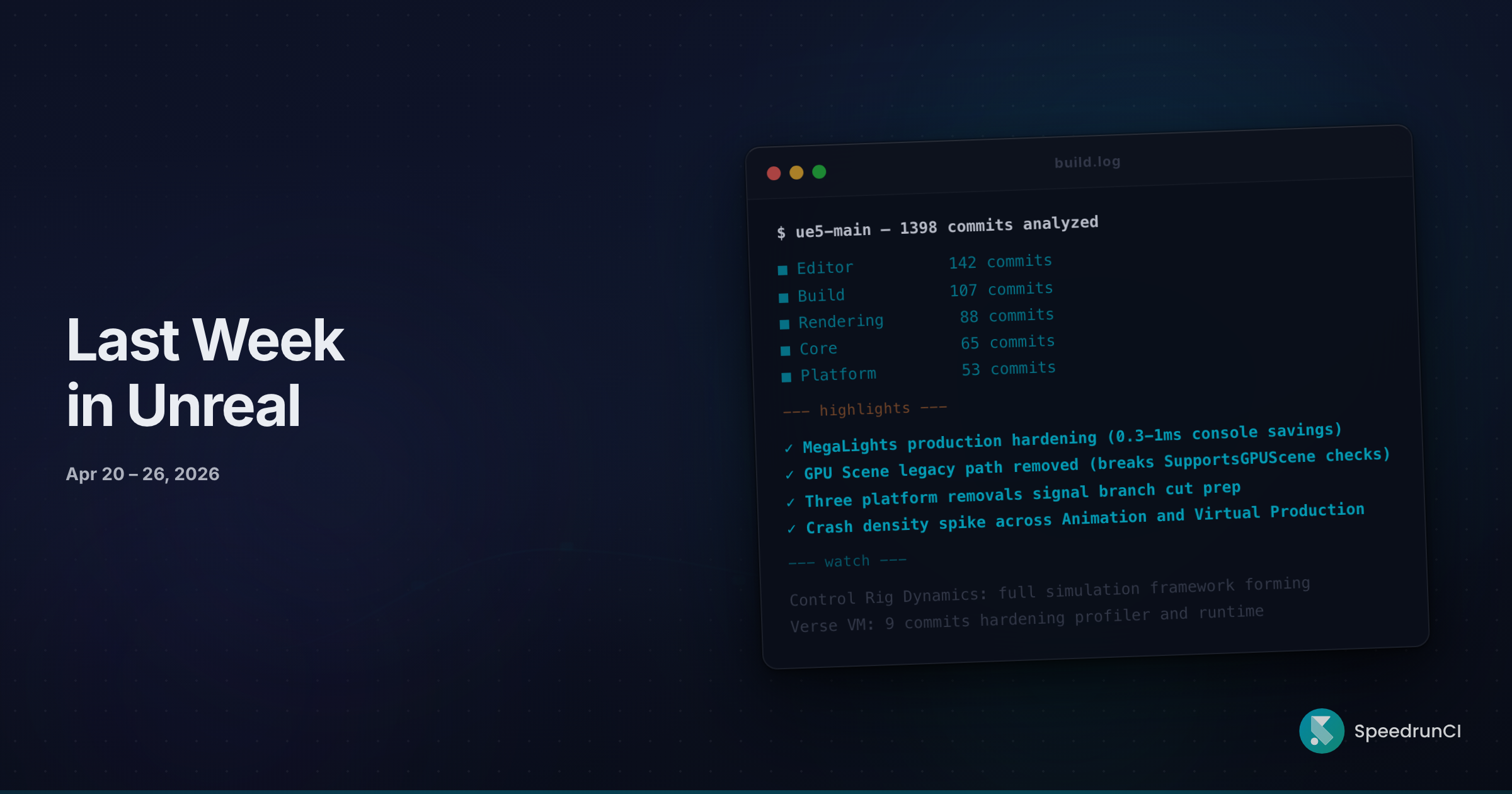
Week of April 20-26, 2026 | 1398 commits analyzed | Branch: ue5-main
Overview
This week in Unreal Engine was active, with most changes concentrated in rendering (MegaLights, TSR, Vulkan), animation systems, and core engine stability. A few changes require immediate attention if you maintain custom rendering code or ship on Vulkan, but the broader theme is hardening. Epic is stress-testing production pipelines and cleaning up legacy abstractions.
Development Trends
Rendering Snaps Back: MegaLights Production Hardening Returns
Pattern: Rendering jumped from 60 to 88 commits this week, a 47% single-week increase and the highest count since March 22 (74). After weeks of decline (60, 54, 74, 66, 60, 51, 60), this is a decisive reversal. MegaLights themes appeared in 9 of the last 12 tracked weeks, went quiet for 3 weeks, and returned this week with multi-front optimization: penumbra ray trace skipping (0.3-1ms console savings, e0e31c8e), CPU tracking overhead removal (b096dfb9), register pressure reduction (28ddd116), and flickering fixes (0e1531fb). TSR, shadow time-splicing, and Fog Separate Screen Space improvements all target dynamic resolution behavior.
Interpretation: The MegaLights silence from late March through mid-April now reads as a pause between feature-complete and production stress-testing. The return with console-specific optimizations rather than new features suggests internal certification testing surfaced performance budgets. Combined with TSR and shadow improvements targeting dynamic resolution, this looks like a coordinated console rendering readiness push.
Who cares: Graphics programmers, teams evaluating MegaLights for shipping titles, anyone targeting console with dynamic resolution.
Signal strength: Strong. 9 of 12 tracked weeks, current work profile (multi-front optimization, no new features) is the clearest production-readiness signal yet.
Animation Sustains Peak: Control Rig Dynamics Becomes a Real Physics System
Pattern: Animation held at 45 commits for the second consecutive week, nearly 4x the baseline (~12). The trajectory: 17, 21, 17, 13, 22, 29, 45, 45. Control Rig Dynamics received 11 commits adding confiners (0f295ecb), collision differentiation by type (physics/query/probe, 3b9ab545), drag settings broken out (51fd4aff), curve support and runtime simulation space adjustment (98b9fe00), and a debugging widget (e1373ecb). The “Animation and Control Rig” theme has appeared in 4 of the last 5 weekly summaries. Physics pulled back from 26 to 18, but the physics work appears to have migrated into Control Rig itself.
Interpretation: This is the construction of a first-party secondary simulation framework inside Control Rig. Collision-type differentiation and proper debugging tools indicate production thinking, not prototyping. Teams maintaining custom AnimBP physics solutions for secondary motion should be evaluating this as a potential replacement path.
Who cares: Animation programmers, character TDs, anyone maintaining custom secondary simulation solutions.
Signal strength: Strong. 4 consecutive weeks above baseline, scope expanding from bug fixes to a full simulation framework.
Legacy Removal Wave: Three Breaking Changes Signal Branch Cut Preparation
Pattern: Three removal themes in one week: GPU Scene legacy instancing path removed (d34537b7), iOS Simulator support removed (54f4a856), Android OpenXR platform flavor eliminated (b0edc9bc). Platform spiked to 53 (2x last week, 8-week high). Build has been above 100 for three consecutive weeks (118, 109, 107). GetGlobalShaderMap deprecated from FeatureLevel to ShaderPlatform (99575ed5). This follows TObjectIterator API break, Windows SDK upgrade, SHA1 to xxHash64 migration, and 5.7 deprecation cleanup over the past 6 weeks.
Interpretation: The convergence of breaking API changes, platform simplification, and sustained high build activity is the strongest branch cut signal in the tracking period. The GPU Scene removal affects every custom rendering pipeline that checks SupportsGPUScene. Three breaking changes in one week is coordinated cleanup before a major version boundary.
Who cares: Engine programmers with custom rendering code, plugin authors, platform engineers, anyone maintaining an engine fork.
Signal strength: Strong. Build above 100 for 3 weeks, platform at 8-week high, three independent removal themes.
Editor Hits New High: AI Tooling Enters 8th Week
Pattern: Editor reached 142 commits, a new 8-week high, 33% above last week. Tools rose to 36 (also 8-week high). The activity is multi-threaded: Control Rig Dynamics editor widgets, virtual production crash fixes (CineAssembly, TakeRecorder), and AI tooling maturation. AI-assisted editor tooling has appeared in themes for 8 consecutive weeks, progressing from infrastructure through expansion, consolidation, architecture split, and production hardening.
Interpretation: The 142 figure represents convergence of three independent workstreams rather than a single initiative. The AI tooling component is the most durable signal: 8 weeks of continuous development with clear architectural progression from monolith to modular toolsets.
Who cares: Editor extension developers, tools teams, AI/ML teams watching the MCP ecosystem.
Signal strength: Moderate (convergence peak likely), but the underlying AI tooling trend is Strong at 8 weeks.
TL;DR
- GPU Scene is now the only instancing path. The legacy
SupportsGPUScenecapability flag and fallback have been removed (d34537b7), which will break custom rendering code that checks for it. - MegaLights received multi-front optimization work (0.3-1ms savings on console) that signals it is being treated as console-ready, not experimental.
- A barrage of crash fixes across animation, virtual production, and core engine systems addresses memory safety issues that affect normal production workflows.
Highlights
Rendering: MegaLights Production Hardening
What changed
At least four significant commits landed for MegaLights: skipping redundant ray traces outside the penumbra (saving 0.3-1ms on console, e0e31c8e), automatically disabling local primitive interaction to eliminate CPU tracking overhead (b096dfb9), disabling anisotropy support on non-Substrate paths to reduce register pressure (28ddd116), and a flickering lights improvement via light power delta and target PDF changes (0e1531fb).
Why this is important
This is multi-front optimization, not feature work. The combination of GPU savings, CPU overhead removal, and visual quality fixes is what production hardening looks like. If your project has been waiting for MegaLights to stabilize before committing to it, this week is a data point in its favor.
Who should care
Graphics programmers, technical artists, anyone evaluating MegaLights for a shipping title.
Urgency
Track
Rendering: TSR, Shadows, and Temporal Quality
What changed
TSR got improvements to after-DOF translucency responsiveness (less ghosting on translucent particles, a83d00f5) and fp16 high-contrast line detection (less shimmer on thin geometry, 775a4b96). Shadow rendering gained a time-splicing system with temporal reuse that can skip depth re-renders on stable frames (b1afacf5). The Fog Separate Screen Space system received three commits making it resolution-scale independent and optimizing from its previous 1ms cost at 4K.
Why this is important
All of these changes improve behavior under dynamic resolution, a critical concern for console titles where resolution scaling is constant. The shadow time-splicing feature in particular could deliver meaningful performance savings if your scenes have many stable shadow casters.
Who should care
Graphics programmers, anyone using dynamic resolution on console, teams with heavy shadow workloads.
Urgency
Track
Vulkan RHI Infrastructure Fixes
What changed
Three commits fix push constant stage flags (e6a209ea), input attachment index mappings with dynamic rendering (4ddbe5b3), and add a dynamic local read function to the loader (0271efa6). A community PR fixes Scene Depth sampling in Vulkan Mobile Forward with Multi-View (4c033719). Intel Extensions Framework was upgraded for async compute detection (fbcf2fea).
Why this is important
Inconsistent push constant stage flags cause validation errors and undefined behavior. Broken input attachment mappings with dynamic rendering mean subpass inputs silently fail. These are the kinds of issues that produce mysterious rendering artifacts that only appear on specific hardware in the field.
Who should care
Platform engineers, mobile developers, anyone shipping on Android, Linux, or Steam Deck.
Urgency
Act now (if shipping Vulkan)
GPU Scene: Legacy Instancing Path Removed
What changed
The SupportsGPUScene platform capability flag and its associated legacy instancing path have been removed entirely (d34537b7). GPU Scene is now the only path. Separately, GetGlobalShaderMap with a FeatureLevel parameter has been deprecated in favor of ShaderPlatform (99575ed5, 83311e43), and HWRT shared vertex buffer management was refactored (4a0fd720).
Why this is important
If your project has custom rendering code that checks SupportsGPUScene or calls GetGlobalShaderMap with a feature level, it will break. This touches platform configs across Android, Mac, VulkanPC, Windows, and multiple renderer files.
Who should care
Engine and graphics programmers with custom rendering code, plugin authors, anyone maintaining a custom engine fork.
Urgency
Act now
Stability: Crash Fixes Across Animation and Virtual Production
What changed
An unusually high density of crash fixes landed in animation and virtual production: IK Retargeter (06103d44), StrideWarping and OrientationWarping (c38329ea), Control Rig (multiple, 5a6d4b41, 5711cfc9), LiveLink (8f0a7468), Chaos Cloth (d732df10), TakeRecorder (5c59043e), CineAssembly (three separate crashes, 43a53953, 994ac8ec, e3ee1646), and the Sequencer AnimMixer (e1e0968a). StrideWarping and OrientationWarping now log and recover on NaN inputs instead of hard-crashing. CineAssembly fixes address infinite recursion when a SubAssembly references its own schema as a template. Control Rig’s CanCauseCycle was ignoring inactive parents, allowing cyclic dependencies that crash the space picker.
Why this is important
Many of these are null pointer or use-after-free issues triggered during normal editorial workflows. The CineAssembly fixes in particular suggest the tool is being stress-tested by real production teams reporting real crashes.
Who should care
Animation programmers, virtual production teams, anyone using Control Rig or CineAssembly in production.
Urgency
Act now (if using these tools in production)
Stability: Core Engine Safety
What changed
Fixes for infinite recursion in StackWalk code (the crash handler itself could crash, 843c39f5), Windows CrashReporter failures during early initialization crashes (48eba6ac), a scatter upload buffer overflow in the unified buffer system (9c508ee5), and a dangling pointer crash during “Save As” on non-transient objects (1de55b01). Additionally: a heap-buffer-overflow in Gameplay Ability System’s UpdateTagMap_Internal from re-entrancy (63d2218b), a SkinnedMeshComponent race condition from missing mutex locks (742ebb6f), a WAV integer overflow (d157199e), curl handle starvation under MAX_HOST_CONNECTIONS (9c3b1163), and RigLogic security vulnerabilities in the DNA lib (4c51dab3).
Why this is important
The StackWalk fix is the standout. A crash in the crash handler means zero diagnostic information. The GAS heap-buffer-overflow and SkinnedMeshComponent race condition are the kind of issues that manifest as intermittent, hard-to-reproduce crashes in shipping games. The curl handle starvation bug can cause network requests to hang indefinitely.
Who should care
All UE developers. The GAS fix matters specifically to gameplay programmers; the curl fix matters to anyone doing HTTP requests at scale.
Urgency
Act now
Control Rig Dynamics: Building a Real Physics System
What changed
Eleven commits from a single team in one week: confiners (0f295ecb), collision differentiation by type (physics/query/probe, 3b9ab545), drag settings broken out with consistent local/external effects (51fd4aff), curve support, runtime simulation space adjustment (98b9fe00), and a debugging widget with cvars (e1373ecb). A RigidBody content drop (c0e892f5) and physics solver refactor for ISM and world body collision types also landed.
Why this is important
This is no longer jiggle bones. They are building a full secondary simulation framework inside Control Rig with collision, constraints, and proper debugging tools. The collision-type differentiation commit signals they are thinking about production edge cases. Teams currently using custom AnimBP physics solutions for secondary motion should be watching: this is converging toward a first-party replacement.
Who should care
Animation programmers, character TDs, anyone maintaining custom secondary simulation solutions.
Urgency
Track
Platform: iOS Simulator and Android OpenXR Removed
What changed
iOS Simulator support has been removed because the Simulator’s Metal support (~A8 equivalent) is now below minimum spec, with full removal from the Metal compiler upcoming (54f4a856). The separate Android_OpenXR target platform flavor has been eliminated entirely (b0edc9bc).
Why this is important
Anyone using the iOS Simulator for development iteration loses that path. Teams shipping to Quest need to know the Android XR build matrix has been simplified: the separate flavor is gone.
Who should care
iOS developers using Simulator for iteration, Quest/Android XR teams.
Urgency
Act now (if affected)
Rendering: Lumen Translucency Fix
What changed
Missing skylight leaking was causing lit translucency and volumetric fog to be too dark when skylight leaking was used (fda67e09).
Why this is important
If you have been compensating for dark translucent materials or fog in outdoor Lumen scenes by boosting material values, this fix may require re-tuning. Your workarounds may now over-brighten.
Who should care
Lighting artists, anyone with manually tuned translucent materials in Lumen scenes.
Urgency
Track
Worth Tracking
Control Rig Dynamics and the UAF (Unreal Animation Framework). Between Control Rig Dynamics getting collision, constraints, and debugging tools, and 20+ commits landing for the next-gen animation framework with layering, state trees, and Mass Entity integration, Epic is clearly investing heavily in making animation a first-class engine system rather than a collection of disconnected tools. Teams planning animation pipelines for 5.8+ projects should be watching both of these closely.
Verse VM performance work is getting serious. Nine commits this week optimize VM internals. Return only trails for suspend functions (5fd5eae6), await state consolidated into VTask for better C++ interop (ff37e35c), and the sampling profiler was moved off GC marking to a dedicated thread because GC “is not guaranteed to run frequently enough” (7ca408c9). That last detail is revealing: someone tried to profile a real Verse workload and got garbage data. The addition of llm_description attributes for AI-assisted tooling is also notable (29544bd5). Verse is being used for something real internally.
What We Ignored
This week we ignored roughly 1,100 commits covering localization automation, gitdeps.xml updates, MetaHuman iteration, Audio Insights profiling tool buildout, Mutable/Customizable Skeletal Mesh work, routine test infrastructure, documentation updates, and incremental feature work across dozens of subsystems. The mesh_part workflow had an interesting backout-and-re-land cycle suggesting a foundational change to static mesh sub-objects, but it is too early and too unstable to report on with confidence. AutoRTFM deprecation annotations are being swept across multiple subsystems: if you use AutoRTFM annotations directly in C++ code that interfaces with Verse transactional boundaries, the new API is landing now.
Closing
A week of production hardening across rendering, platform stability, and animation. The kind of work that makes engines shippable rather than just impressive.
This analysis covers commits to the ue5-main branch of Epic’s Unreal Engine repository for the week of April 20-26, 2026. “Act now” = likely affects your project, worth investigating this week. “Track” = notable change, no immediate action required.
Built by Speedrun CI — we read every commit so you don’t have to.
Never miss a ue5-main update.
Get them delivered straight to your inbox.