Last Week in Unreal — Apr 13-19, 2026
Unreal Engine Weekly — What Changed and What Matters
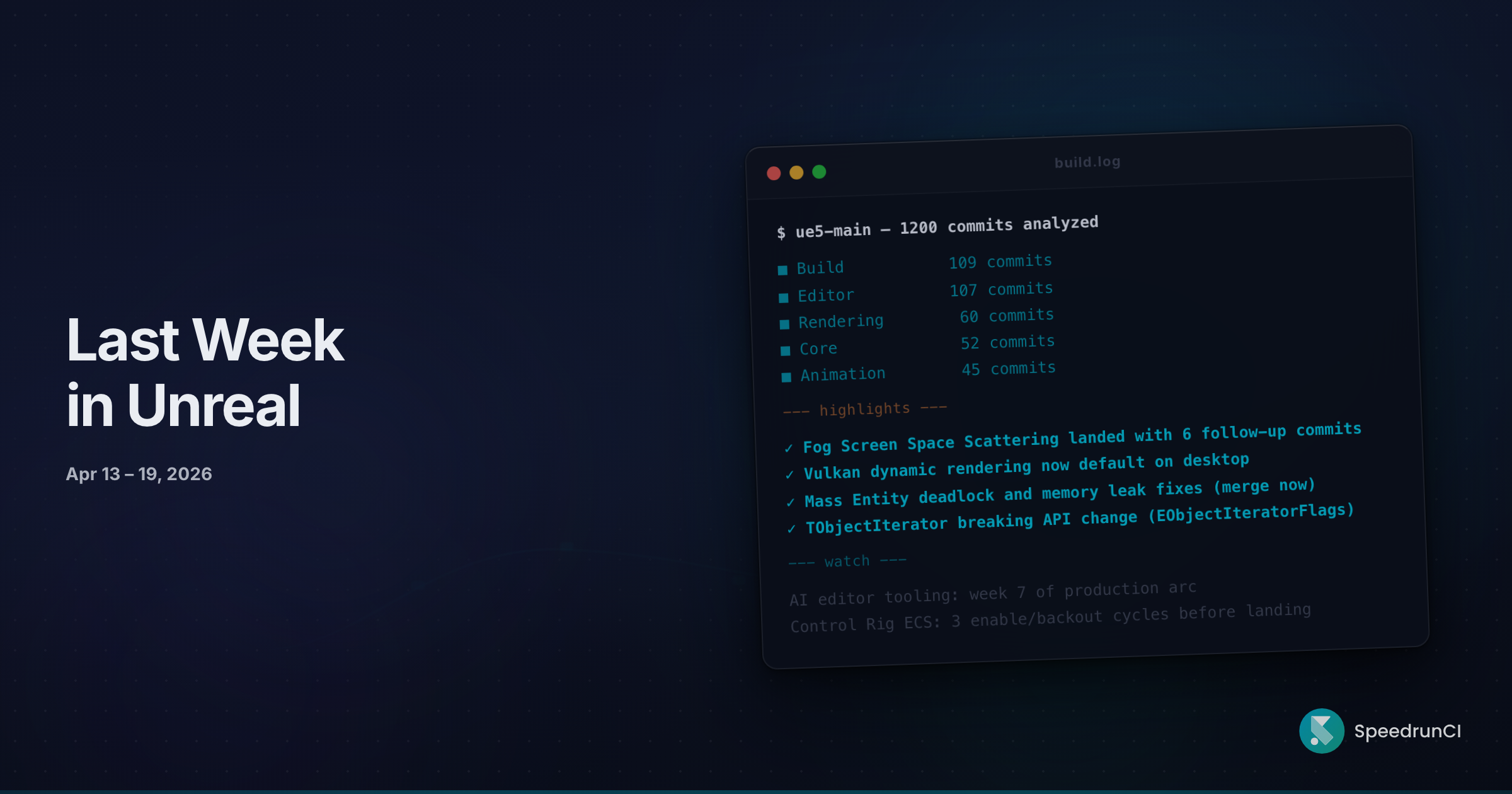
Week of April 13-19, 2026 | 1200 commits analyzed | Branch: ue5-main
Overview
This week in Unreal Engine was active, with most changes concentrated in rendering, AI editor tooling, and stability fixes across core systems. Nothing here requires a fire drill, but several rendering defaults changed silently, a new fog scattering system landed with unusual velocity, and Epic’s AI-assisted editing infrastructure is no longer a prototype. It is production plumbing. Teams shipping on Vulkan desktop, using Mass Entity, or maintaining custom RHI passes should read on.
Development Trends
Animation Pipeline Acceleration: From Breakout to Dominant Workstream
Pattern: Animation commits surged to 45 this week, a 55% jump from last week’s 29, and nearly 4x the 8-week baseline of ~12. The trajectory is unmistakable: 12, 17, 21, 17, 13, 22, 29, 45. This week’s activity came from two distinct fronts. Danny Chapman landed 8+ ControlRigDynamics commits (cone limits, angular limits, collision, teleport detection, solver visualization), and Control Rig ECS evaluation went through multiple enable/backout/re-enable cycles before landing as default-on. Physics also continued rising (26, up from 24), suggesting coordinated investment in runtime simulation systems.
Interpretation: Animation has graduated from “breakout” to the single largest growth story in the engine. The ControlRigDynamics velocity (proof-of-concept to production-usable in one week) suggests this feature is on a fast track out of Experimental. The ECS evaluation churn is the kind of integration testing you do when you’re shipping, not prototyping. Combined with physics rising for three consecutive weeks, Epic appears to be entering a sustained runtime simulation investment phase timed for 5.8.
Who cares: Animation programmers, rigging teams, studios using external dynamics solutions on top of Control Rig, physics simulation teams.
Signal strength: Strong. 8 weeks of rising data, with acceleration in the last 3 weeks.
AI-Assisted Editor Tooling: Production Infrastructure at Week 7
Pattern: Seventh consecutive week of AI editor tooling commits. The arc: infrastructure (week 1), expansion (weeks 2-4), consolidation (week 5), architecture split (week 6), production hardening (week 7). This week the monolithic 234-tool SequencerTools class was split into 7 focused toolsets (e4756f44), AI tool calls gained sandbox execution (99a255fb), Python asyncio landed for UE’s main thread (3738388f), MCP was renamed to “Unreal MCP” with stable descriptions (ff7b9079), and SemanticSearch got DDC integration and a cancel-indexing UI (9405502d). The theme has appeared in every weekly summary since March 8.
Interpretation: Consolidation, splitting, sandboxing, naming stabilization is textbook production preparation. Epic is no longer iterating on whether AI-assisted editing works. They’re making it shippable. The sandbox integration is telling: you don’t sandbox tool execution unless you’re planning to expose it to users. Combined with Python asyncio support, this is being built as a first-class editor feature, not a plugin.
Who cares: Tools programmers, technical artists building editor automation, studios evaluating AI-assisted content workflows.
Signal strength: Strong. 7 consecutive weeks, clear arc from prototype to production.
Build Infrastructure Plateau at Elevated Levels
Pattern: Build posted 109 commits this week, following 118 last week. These are the two highest values in the 8-week window. The trajectory: 66, 79, 78, 94, 62, 73, 118, 109. This week included the Windows SDK upgrade to 10.0.26100.0 (61d78aaa), the TObjectIterator breaking API change (boolean to EObjectIteratorFlags with two follow-up compile fixes, ba2dc9cb), Apple TLS submit/backout/resubmit churn (c5c34492), Clang LTO link time reduction (e1dbc911), and AWS Graviton3/4 ARM64 targets (c8ddaea2).
Interpretation: Two consecutive weeks above 100 is a new operating level. Breaking changes to fundamental iteration patterns and forced SDK migrations are late-cycle decisions made when there’s time to fix downstream breakage before a release branch cut. Combined with rendering’s maturation phase, the data strongly suggests 5.8 infrastructure lockdown is approaching.
Who cares: Build engineers, platform teams, anyone maintaining engine forks, Windows developers, dedicated server teams on AWS.
Signal strength: Strong. 8+ weeks of elevated activity, two consecutive weeks above 100.
Rendering Enters Selective Innovation Phase
Pattern: Rendering bounced from its 8-week low of 51 to 60, but a brand-new feature landed for the first time in the maturation arc. Fog Screen Space Scattering (FSSS) received its initial implementation (2a77cec2) plus six follow-up commits in one week. MegaLights continued in maintenance mode. Vulkan dynamic rendering was silently enabled by default on desktop (a7854020).
Interpretation: Rendering is no longer simply declining. It’s entered a selective innovation phase where commit count stays moderate but individual changes carry higher impact. FSSS getting six follow-up commits in its debut week signals a fast track to production-default. The Vulkan dynamic rendering default is a two-line change with outsized implications. The rendering subsystem isn’t winding down. It’s being more deliberate about where new investment goes.
Who cares: Graphics programmers, environment artists using volumetric fog, Vulkan desktop shipping teams.
Signal strength: Moderate. FSSS is strong but single-week, while broader rendering maturation has 10 weeks of support.
TL;DR
- A new Fog Screen Space Scattering system landed (
2a77cec2) and received six follow-up commits in the same week, signaling it is on a fast track from experimental to default-on. - Vulkan dynamic rendering is now enabled by default on desktop (
a7854020). A silent default change that can break custom render passes assuming traditional VkRenderPass objects. - Mass Entity got a deadlock fix (
f4c7b410) and a memory leak fix across 22 files (cf3c0030). Both are merge-immediately quality for any team using the framework.
Highlights
Rendering and Performance
What changed
Three significant rendering changes this week. First, a brand-new Fog Screen Space Scattering (FSSS) system from Sebastien Hillaire (2a77cec2) that simulates multiple scattering from participating media: height fog, volumetric fog, local fog volumes. It shipped with its own blur mip chain, separate composition pipeline, and ExponentialHeightFogComponent properties, then received six follow-up commits: TAA stabilization (cacf0a56), cloud ordering fixes (3cc9ae44), an optimized 5×5 Gaussian upsample with 9 bilinear fetches instead of 25 (2a7079af), NaN and bounds fixes (d14c037f), artist-facing power controls (409ddcc1), and filtering improvements (4bac1bf4).
Second, the MegaLights denoiser had a sizzle artifact around moving objects because disocclusion filtering only ran when shading confidence was low. The fix (71dd66cc) makes it always run and converts NumFramesAccumulated from UNorm to U8 to eliminate cross-GPU precision differences. Virtual Shadow Maps also got a fix for missing shadow invalidation when FLevelCommand unhides primitives (ff5dd170), a bug tracked since late 2025 (UE-354815). Hair depth data now populates the scene HZB for improved MegaLights screen traces (0c088f05).
Third, Vulkan dynamic rendering is now enabled by default on desktop (a7854020). This eliminates VkRenderPass/VkFramebuffer objects, simplifying the driver path and reducing CPU overhead. Android explicitly opts out. This is a two-line change with outsized implications for anyone with custom Vulkan render passes.
A Nanite tessellation GPU crash was also fixed (74a0b402): FDiceTask::CreateChild crashing when the parent task was invalid. Work distribution now guarantees a valid parent even for inactive threads.
Why this is important
FSSS is a net-new rendering feature getting rapid iteration, which historically means it will be production-default within a release or two. The MegaLights and VSM fixes address real visual artifacts teams have been working around. The Vulkan default change is the kind of silent flip that surfaces as subtle rendering bugs weeks later if you are not paying attention.
Who should care
Graphics programmers, technical artists, environment teams using volumetric fog, anyone shipping on Vulkan desktop with custom RHI code, and teams that have hit shadow popping when streaming levels.
Urgency
Act now: Verify custom Vulkan render passes against dynamic rendering. Track: FSSS, MegaLights denoiser fix, VSM shadow invalidation.
Stability and Crash Fixes
What changed
A concentrated batch of crash and hang fixes across core systems this week. Mass Entity got two critical fixes: a deadlock caused by a race condition in ReserveChunkWorkerSlot (the processing queue was simplified to dispatch all ready work immediately, f4c7b410), and a memory leak in the Mass Representation subsystem where strong object pointers kept assets alive indefinitely, converted to weak pointers across 22 files spanning MassCrowd, InstancedActors, and MassRepresentation modules (cf3c0030).
Beyond Mass, several high-severity fixes landed: an AssetRegistry race condition crash in FFileReadScheduler (4b22dcb3), an OpenXR early-out that could cause crashes or hangs when launching VR (f36e4e5e), a CharacterMovementComponent null-pointer crash in FindWaterLine (cce51cf0), a memory leak in ParameterCollectionInstances where UWorld::PostGC callbacks were not registered for streamed levels (0eea946d), a taskgraph shutdown deadlock on oversubscription (e73b0318), a recursive Viewport::Resize fix for D3D11/D3D12 fullscreen transitions (83d43225), and a Launcher process/thread leak that caused memory corruption (bd31a85d). An Iris networking crash was resolved by removing the problematic NetRPC_GetDebugFunctionName entirely (b96d6230).
Why this is important
These are not edge cases. AssetRegistry, CharacterMovementComponent, and Mass Entity are systems that virtually every project touches. The Mass fixes in particular are merge-immediately quality for any team using open-world or crowd simulations.
Who should care
Everyone syncing to latest. VR teams (OpenXR fix). Open-world and crowd simulation teams (Mass Entity). Multiplayer teams (Iris networking).
Urgency
Act now: Mass Entity deadlock and memory leak, AssetRegistry crash fix, OpenXR hang fix. Track: the rest.
Build, Platform, and SDK Changes
What changed
The default Windows SDK was upgraded to 10.0.26100.0 as the previous version is out of support (61d78aaa). Extended TLS support for Apple platforms went through a submit/backout/resubmit cycle (c5c34492, ed807892, 03e53fee), standardizing thread-local storage between Apple and Windows with shared logic touching UBT target rules, AtomicQueue, and platform-specific TLS headers. Clang LTO link time was reduced by disabling debug info upgrading during LTO (e1dbc911). AWS Graviton3/4 got explicit ARM64 CPU targets in UBT for dedicated server builds (c8ddaea2, 514b4cea).
TObjectIterator received a breaking API change: boolean parameters were replaced with EObjectIteratorFlags (ba2dc9cb), which needed two follow-up compile fixes (f4cdd596, bebad927). A clear sign that downstream code will also need updates.
Why this is important
The Windows SDK change affects every Windows developer on the team. The TObjectIterator API change is a quiet breaking change to a fundamental iteration pattern. Any code using the old boolean overloads will fail to compile. The Apple TLS churn (submit-backout-resubmit in 24 hours) suggests it caused real build failures but was deemed important enough to force through.
Who should care
All Windows developers (SDK upgrade). Platform engineers and Mac/iOS teams (TLS). Anyone iterating UObjects with custom flags (TObjectIterator). Dedicated server teams on AWS (Graviton targets).
Urgency
Act now: Windows SDK upgrade, TObjectIterator API change. Track: Apple TLS, Graviton targets, LTO improvements.
AI Tooling and Editor Automation
What changed
Epic’s AI editor infrastructure saw coordinated work across multiple engineers. The monolithic 234-tool SequencerTools class was split into 7 focused toolsets (e4756f44) covering core, keyframing, control rig, outliner, conditions, custom bindings, and import/export. Python asyncio support landed for UE’s main thread via a pollable loop implementation (3738388f). The MCP plugin was renamed to “Unreal MCP” with description cleanup (ff7b9079), and MCP gained deferred tool loading (955a8f99). AI tool calls now run in a sandbox (99a255fb). AutomationTestToolset was enabled across all toolsets (621afa98). SemanticSearch got DDC integration, a cancel-indexing UI, and a command queue replacing per-index read-write locks (9405502d). BM25 was made memory-efficient (ef953310) and a new embedding provider config was added (1e1cd156).
A new asset read logging system activated via -LogAssetReads (57d4ce6a) hooks into AsyncLoading2 and UObject globals to capture every asset read with context as CSV output.
Why this is important
This is not experimentation. Sandbox integration, test infrastructure, naming stabilization, and search backend hardening are what you do when you are preparing to ship. Epic is building AI-assisted editing as a first-class feature. The asset read logger is immediately useful for any team fighting load times or debugging streaming hitches.
Who should care
Tools programmers, TA teams building editor automation, anyone watching Epic’s AI strategy. The asset read logger is relevant to any team with load time or streaming concerns.
Urgency
Track. The AI tooling is not something you need to act on yet, but understanding where it is going matters for tooling strategy. The asset read logger is use-it-now useful.
Animation and Control Rig
What changed
Danny Chapman landed at least 8 commits on ControlRigDynamics (experimental): cone limits and angular limits (b1ecdf0d), teleport detection (89249139), reset detection (df9d820d), collision support (66eee9c8), pass-through at alpha zero (3ec6025e), solver visualization (8e9f3cc1), and promotion to experimental (2e3c049b). Separately, Control Rig ECS evaluation went through multiple enable/backout/re-enable cycles this week (c60845bd, 8fbbfb6a, 9c36aee5) before landing as default-on with a CVar escape hatch (ControlRig.UseLegacySequencerTemplate true). The underlying issue was stale parameter entities in the BlendChannelOutput filter (02884fc5).
Why this is important
ControlRigDynamics is moving from proof-of-concept to production-usable at a pace that suggests it could leave Experimental within 1-2 release cycles. If your animation team uses external dynamics solutions on top of Control Rig, this is the native replacement coming. The ECS evaluation churn means that if you hit unexplained Sequencer + Control Rig issues after syncing, the CVar is your first troubleshooting step.
Who should care
Animation programmers, rigging teams, anyone using Control Rig in Sequencer.
Urgency
Track: ControlRigDynamics. Act now: if you hit Control Rig + Sequencer issues, try the legacy CVar.
Compositing, Media, and VP
What changed
The new Composite plugin (successor to Composure) is being promoted from Experimental to Beta (7424ff76) with significant feature work: geometry masking (971b6997), luma keying (6090f653), per-actor primitive collection performance optimization (e8c0d6a1), and alpha handling fixes for FXAA/SMAA (8f259576, b52f5ed0). API churn is still happening: CenteredScale was renamed to Transform2D (46903307) and an FXAA plugin setting was removed (850547b8).
A new CrashDiagnostics module landed under the experimental EditorPerformance plugin (7877cadc), providing an in-editor crash report browser that reads from Saved/Crashes/, loads into TEDS, and displays a searchable, sortable table. CrashedThreadId was also added to crash context across all platforms (a9581225).
Why this is important
If you use Composure in a VP pipeline, the new Composite plugin is where investment is going, but the API is still churning. Wait for post-beta stabilization before migrating. The crash diagnostics panel makes crash investigation accessible without leaving the editor, which is a meaningful QA workflow improvement.
Who should care
Virtual production teams (Composite plugin). All developers and QA teams (crash diagnostics).
Urgency
Track both. Do not migrate to the Composite plugin yet.
Worth Tracking
New Material Translator (NMT/MIR) saw 15+ commits this week including bug fixes, new expression nodes (ad5ffaed, 8dc753c9), and a preshader optimization (665e2b7b). This is a major rewrite of the material compilation pipeline targeting 5.8. If you maintain complex custom materials or material expressions, this rewrite will eventually affect you.
PlainProps serialization also had 10+ commits building a new text-based property serialization format with a resave commandlet (2ace3851). This is groundwork for a significant serialization change, the kind of infrastructure work that precedes a format migration.
Mass Entity beyond the crash fixes received 15+ commits including query optimization, a const-correctness sweep, new API surface, physics batched init (f4bc3903), and navigation relevance fixes. Mass is clearly being treated as tier-1 infrastructure.
Take Recorder had 7 commits making modules runtime-ready (93d2a510, 8eee0382, 29ca6ed8), signaling that runtime animation recording in shipped games is coming.
What We Ignored
This week we filtered 12 commits as noise and editorially dismissed roughly 200 more: localization automation, Mocap Manager and VCam virtualized content changes, an AnimatorKit add/backout cycle, PCG Biome Core gitdeps updates, fluid sim virtualized changes, Bink library updates, minor null-check crash fixes, and test infrastructure commits that do not affect shipped behavior.
Closing
A rendering-heavy week with real consequences for Vulkan desktop teams and a clear signal that Epic’s AI editor tooling has graduated from experiment to engineering priority.
This analysis covers commits to the ue5-main branch of Epic’s Unreal Engine repository for the week of April 13-19, 2026. “Act now” = likely affects your project, worth investigating this week. “Track” = notable change, no immediate action required.
Built by Speedrun CI — we read every commit so you don’t have to.
Never miss a ue5-main update.
Get them delivered straight to your inbox.